


UPDATE 9/23: A video response by President Poon to the Sept. 16 meeting has been released.
LOS ANGELES — For nearly nine months, Loyola Marymount University’s (LMU) non-tenure-track faculty (NTTF) union has attempted to negotiate with the administration, hoping to gain better wages and rights. That all changed last Friday, Sept. 12, when Board of Trustees Chair Paul S. Viviano announced in an email that the university administration would pull out of negotiations and cease to recognize the union per a “constitutionally protected religious exemption.”
The decision prompted strong responses across the community. Many were confused and angry considering the administration’s commitment to honor the certification a year ago.
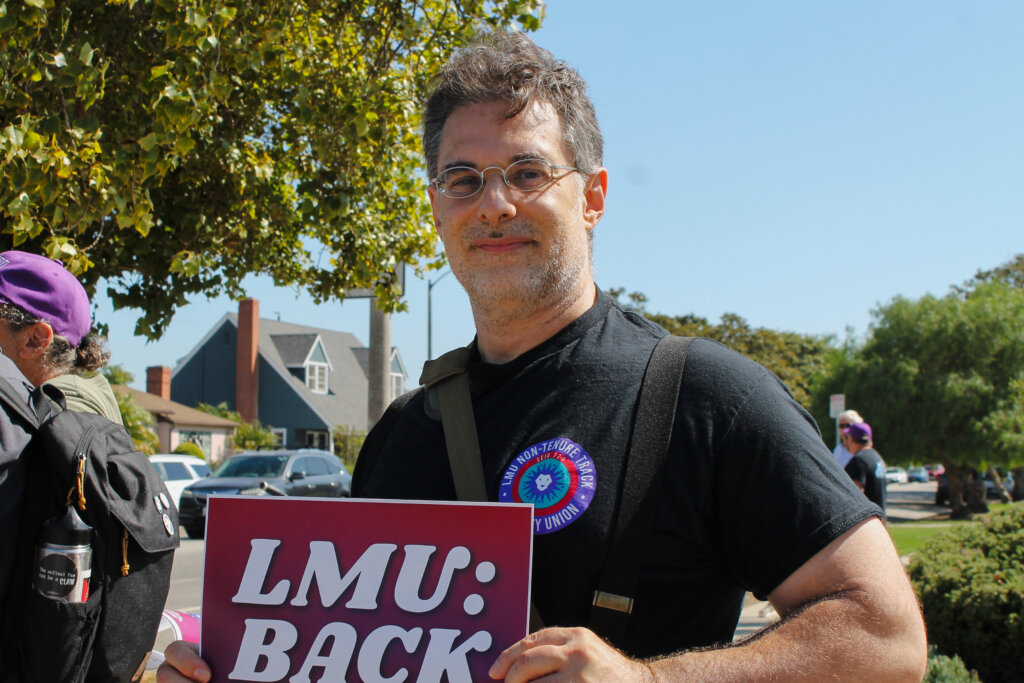
“At any time, they could have said, ‘no, we want a religious exemption’ but they never did,” said Arik Greenberg, theology instructor and one of the union’s initial organizers who has been involved since 2011.
Instead, the administration offered to reinstate merit raises withheld during bargaining and said it is committed to expanding full-time faculty positions over the next three years.
Four days later, on Tuesday, Sept. 16, the NTTF union represented by the labor group Service Employees International Union (SEIU) Local 721, rallied ahead of a Community Conversations meeting organized by the administration to address the decision.
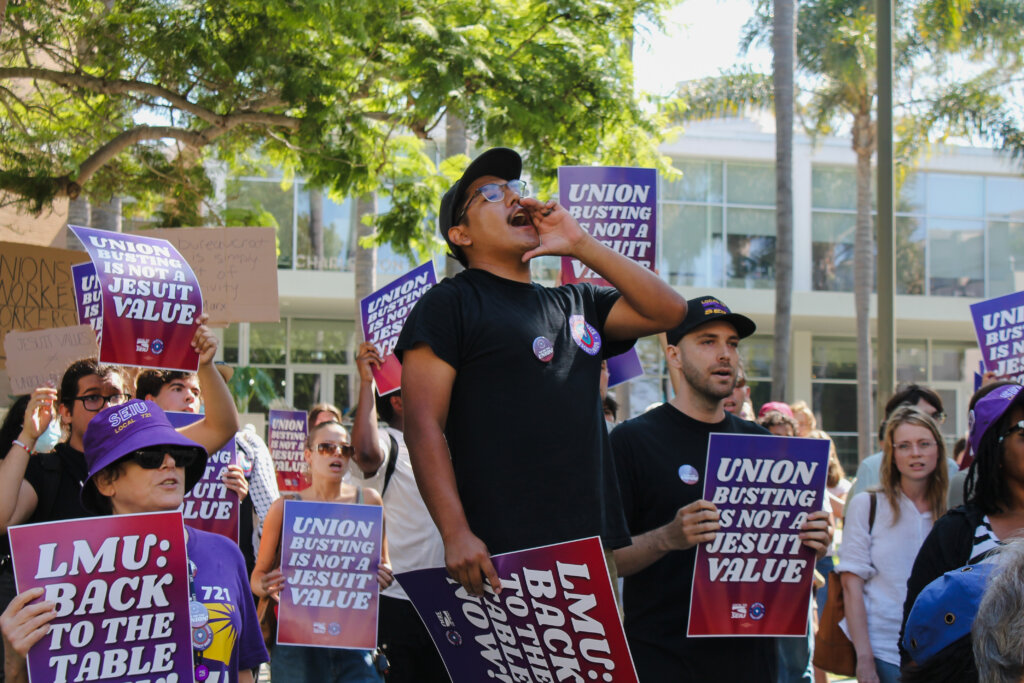
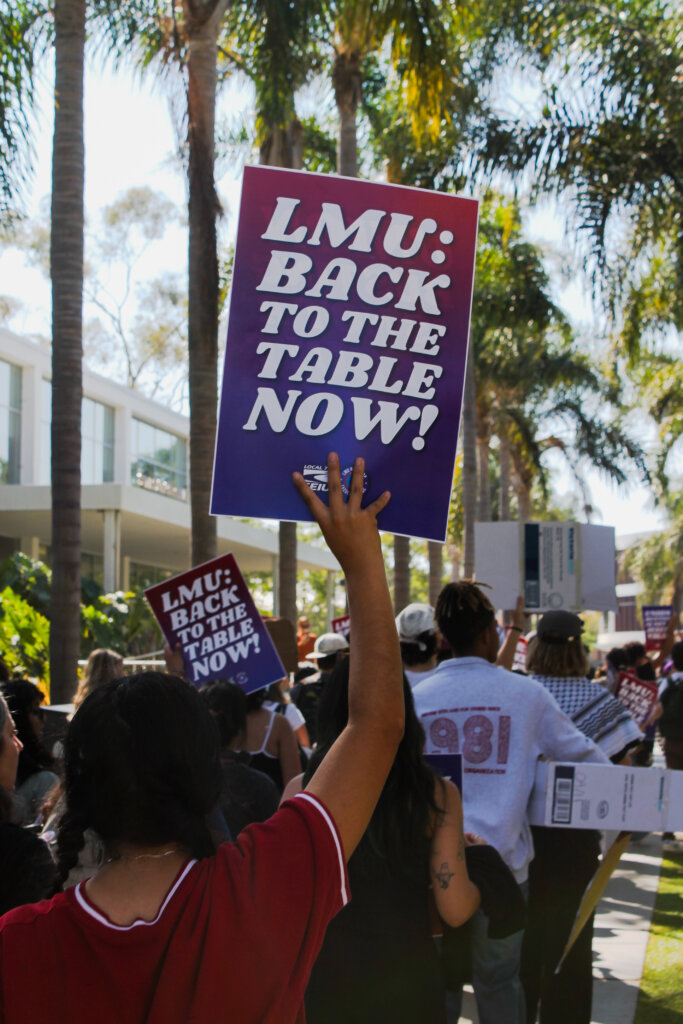
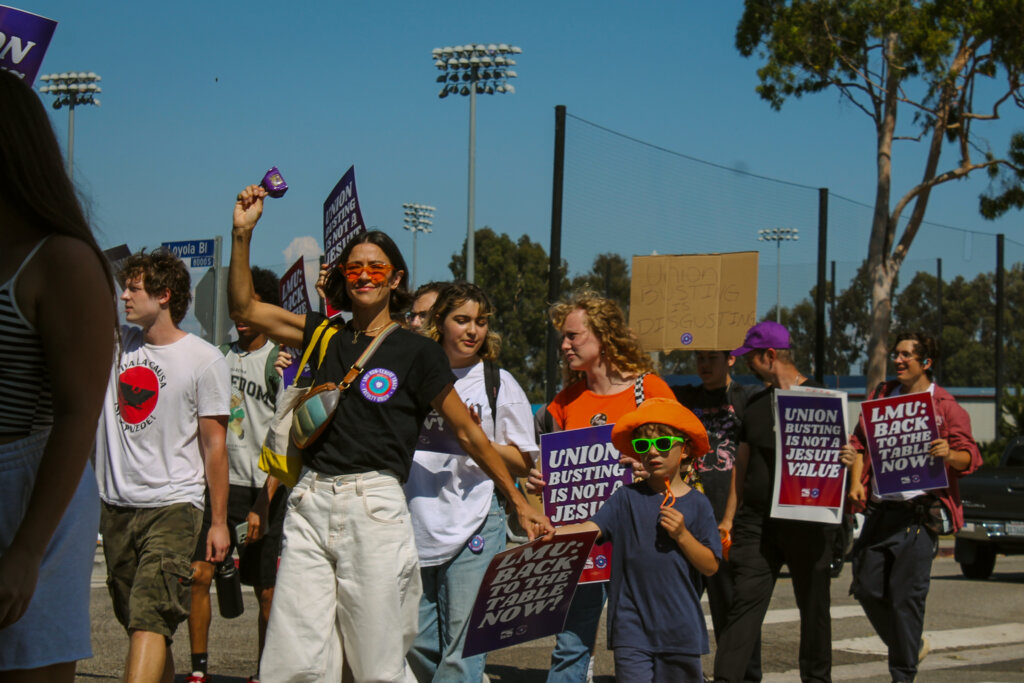
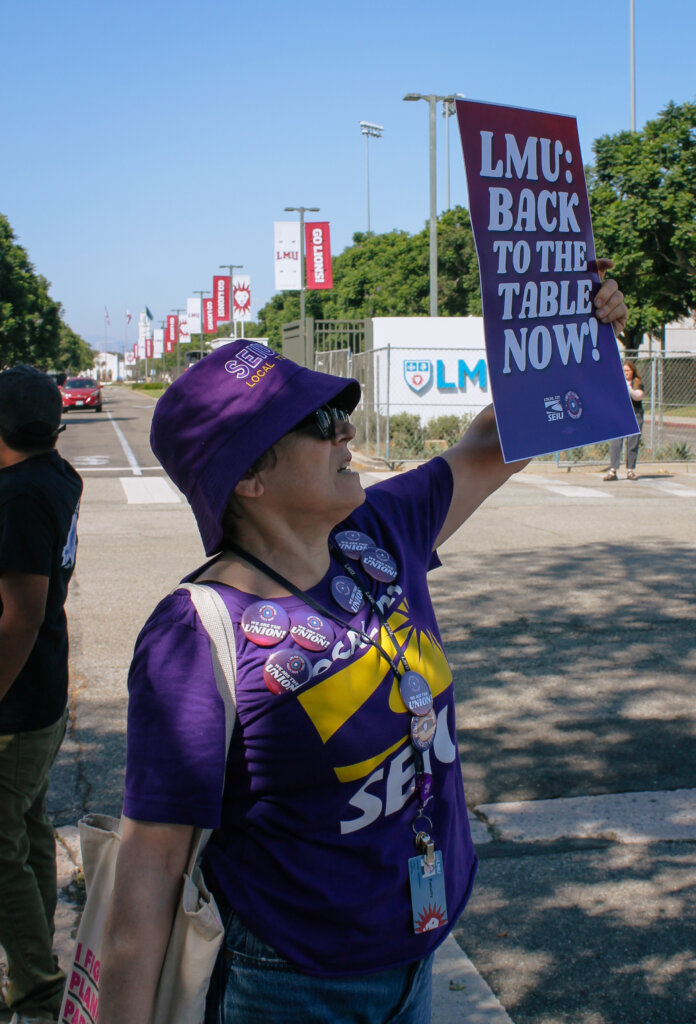
An hour before the meeting, about 50 faculty, staff, students, and supporters rallied outside the university’s back entrance on Loyola Boulevard, chanting “Union busting is disgusting!” and waving signs with slogans like “LMU: Back to the table now!”
From there demonstrators marched to St. Robert’s Auditorium, gathering outside just before the meeting was set to take place. After conflicting information regarding who was permitted inside, those who presented LMU One Cards were eventually let inside.
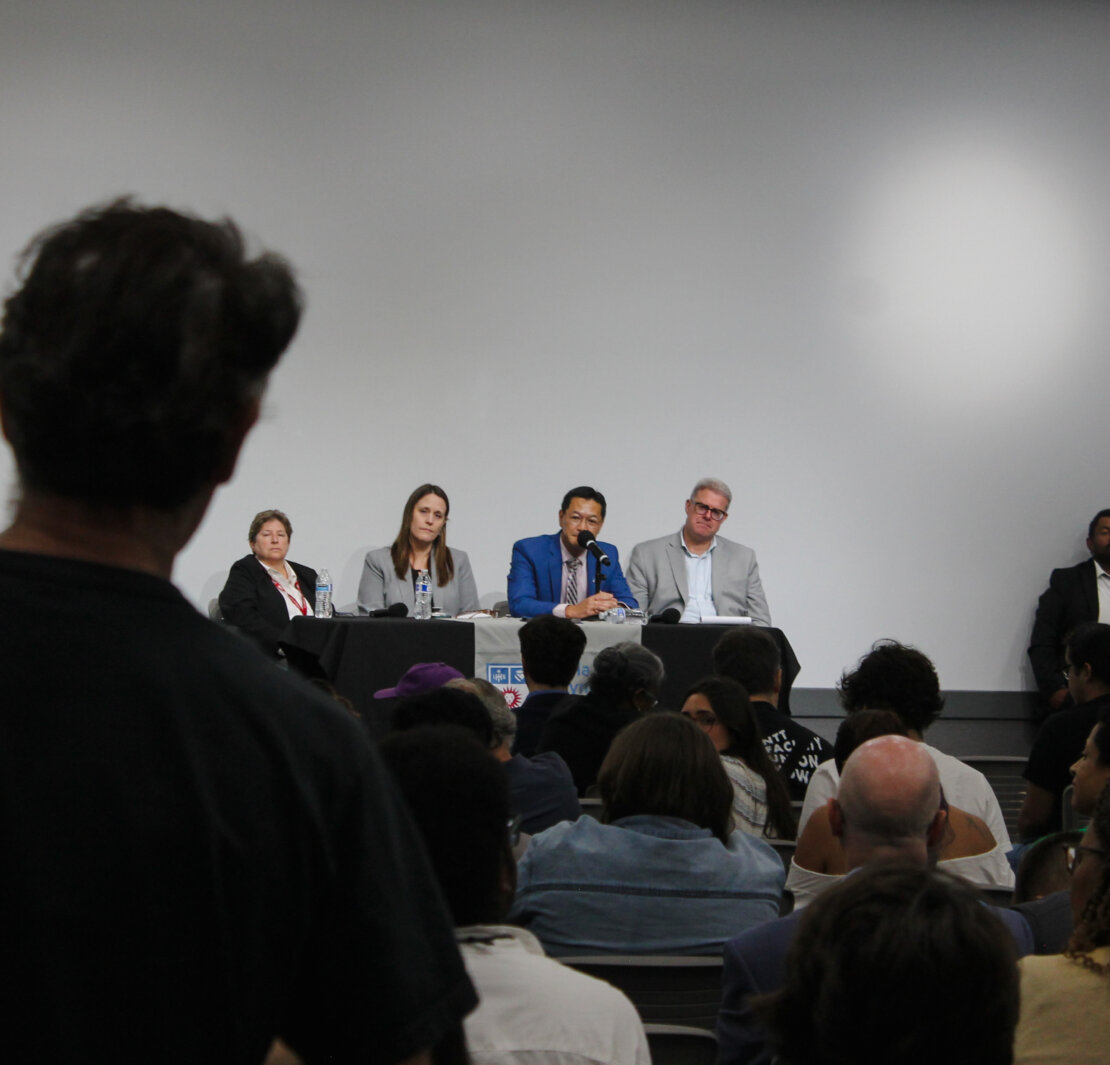
The meeting, which drew more than 200 people, opened with Interim Executive Vice President and Provost Kat Weaver discussing “shared governance,” and urging faculty and students to bring their concerns “directly to the administration.”
As the floor opened for questions, the tone quickly shifted. Laura Huffman, a union bargaining team member and modern languages instructor, was the first to speak, sharply criticizing the administration for failing to counter any of the financial proposals submitted over several months. Weaver reiterated that “the board’s decision is final,” but as the meeting stretched nearly three hours past its scheduled length, NTTF and community members made it clear they were not backing down.
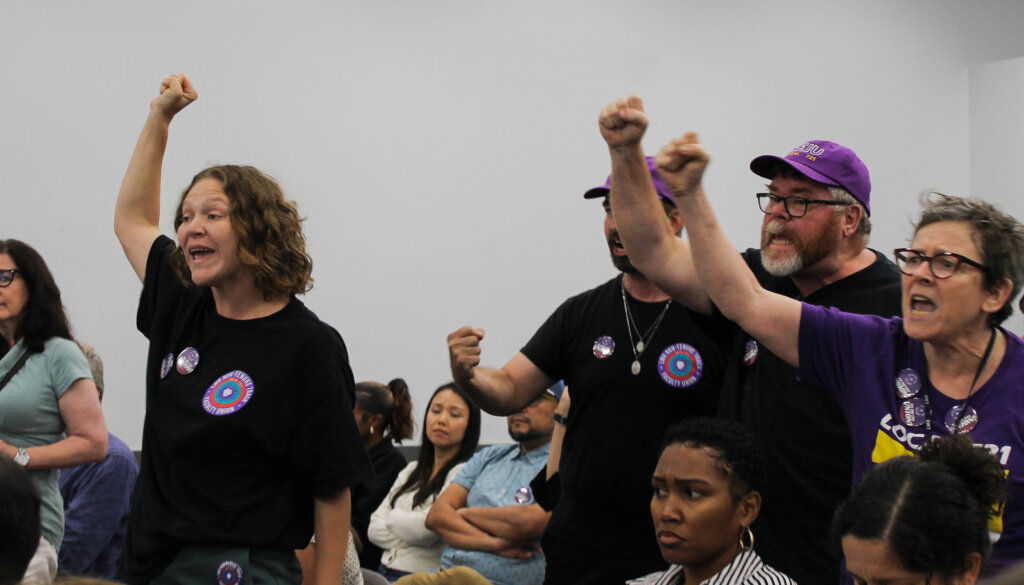
During the initial questions, laughter, murmurs, and scoffs rippled through the crowd, expressing widespread dissatisfaction with the provost’s responses. Weaver emphasized LMU’s commitment to faculty, saying it would be demonstrated through her actions. Several times, her responses prompted members of the crowd to shout out, “You didn’t answer the question at all!”
Among the many faculty members who spoke, political science professor Andrew Dilts addressed the contradictions between Weaver’s speech and the administration’s actions. “You’re stuck between a board of trustees apparently making unilateral decisions outside of ‘shared governance,’ and a faculty and student body who are … the heart of the university,” said Dilts.
The faculty senate, which represents tenure and non-tenure-track faculty, alleges that they were not involved nor informed of the decision made by the board. Members of the union’s bargaining team were also not informed of the decision prior to Viviano’s public email announcement, and claim the “decision to decertify the union was made at the highest levels and in secrecy,” per a letter sent to the board. None of the faculty interviewed for The Lion have ever met Viviano or any of those involved in the decision.
The discussion returned to Weaver when dance lecturer Maureen Gonzalez asked why the religious exemption was being invoked now, despite the union being legally certified by the National Labor Relations Board (NLRB) for over a year. Weaver was unable to provide an answer and pivoted the question to administrative lawyer Loretta Martinez, who vaguely stated that there is “no waiver of the exemption” and no “time limitation,” but that the board was within their “constitutional right” to invoke it.
Later in the meeting, LMU President Thomas Poon, Vice President John Sebastian, and Human Resources Vice President Nancy Pluzdrak joined Weaver on stage for the panel to further answer questions. Faculty, staff, and students lined up on both sides of the auditorium, ready to confront the administration directly.
Speakers expressed frustration over the administration’s lack of accountability and conflicting messages. Poon, however, emphasized the finality of the decision: “Their [the board’s] decision is final. There is no going back.”
Poon’s use of “they” drew criticism because he is a member of the board, a fact later acknowledged in the meeting. In a statement he immediately retracted, Poon characterized the board as a “third-party,” even though he had previously stated that the administration would not work with third-party groups such as the SEIU union (comprised of LMU faculty) and the NLRB.
In a letter addressed to the Board of Trustees on Sept. 19, a group from LMU’s theological studies department referred to the characterization of the union as third-party by saying, “It hurts our hearts to hear you speak of our colleagues as if part of an external force opposed to the survival and common good of the university we share and serve.”
SEIU is an international labor rights network which local unionized groups can join, but LMU’s faculty make up the union itself, not a third-party.
Another point of contention from Tuesday’s meeting was the pay gap between NTT faculty and LMU leadership. When asked about the difference in his salary compared to that of non-tenure-track faculty, Poon initially refused to respond but eventually said, “I feel like I earned it.” While Poon’s current salary has not yet been publicly released, the student’s comment also referenced former President Timothy Snyder, who made $1.18 million in 2024.

Students, too, expressed frustration over the administration’s decision, highlighting their connection with NTT professors whose jobs are at risk. “I want to reiterate that the people here are the heart of our university. I know Bryan Wisch, I don’t know you,” said LMU student Emily Hernandez to the panel. “That speaks to the detriment when you are not embedded within our community.”
Faculty also challenged the administration’s use of a “religious exemption” to end negotiations, calling it “disingenuous” and questioning its morality. “I do think this decision [is moral],” Poon said when asked. Weaver responded, “It doesn’t matter whether I think it’s moral.” She later said that she would “question it too” if she were in the faculty’s position.
With tensions rising, there is talk of a potential strike for the NTTF faculty. Weaver and Pluzdrak stressed in the meeting that retaliation against those who strike is illegal.
“If any of you feel retaliated against, please come to my office—1901. I’m happy to talk with you,” Pluzdrak said. Still, many faculty remain uneasy.
“We don’t want a strike, we’re scared of that,” said Greenberg, who is worried the administration might use a strike as an excuse to fire faculty. “If they were to fire us… it would take months—if not years—to get back our jobs, to prove it was retaliation,” he added.
The union and many in the campus community are urging the administration to return to the bargaining table. “No decision is final. At any point, the Board of Trustees can end the crisis they have thrown the university into by simply returning to the bargaining table,” said union member Bryan Wisch.
The administration has scheduled two more “Community Conversation” meetings on the topic for Oct. 28 and Nov. 18.
The Lion is following this story closely. More updates to come.

