


Barbara Dyer, 74, stands in front of her music office at Loyola Marymount University.
LOS ANGELES — For 27 years, Brian Moss has taught darkroom photography at Loyola Marymount University (LMU), during which he has never been paid more than a low-income salary. The only way he survives in one of the most expensive cities in the country is through the continued financial support of his 86-year-old mother. His mother, a retired preschool teacher from Philadelphia, still earns twice his pay through her pension, investment returns, and social security benefits that were secured through her local labor union — something Moss has been fighting for since 2012.
Moss is a non-tenure-track (NTT) faculty member, employed by the university on a semester basis rather than a yearly contract, which means the renewal of his position is never guaranteed. If too few students enroll in his classes, he loses his job and his health insurance, making every semester a gamble. He lives in a subsidized workspace in Santa Monica, where residents must meet strict low-income requirements. The circumstances are not ideal, Moss said, but his story isn’t unique.

NTT faculty make up a substantial amount of those teaching at LMU; Moss estimates it’s about 60-65%. NTT faculty (particularly part-time and adjunct instructors) in the Bellarmine College of Liberal Arts, College of Communications and Fine Arts, and the School of Film and Television experience low pay, few benefits, and job insecurity, which led them to unionize in June 2024 and join Service Employees International Union (SEIU), representing their labor group, 721.
After months of stalled bargaining, LMU’s Board of Trustees abruptly announced last Friday that it would no longer recognize the union, citing a “constitutionally protected religious exemption,” despite the administration’s commitment to honor the certification a year ago.
During negotiations, union members described how they would often receive copies of their own proposals with most items crossed out and no additional context, leaving the bargaining team (BAT) to guess what terms the administration might accept. Faculty say the negotiations were never done in “good-faith,” as the administration claims, and for those already living paycheck to paycheck, the news was crushing.
Many NTT faculty can’t afford the financial risk of quitting, and are instead forced to patch together several jobs to get by.
“As non-tenure-track faculty, we’re seen as second-class citizens to the other faculty,” said Sam Goff, a part-time lecturer in animation and LMU alum. Goff has a day job as a talent manager to cover her living expenses, and with twins on the way, she worries about the looming financial expense that maternity leave will bring.
“That extra income makes a huge difference between being able to pay for baby formula and not being able to,” Goff said.
For other NTT faculty like Barbara Dyer, the financial struggle has stretched across decades. She has taught music for 35 years, and works in a stuffy shared office in the Burns Fine Arts Center, where students’ handwritten notes cover the walls. From teaching at LMU, Dyer has never been given a livable wage.
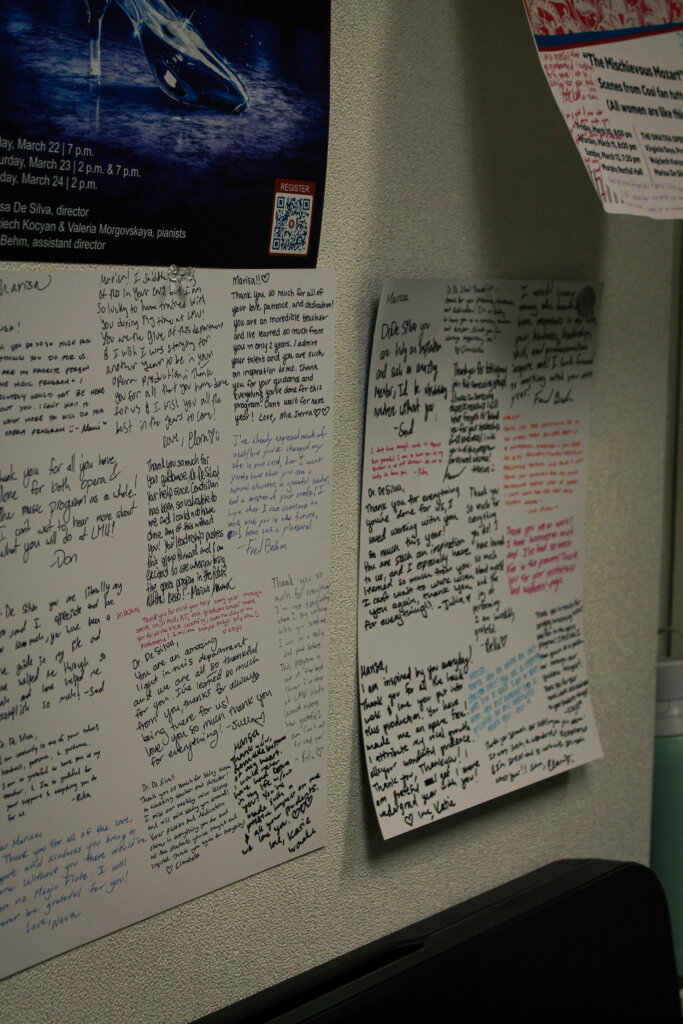

“I’m really good at what I do,” Dyer said, her voice breaking, “and it’s been unacknowledged.”
At home, she teaches private voice lessons and has at times taught at three universities at once just to survive.
For alumni-turned-instructors like Bryan Wisch, the university’s decision to abandon negotiations felt personal. “Coming back to teach at LMU was a point of pride for me,” Wisch said. But Friday’s decision, “feels like a betrayal.”

Wisch, who has taught rhetorical arts for eight years now, also works as a content writer due to his low salary.
“That’s a large part of why we unionized in the first place– one job should be enough,” said Wisch.
Faculty say their low wages and lack of security also limit what they can offer students. Moss believes he could have contributed more to the university had he been given a better contract. Even union organizing takes an additional 10 to 20 hours a week, which none of the members are compensated for.

But along with the hours of dedication, the union has provided NTT faculty with a sense of community and representation on campus. Moss described teaching as a NTT employee as a “suffocating isolation,” and said that SEIU 721 helped lift that weight.
“We’re really passionate, we’re really engaged, and we’re really angry,” said Goff.
As of now, the administration maintains its Friday decision as final, and the union plans to file an unfair labor practice charge with the National Labor Rights Board.
The Lion is following this story closely. More updates to come.
Editors’ Note:
A previous version of this article had inaccurately stated that non-tenure-track faculty make up 23% of all those teaching at LMU due to incomplete data online.
A previous version of this article stated that the mother of Brian Moss used to make more money than him, when in fact, she still does as a retiree.
