


Note: Numbers and percentages in this article were rounded using standard GLP 9 rounding methods.
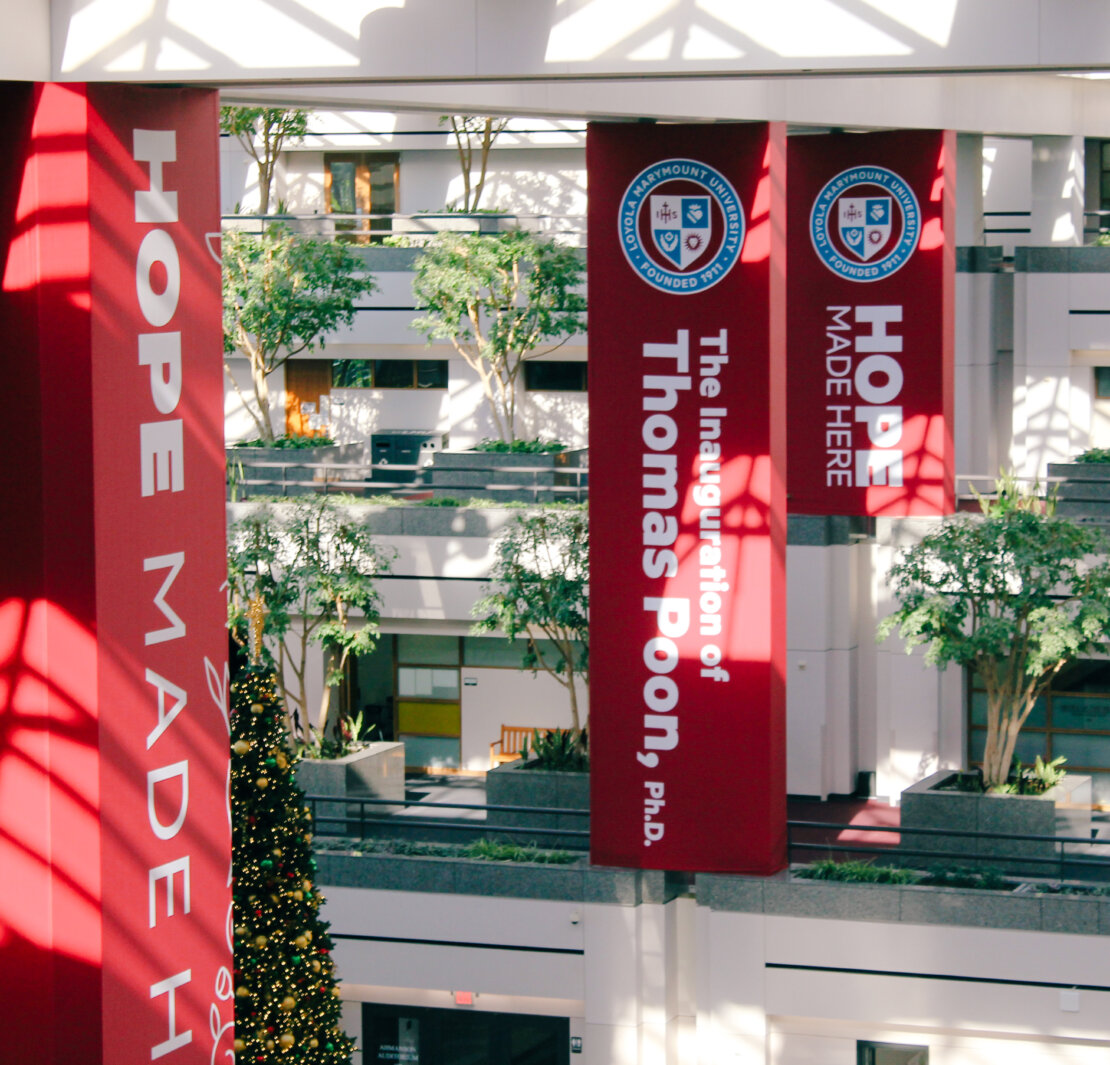
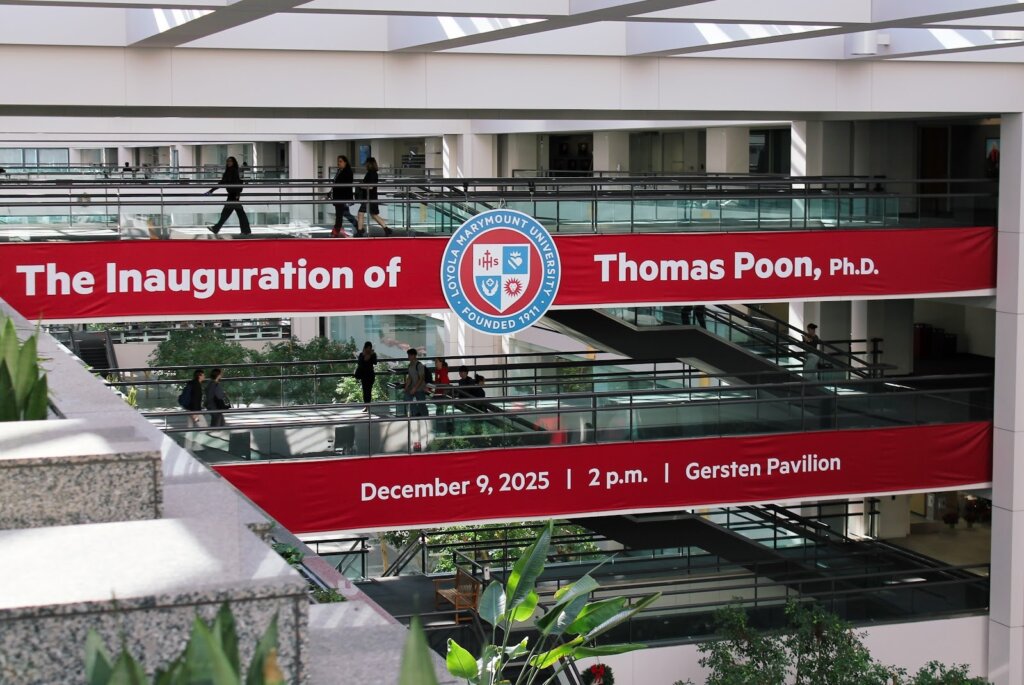
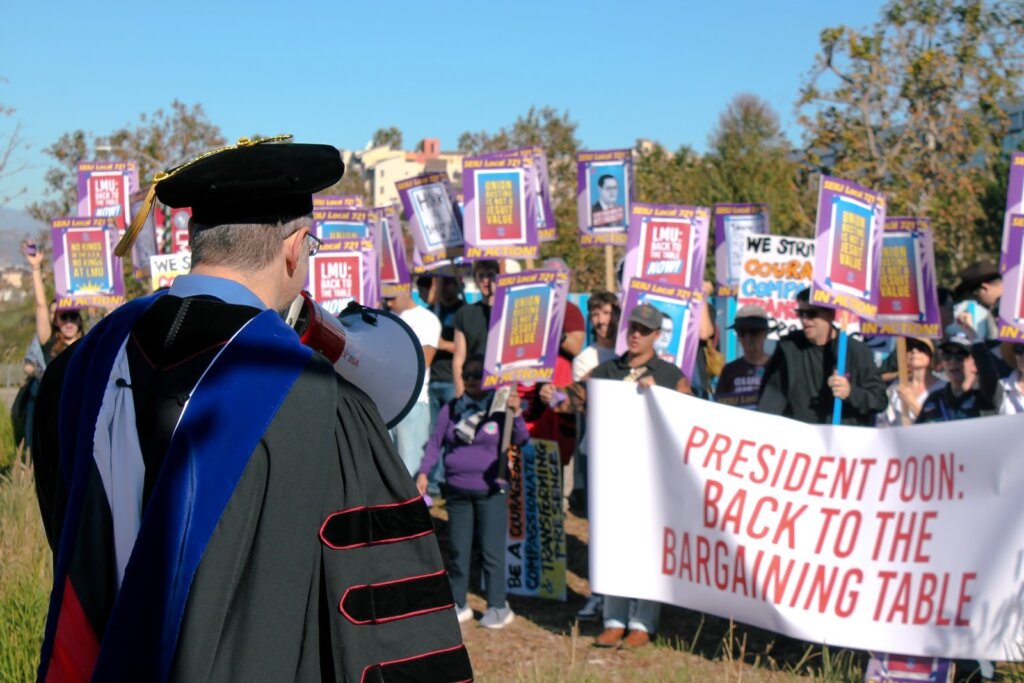
LOS ANGELES – On Tuesday Dec. 9, a plane flew over Loyola Marymount University. A trail of vaporized words in the sky followed, reading, “Congrats LMU and President Poon.” A new LMU sign marked the university’s main entrance on Lincoln Boulevard. Across from it stood a bubbling fountain that had been previously dry for months. A-frame signs designating certain areas of campus as ‘Free Speech Zones’ lined campus sidewalks. LAPD liaisons trailed LMU non-tenure-track faculty (NTTF) and supporters as they marched towards Burns Recreation Center. It was the day of President Thomas Poon’s inauguration.
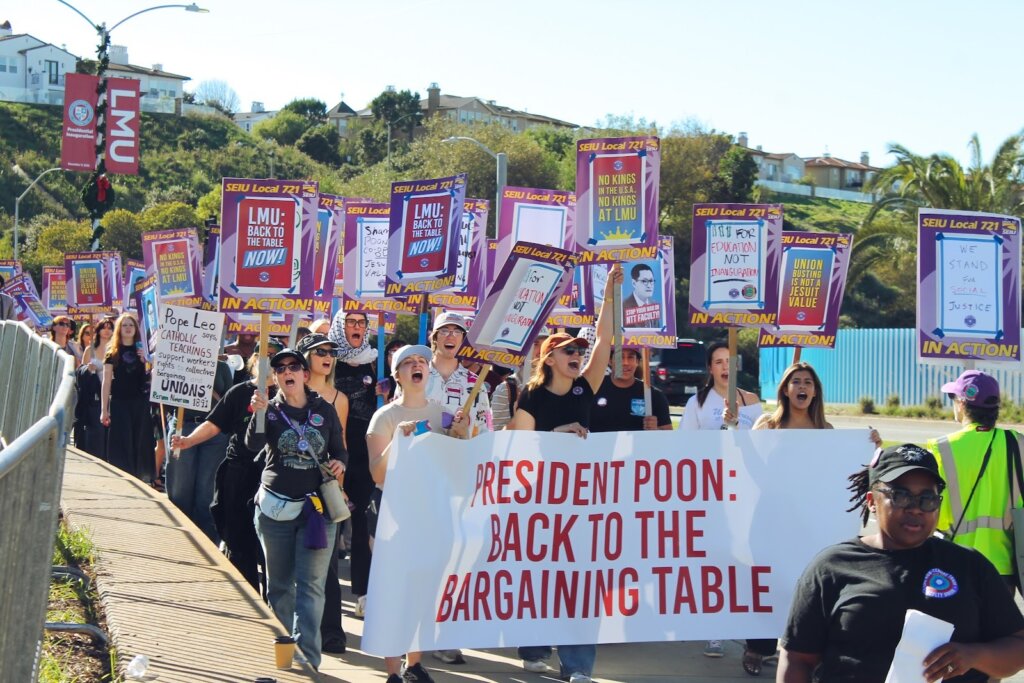
For many, the inaugural decorations across campus stood as examples of the administration’s financial priorities. Following the LMU Board of Trustees’ September decision to stop union negotiations with NTTF, members of the administration claimed that raising wages for these faculty members would be ‘unreasonable’ and result in an 18% tuition increase.
Bryan Wisch, a rhetorical arts instructor, said the administration’s calculations were “wildly inflated” and “meant to drive a wedge between faculty, students, and other LMU employees.” He said the claims relied on assumptions such as full usage of health benefits, a higher number of employees eligible for raises, and an inflated count of union faculty.
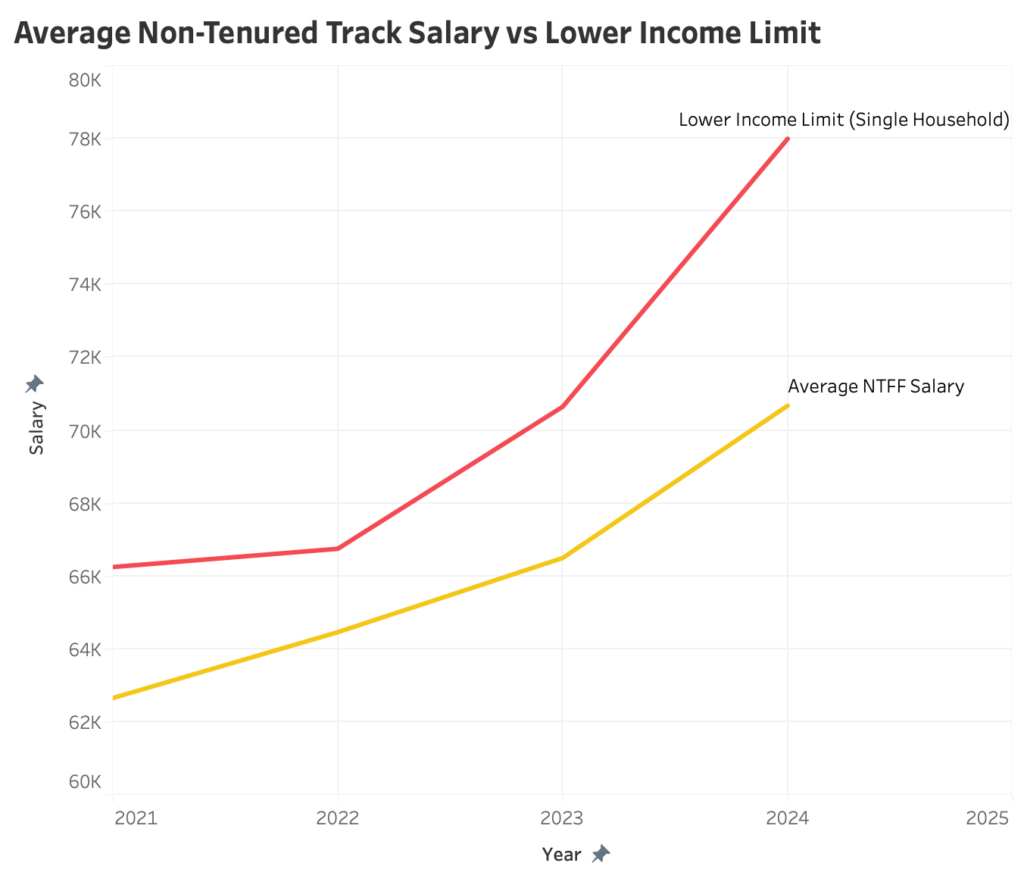
Currently at $65,000 per year, LMU tuition has continued to rise while the average NTTF member works below the Department of Housing and Urban Development’s (HUD) low-income limit in one of the country’s most expensive cities to live in. In light of this, members of the campus community have questioned how the university is allocating its money.
Dorothea Herreiner, a tenured economics professor who has been at LMU for more than 20 years, is one of many feeling frustrated. “We were told LMU can’t afford any of us [faculty]…and we’re not really willing to just take their word for it,” Herreiner said.
Herreiner served as Faculty Senate president during the pandemic from 2020 until 2022. During this time, faculty requested more transparency following Covid-induced layoffs and changes to employment benefits. Herreiner invited then LMU Chief Financial Officer (CFO) Tom Fleming to provide a breakdown of different departments’ salaries, as a move towards transparency. Fleming gave a rough breakdown of salaries but this is no longer common practice.
“You get a sliver of the whole budget, and you don’t see any of the rest,” said Herreiner.
In the 2024-25 fiscal year, LMU reported $565.5 million in revenue, according to a 2025 financial audit. As a nonprofit institution, LMU is not designed to generate profit. Instead, any surplus is intended to be reinvested back into the university.
In order to build long-term wealth, LMU relies heavily on what it owns, also known as assets. The university’s assets include cash, property holdings (campus buildings and equipment), and its investment portfolio. The investment portfolio includes LMU’s $782.9 million endowment fund, a pool of donated money invested to generate returns over time. These are meant to support future operations, scholarships, and academic programs.
Out of the total endowment, which acts similarly to a piggy bank, LMU has designated $52.5 million of its unrestricted funds for faculty support. While that pool is intended as a future reserve for faculty, the university cannot use it all at once due to withdrawal limits. Faculty support refers to “faculty research, professional development, travel grants, and sabbaticals,” according to an email statement from Marketing and Communications (MarComm) representative Griff McNerney. However, the financial audit notes that the Board of Trustees can authorize additional withdrawals from these funds “if necessary.”
Alongside the endowment, LMU has real estate investments in the Westchester area. In 2022, the university purchased a 5-bedroom, 6-bathroom Spanish-style estate valued at $5.75 million for then-President Timothy Snyder. “The university has a longstanding strategy of acquiring off-campus properties…to provide affordable faculty housing to enhance recruitment and retention and to address space limitation on the LMU Westchester Campus,” said McNerney in an email. The same email response also clarified that most university-owned residential properties are tax-exempt because LMU is a nonprofit and “they support LMU’s overall mission.”
Like Snyder once did, Poon now lives in an estate due to presidential requirements. He owns another private residence currently worth an estimated $2.4 million, which LMU provided one of the mortgages for back in 2017, based on public property records. At the same time, a faculty member at a NTTF union event on Oct. 9 said that a colleague of theirs slept in their office due to an inability to pay rent.
Even in a $109 million salary budget, there remains a gap between administrative and faculty pay. While then-President Timothy Snyder made $911,000 in 2024, the average non-tenure-track professor earned about $70,000 a year. This put NTTF below the HUD low-income limit of $78,000 for a single person in Los Angeles County – earning just 71% of the county’s median income.
Glenn Colby, a senior researcher at the American Association of University Professors (AAUP), explained that “it’s a general trend across the country that institutions are shifting their expenditures towards managerial-type positions rather than faculty salaries.” When asked about the cause of this trend Colby said, “It’s related to the general corporatization of education … they are thinking of students as customers.” Colby reported that LMU’s number of management positions increased by more than 50% over the span of 10 years, while the number of instructional faculty positions has remained stagnant, as shown through Integrated Postsecondary Education Data System (IPEDS) data.
LMU’s presidents and administrators did not always receive such high salaries. Presidents were once Jesuits whose salaries were reinvested into the Society of Jesus and lived in modest campus housing near the Sacred Heart Chapel. But when David Burcham became LMU’s first non-Jesuit president in 2010, the system changed. In the last decade, presidential compensation at LMU has increased drastically, a trend also seen at other institutions like Pepperdine University.

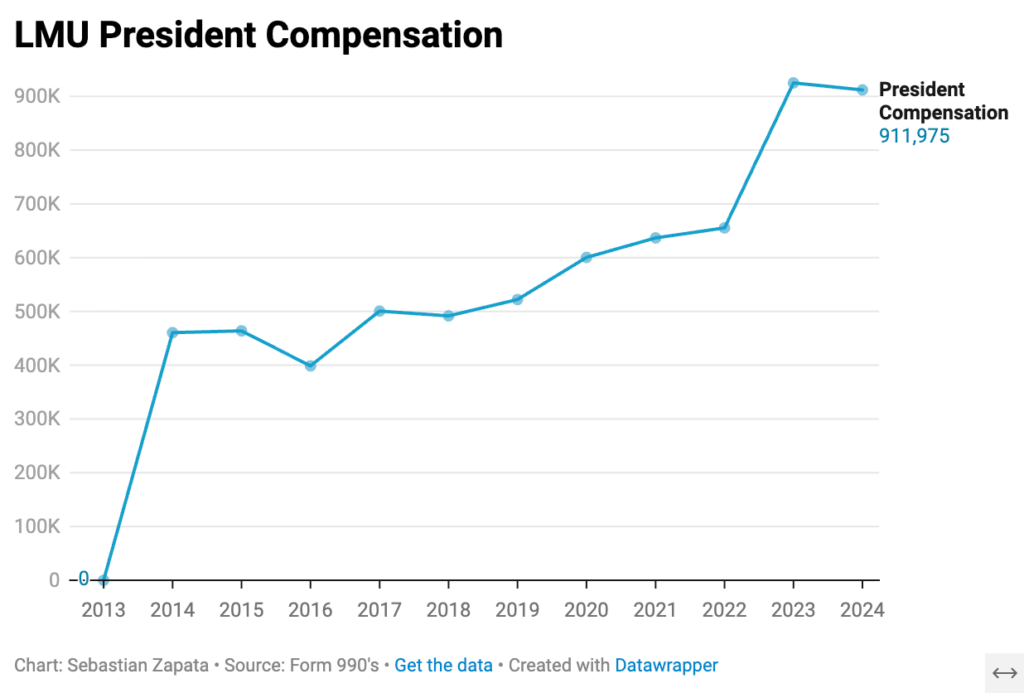
Despite the notable rise, former President Snyder was still not the institution’s top-paid employee last year. Men’s basketball head coach Stan Johnson earned $1.1 million in 2024, a 31.35% salary increase from the previous year. Athletics director Craig Pintens, whose salary jumped 62.7% from 2023 to 2024 to $819k, was the school’s third highest-earning employee.
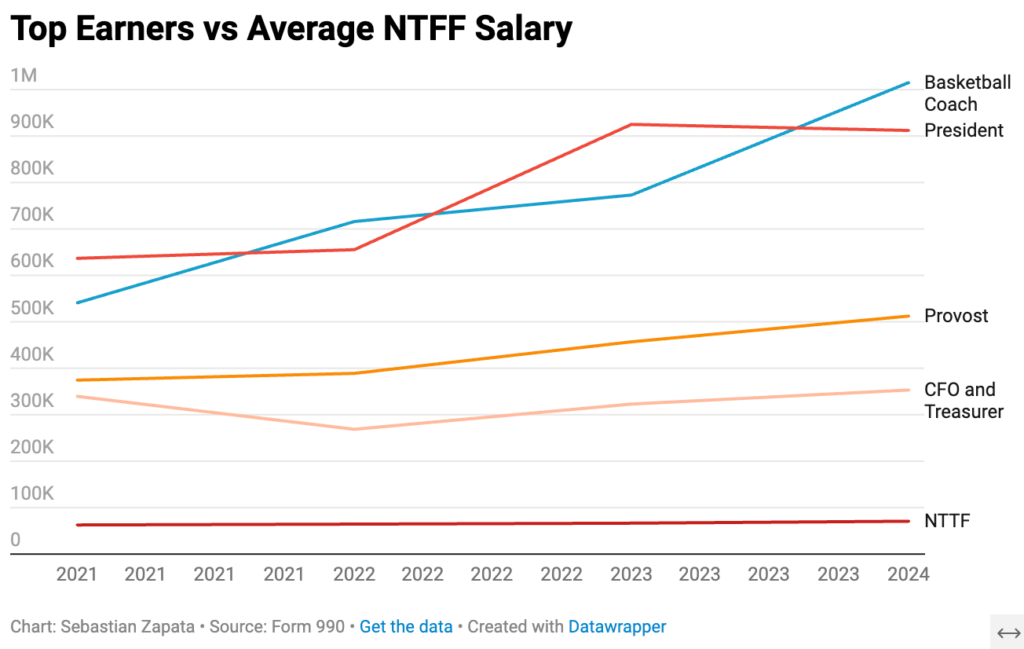
These raises continue to meet criticism from faculty and students who argue that LMU’s compensation priorities do not align with academic needs.
In 2023, former President Snyder announced a Multi-Year Compensation Initiative, which has since been promoted by the administration as an alternative to collective bargaining with the union. When asked about the difference in pay between LMU’s schools, Chief Financial Officer (CFO) Aimee Uen responded over email and said, “the Multi-Year Compensation Initiative [was launched] to raise faculty and staff salaries from the 50th percentile to the 75th percentile, which means that LMU’s salary ranges are set higher than most of its peers.”
Following a stop to bargaining, another initiative in November 2025 promised between 3.5% and 7.8% salary increases for non-tenure-track faculty who qualified. But for the average non-tenure-track faculty earning $70,000 a year, even a maximum 7.8% raise still brings their salary below the L.A. County low-income limit (2024).
After the Board of Trustees chose to no longer recognize the union, NTTF were also promised more full-time positions, which Herreiner said would likely lead to lay-offs among part-time faculty and more work consolidated to less employees. Unionized faculty were also offered reinstated merit raises that had been previously withheld during bargaining, which the National Labor Relations Board categorizes as an unfair labor practice.
Herreiner echoed a sentiment common among non-tenure-track faculty union members: the administration’s calculations of the costs of unionization will be hard to understand because “we have no idea what they [the administration] would have agreed on” in bargaining.
If the administration’s numbers are accurate and representative, “then the university should have absolutely no problem showing their cards,” said Herreiner.
