


A note on the methodology: The analysis is based on data downloaded on Nov. 3 from the California Secretary of State Power Search website. The highest earning federal PACs such as ‘No On Prop 50 Congressional Leadership Fund’ were manually excluded from the analysis. As noted in this law, the contributions for committees donating in multiple state ballots can be overstated.
Cypress, Texas resident Andrea Wardlaw felt betrayed by Texas Governor Greg Abbot’s mid-decade redistricting. President Trump pushed Abbot to redistrict before the 2026 midterm elections to maintain house majority, leaving Texans like Wardlaw upset. “Trump said, ‘Jump.’ and Greg Abbott said ‘How high?’” says Wardlaw. So, she sent $800 to California.
More than 265,000 donations have gone into California Ballot Measure Proposition 50, a redistricting state ballot introduced by California Gov. Gavin Newsom in response to Texas’ redistricting measures. Committees have collected over $120 million in donations, ranging from state teachers’ union to megadonor and physicist Charles T. Munger. Buried in these donations remains curious contributions—70,000 out of these donations are from people not even living in California. For donors nationwide, these investments are forms of resistance to the Trump administration.
Proposition 50 will go before voters on Nov. 4. Although the California Citizens Redistricting Commission draws new maps every 10 years, Proposition 50 will install new district map boundaries that will provide Democrats an opportunity to get five additional U.S. House seats. As Newsom often mentions, Proposition 50 is a temporary four-year measure to balance Texas’ gerrymandering decision.
Texas’ gerrymandering decision centers on a 2022 filed by the Biden Justice Department, which challenged Galveston County’s redistricting plan. In this lawsuit, the Justice Department argued that redistricting would silence the predominant Black and Latino groups of the Texas county.
The U.S. Fifth Circuit Court of Appeals held that coalition groups that account for two or more racial demographics are not protected under the Voting Rights Act. Five districts in Texas were found in violation of the law. Trump used the court ruling to push the Texas legislature towards redistricting, aiming to pick up five new Republican seats in the midterms in 2026.
“Republicans have locked in power through gerrymandering,” Wardlaw says. Comparing the current state of the United States to an Orwellian dystopia—she briefly mentions 1984 and Animal Farm—Wardlaw says she is deeply disappointment in Greg Abbot’s relinquishment of his power as governor to President Trump. “[Politicians] don’t understand that the minute Trump has no use for them, Trump will turn on them.”
Wardlaw, like others, submitted her complaints to her representatives in Congress. “I already complained to our senators,” Wadlaw says. “Congressman [Wesley Hunt] isn’t any help. What can we do?”
Feeling ignored, Wardlaw turned to California. Proposition 50 Ballot Measure Committee, an organization backed by the likes of Newsom, California U.S. Senator Alex Padilla, and Democratic House Leader Hakeem Jeffries, has been marketed as a direct response to Texas’ redistricting. In the months since the measure was proposed, donations have come flooding in from states across the country.
“I’ve donated before—smaller amounts,” Wardlaw says. “I happen to be a fortunate person. I feel like [donating] gives people a voice for those who don’t have a lot of money.”
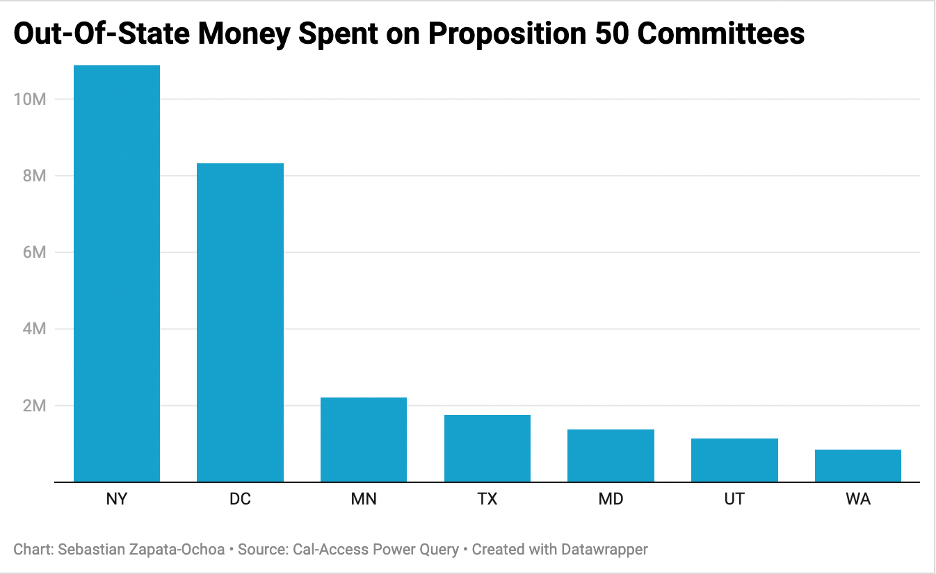
Texas donors like Wardlaw have sent roughly $1.8 million to Proposition 50. Donors in six states contributed more than $1 million. Utah, a state that has voted for a Republican president candidate every election since 1968, passed the $1 million Prop 50 donation mark with the help of large donations from Los Angeles native and Utah resident Bill Bloomfield, a philanthropist donating towards research, health initiatives, and politicians, and AES Distributed Energy Inc, the largest US-based global power company.
Large donations from unions drive Washington D.C. state donations up to $8.3 million. The United Brotherhood of Carpenters and National Education Association donated a combined $5 million to Newsom’s ‘Yes on 50’ ballot committee.
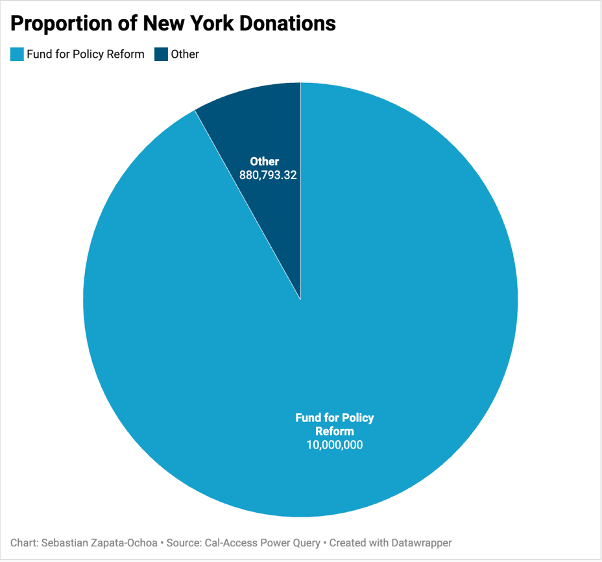
New York donations rank highest among state donations thanks to the Fund for Policy Reform, a nonprofit funded by philanthropist George Soros. With a donation of $10 million, this fund is one of the largest single out-of-state donations to fund the ballot. Even though New York sent 5,586 donations to Prop 50 Measure Committee, Fund for Policy Reform made up 94.7% of New York donations.
New York only fell behind Washington State for sheer number of donations. Amidst these donors, Michael Shaieb, a New York-based composer, does not shy away from involving himself in politics. Although Shaieb works primarily in local politics, Newsom’s efforts against Texas redistricting motivated Shaieb into donating $360 past the borders of his state. “[Governor Newsom]’s message is getting out there,” Shaieb says. “And I want to be part of that.”
Newsom has been prolific on social media about his criticism of Trump. For many donors, Newsom is a symbol of retaliation against the Trump administration. “Our president goes ahead and compels the governor to basically do his bidding,” says Shaieb. “Then I followed Newsom, who I really like a lot, trying to combat this to make it an equal playing field.”
Newsom and Prop 50 have even appealed to donors from predominately red states. “I remember the feeling of injustice,” John Warley, a resident of Beaufort, South Carolina, said. “Plenty of people were echoing the same opinion. The only place I saw doing anything about it was California.”
Warley, a retired lawyer and full-time writer, donated $100 to Newsom’s Prop 50 committee, a part of the total $59,000 sent from South Carolina donors.
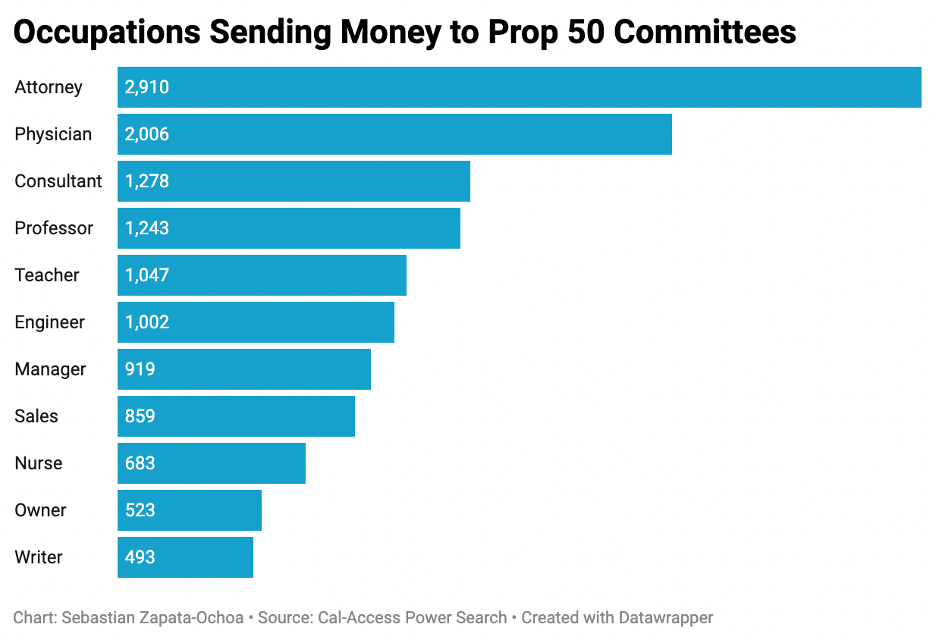
Like Warley, legal professionals represent the most active occupation donating to this ballot measure. Questions about 14th amendment, historic cases of gerrymandering, and voters’ rights have attracted some legal professionals worried about the implication of mid-cycle redistricting.
A Bakersfield native lawyer Mark Bigger donated to a committee opposing Proposition 50. Amidst the barrage of out-of-state donations, Bigger puts his donation of $6,250 into perspective. “I’ve had a long-time issue with redoing the lines when it’s in between the end of decades,” Bigger says. “Unless there is a legal reason to do it, the parties on both sides will manipulate it. [Prop 50] might be successful, so that’s why I donated so much.”
Whereas lawyers focus on the legal structure, writers such as Crescent Dragonwagon, an Arizona writing coach and author, felt compelled to donate as a way to stand up to the current administration. “I don’t feel it could be authoritarian. It is,” she says.
“From redistricting to the media to the thrashing of due process to name calling different groups,” Dragonwagon says, “It’s stocking hate. I’m deeply concerned about that.”

Likewise, Michigan-based journalist Ilene Wolf saw a chance to put her $210 donation to Prop 50 to good use. “My first reason is that we’re all in this together,” Wolf says. “My second is that it’s my form of resistance. My third is that money dominates our politics.”
Law professor Richard L. Hasen says he is not surprised that people outside of California care about Prop 50. In an email, he wrote, “Given the national political implications of this measure, it is not surprising there would be significant money coming from out of state. Democrats are playing offense rather than defense on this one and it is easier to attract money to it as a sign of opposition to Trump.”
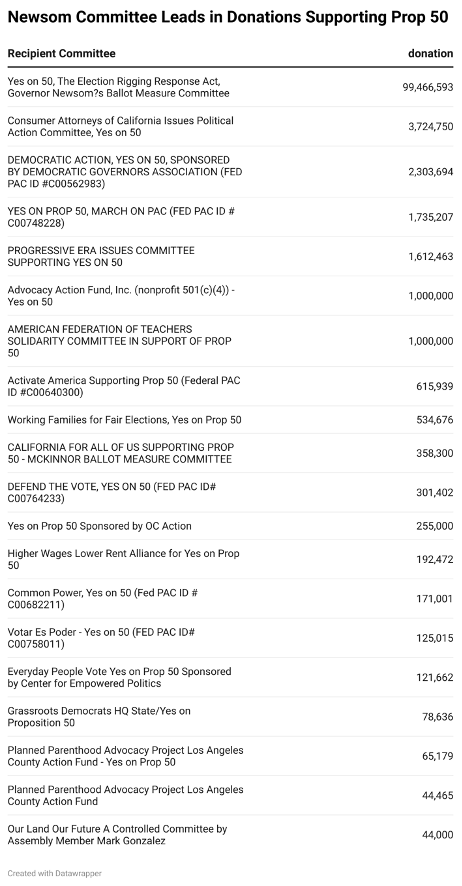
Newsom’s recipient committee Yes on 50’s has garnered $99 million in donations and is one of 26 groups supporting California redistricting.
Among these committees is Activate America, an independent expenditure organization focused on voter engagement and activist mobilization that has received over $600,000 in donations. “We have a large network of donors inside and outside of California,” says Activate America’s communications director and strategist Donald Lathbury, “Many of whom have chipped in to help pass Prop 50.”
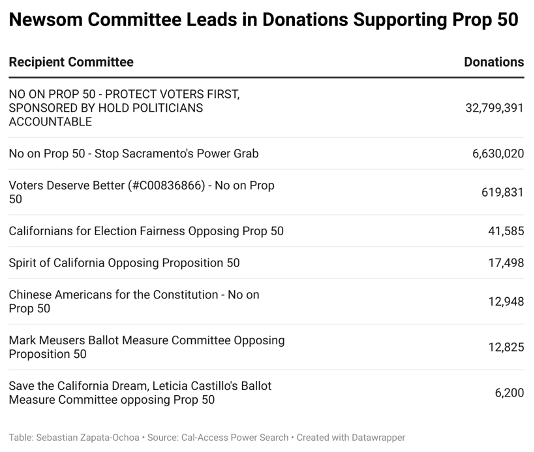
Whereas Newsom’s committee reached unprecedented heights of donations, committees opposing Proposition 50 have had far fewer donations than their opponents. The most-funded committee ‘NO ON PROP 50 – PROTECT VOTERS FIRST’ only reached a third of Newsom’s $99 million fund.
In terms of out-of-state donations, 21 percent of donations to ‘No On Prop 50 – Stop Sacramento’s Power Grab’ came from outside California. Newsom’s Ballot Measure Committee had recorded 48% of their donations as out-of-state.
Lawyer and candidate for California Assembly District 72 Mark Meuser runs his own committee opposed to Prop 50. “Legally, I, as an attorney, have to get down to the facts and elements,” Meuser says. “I use facts to educate judges and the ballot committee to educate people.”
Meuser, like many others, believes Proposition 50 will ignite a chain reaction of gerrymandering across the country. Missouri challenged Newsom’s redistricting initiative with its own while states like Nebraska, Illinois, and Florida are already considering implementing new district maps.
Whether or not Proposition 50 passes in the state of California, what comes to show is that donors, politicians, and spectators nationwide will be waiting to see what Californian voters decide on November 4th.

This is a great paper Sebastian <3