


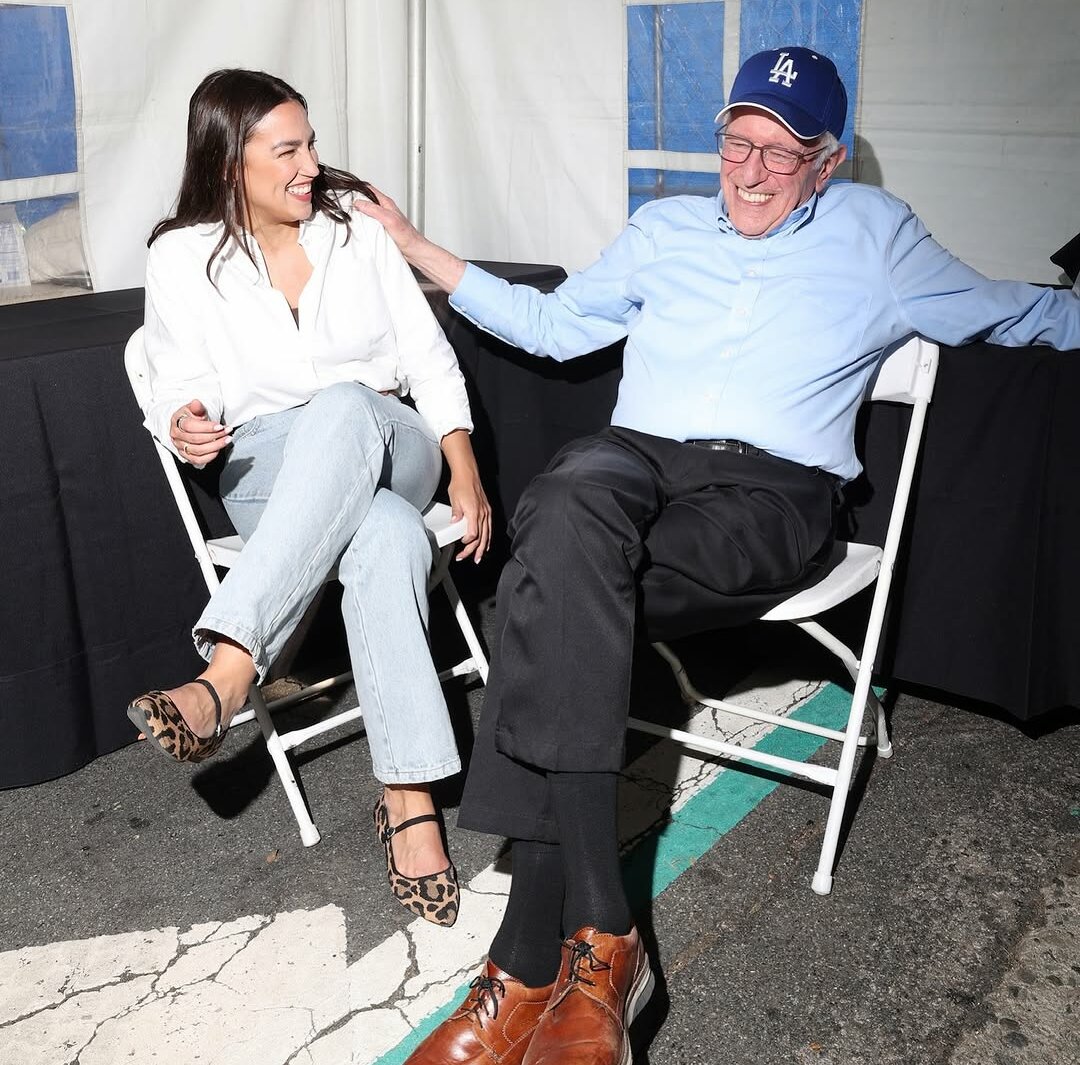
A few weeks ago, on a sunny Saturday afternoon, I stood outside LA City Hall alongside 36,000 others to hear Bernie Sanders and Alexandria Ocasio-Cortez speak to their largest crowd to date. The April 13 rally marked the sixth stop on Sanders and AOC’s ‘Fighting Oligarchy’ tour, a campaign aimed at channeling dissent toward the Trump administration, confronting the shortcomings of the Democratic Party, and rallying the American left. With the future of the Democratic Party up in the air, the tour also seems to be helping AOC build her national profile in advance of the 2028 election cycle.
Alongside me in the audience were a diverse array of left-leaning individuals and ideological groups. Progressives and social democrats, whose views align closely with Sanders and AOC’s politics, certainly made up a significant portion of the audience. Additionally, the anti-Trump momentum generated by the tour has garnered support from many moderate Democrats. And naturally, there was no shortage of leftists from countless different camps– democratic socialists, socialists, anarchists, communists, you name it. While not every attendee was perfectly or even closely aligned with Sanders and AOC’s politics, the energy created by the tour has been undeniable, and for many, a prominent public outlet for dissent is good enough.
Along with individual attendees, a variety of alternative left-wing parties and political organizations capitalized on the event’s popularity to promote their platforms, including some that are openly critical of Sanders and AOC. The Party for Socialism and Liberation (PSL), Democratic Socialists of America, and Bob Avakian’s Revolutionary Communist Party, Revcoms, all had stands outside the City Hall with members handing out flyers and stickers. The Revcoms’ presence was particularly hard to miss, as they had hung posters on nearly every telephone pole within a two block radius featuring bold-lettered catchphrases such as “No Bernie, it’s not the 99% against the 1%, because nearly half of the 99% are fascists”.
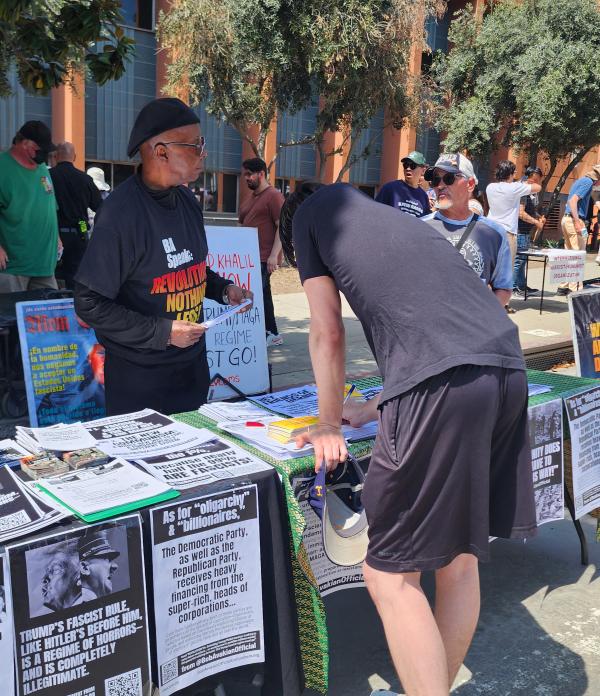
Navigating through the mishmash of leftist factions at the Fighting Oligarchy rally and trying to decipher each of their niche ideological disagreements brought several questions to mind. How do Sanders and AOC intend to channel this crowd’s energy toward a unified collective movement? How does the current state of the Democratic Party shape the urgency of this moment for the left? Which policies are worth compromising for the sake of building a popular coalition? And which aren’t?
Looking to the past might offer some answers. While April 13 was the largest show of support that Sanders and AOC have seen thus far, this is not the first time that a Trump presidency has given rise to an alternative progressive movement. Given how much the political climate has shifted, it’s easy to forget how much social purchase the progressive agenda had during the first Trump administration. It was only five years ago that Bernie Sanders seemed poised to win the Democratic nomination, and nearly all his opponents were proudly endorsing Medicare for All and the Green New Deal, or some watered-down alternative.
Of course, Sanders did not win the 2020 primary, and Medicare for All and the Green New Deal have since been comprehensively erased from the Democratic platform. So what is there to learn from this squandered opportunity for progressive reform? And what does it say about the prospects of the Fighting Oligarchy tour to inspire material change?
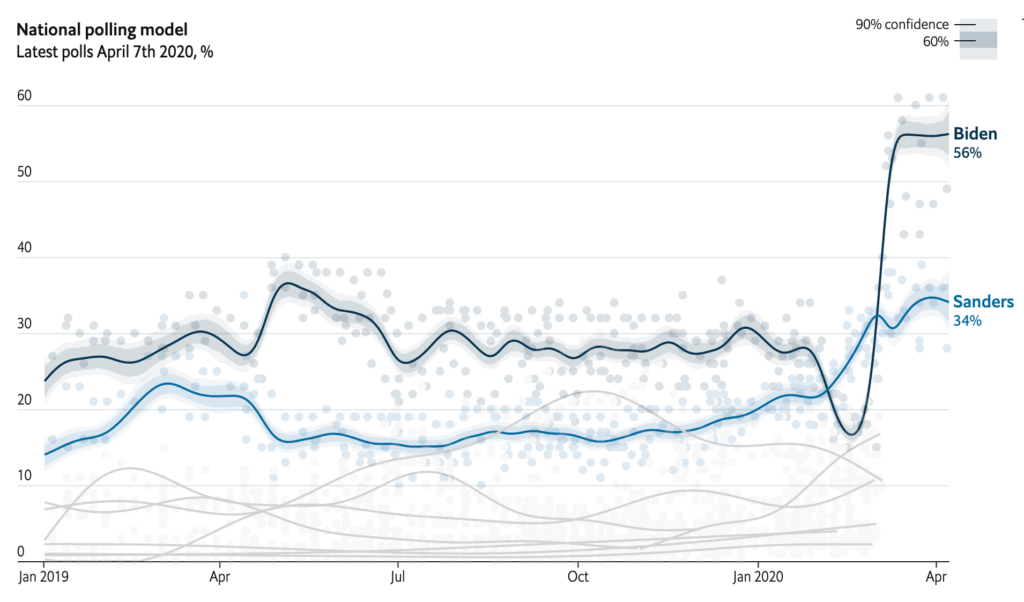
Firstly, I think it is important to recognize that the conditions under which progressive Dems are attempting to mobilize have changed meaningfully between 2020 and 2025. While Sanders had massive popular support in 2020, he was running an adversarial campaign against a Democratic establishment that was both more popular and more unified than it is now. In March 2020, after Sanders surged to a 10 point lead in the primary polls, Party leadership wasted no time in uniting his opponents behind Joe Biden with an orchestrated series of rapid-fire campaign withdrawals and endorsements.
In February of 2020, polling showed that roughly 46% of Americans held a favorable opinion of the Democratic Party, with Party leader Nancy Pelosi’s approval rating sitting around 42%. Meanwhile, polling from March 2025 shows that the Democratic Party’s approval has plummeted to 34%, with Party leader Chuck Schumer’s approval rating at a dismal 24%. The message from the base is clear– something needs to change. And now that there is change on offer, the base is showing out. One thing worth noting is how early in the election cycle this tour is taking place. It seems clear that this is a pivotal moment for the Democratic party, and a popular movement now could have the power to define its look for years to come.
Sanders and AOC, however, are not the only ones striving to shape the future of the left. Establishment Democrats are also pushing to restore public faith in the Party, and prominent center-left figures are pitching ambitious makeovers for liberalism. New Jersey Senator Cory Booker’s record breaking 25 hour Senate floor speech garnered praise for its direct criticism of the Trump administration, and has propelled Booker to fourth place in polling for the 2028 Democratic primary. However, the speech was largely a symbolic gesture that neither sought to block legislation nor strayed from what many see as a stale Party platform.
Meanwhile, liberal columnists Ezra Klein and Derek Thompson have made headlines for their proposal of a “politics of abundance”, a tech-optimistic vision for the future of liberalism centered around deregulation and rapid development of green energy and housing. While the abundance agenda promises ambitious results, its game plan for achieving those results seems somewhat ill conceived. The notion that tinkering with regulations will properly motivate private interests to develop sustainable housing and energy solutions on a mass scale feels far fetched. With Booker and the Democratic establishment clinging to an exhausted status quo, and abundance proponents selling what feels like a half-thought out roadmap to a green utopia, Bernie and AOC’s class-first platform seems to offer the most in-touch diagnosis of the left’s failings, and the most refreshing vision for its future.
While Sanders and AOC are fighting an uphill battle against a hostile establishment, they do have a leg up on important issues such as healthcare, education, and foreign policy. 2024 polling shows that 90% of Democrats believe it is the government’s responsibility to ensure universal healthcare coverage, 71% support cancellation of some or all student debt, and 79% believe the US should not send weapons to Israel. During his speech at City Hall, Sanders reaffirmed his support for universal healthcare, student loan forgiveness, and cutting military aid to Israel.
The progressive wing is closely aligned with the Democratic base on key issues that moderates refuse to budge on– however, neither Sanders nor AOC has made it through the past 18 months with their reputation unscathed by the issue of Gaza. Sanders drew sharp criticism from the anti-war left for his monthslong reluctance to label Israel’s war in Gaza a genocide and call for a ceasefire. AOC faced similar backlash for stating in her 2024 DNC speech that the Biden administration had been “working tirelessly to secure a ceasefire in Gaza” only one week after it had approved $20 billion in military aid for Israel. While Sanders and AOC are still significantly further to the left than most Democrats on Gaza, and likely aren’t in any danger of losing the pro-Palestinian vote, launching a mass movement requires the support of an enthusiastic base that is engaged beyond voting booth.

Another challenge the progressive left will need to address is how to effectively navigate the alternative media landscape. In 2024, Donald Trump successfully capitalized on the changing media ecosystem by appearing on podcasts and livestreams with figures like Theo Von, Adin Ross, and the Nelk Boys, undoubtedly contributing to his gains in the young male vote. To their credit, both Bernie and AOC clearly recognize the shifting media landscape and have worked to adapt. Sanders earned Joe Rogan’s endorsement after appearing on his podcast in 2019, and both he and AOC have made multiple appearances on leftist commentator Hasan Piker’s Twitch stream. However, alternative media is largely dominated by the right, and progressives will need to embrace an unfriendly media ecosystem if they hope to win back key demographics.
Admittedly, since Sanders dropped out of the 2020 primary, I have been deeply skeptical about the prospect of reforming the Democratic Party from within, and have tried to focus my energy elsewhere. The Party’s establishment has proven highly resistant to progressive change, and Kamala Harris’s 2024 presidential campaign reaffirmed many of my doubts. Harris’s refusal to waver on Israel, and her abandonment of the Green New Deal and Medicare for All in favor of a pro-fracking, pro-private healthcare message were deeply discouraging. In general, this is a pretty bleak moment in national politics, and I think that investing too much of yourself in it can lead to a nihilistic outlook. I tend to believe that our time is spent more productively working to make our local communities a better place– supporting organized labor, mutual aid, and social action– than it is getting bogged down in national politics. However, the unprecedented public support for Bernie Sanders and AOC’s Fighting Oligarchy tour certainly offers some hope.
With multiple factions vying for the future of the Democratic Party, this could be the progressive wing’s moment to seize momentum. If Sanders, AOC, and the Democratic left wish to launch a popular movement, however, they will need to overcome key obstacles. Their class-focused messaging is strong, but they must take firm stances on issues that their base cares deeply about, such as Gaza. Additionally, they will need to embrace alternative media to promote their platform, even if those spaces are traditionally unfriendly to the left. Most importantly, they need to prove that these rallies are more than just performances by pushing policy and action that back up their messaging. This is a moment of contingency on a national level, and it will take strong will and bravery to ensure that it doesn’t go to waste. I am hopeful that leaders on the left have learned valuable lessons from the past, and will establish a national movement worth fighting for.
