


Since Donald Trump entered the White House on Jan. 20, the dismantling of diversity, equity, and inclusion initiatives has been a popular topic of conversation across America. Larissa FastHorse’s “Fake It Until You Make It” presents two nonprofits doing everything they can to show this diversity in their Indigenous culture-focused organizations (whether authentic or not) to win over grant money.
The performative activism and utter manipulation of some diversity programs in this production are certainly a familiar notion in contemporary society, oftentimes corporations prioritize an inclusive demeanor over genuine advocacy for marginalized groups. This farce, however, has missed the mark on its satirical relevancy and is rather dated, perhaps due to its delayed opening night at the Mark Taper Forum. Center Theatre Group paused its programming due to post-pandemic challenges, resulting in the play’s premiere being pushed back to January of this year. Despite the seemingly short amount of time since the intended 2023 premiere, America looks immensely different nowadays.

As the first known female Native American playwright to have produced a play on Broadway, FastHorse brought a unique perspective to the satirical realm of plays. Despite this significance, the production falls short of the relevance of its messaging. Many nationwide DEI practices have already been eradicated, making the absurdity of the cast’s jokes less humorous and well, more real. Additionally, the nonprofits’ battle over the grant funds is no longer pertinent, given that federal grant funds have been frozen within the past month. The farce was rather out-of-touch and generated more cringes of discomfort than genuine laughter.
The audience is immediately thrown into the fierce rivalry between Wynona (Tonantzin Carmelo) a Native American-identified woman leading N.O.B.U.S.H, and River (Julie Bowen) a white woman at Indigenous Nations Soaring (INS). The two women work in neighboring office spaces – their proximity instigating competitiveness.
The play has multiple confusing themes, failing to hone in on the complexities of race-shifting and diversity in the workplace. From themes of mistaken identities and falsely claiming identities, to self-reflecting on the role of cultural perspectives within relationships, audiences never could expect what came next, continuously being tossed from one moment of unseriousness to the next. The most random aspect of the plot, however, was the recurrence of Wynona and River’s arguments surrounding River’s cat, Pusila, which incessantly steered the attention away from the primary storyline. While Wynona is busy trying to abduct her opponent’s pet, River continues to plant Buddleja, a dangerous and invasive species, in Wynona’s native plants. These distractions are once again, a parallel to real life, with unnecessary and unproblematic issues being given more awareness than matters needing actual change. The disputes over the animal became more and more monotonous as the play continued.
Wynona’s boyfriend Theo (Noah Bean), assists the woman in her scheming against River. He pretends to be Mark (the real Mark arrives later in the production, played by Eric Stanton Betts), a Native man who applied to work with River’s organization, to strengthen Wynona’s chances of obtaining the grant money.
Perhaps the most jaw-dropping lines of the play’s dialogue came from Grace (Dakota Ray Hebert), another leader of a nonprofit organization within the same office building as the main characters. She was oftentimes accompanied by Krys (Brandon Delsid), an advocate for Two-Spirit youth. Grace, who revealed a new cultural identity with each new presence on stage, is a race-shifting advocate, helping people transition from one race to another. Her outfits ranged anywhere from a Spelman College shirt with a headwrap to a kimono.

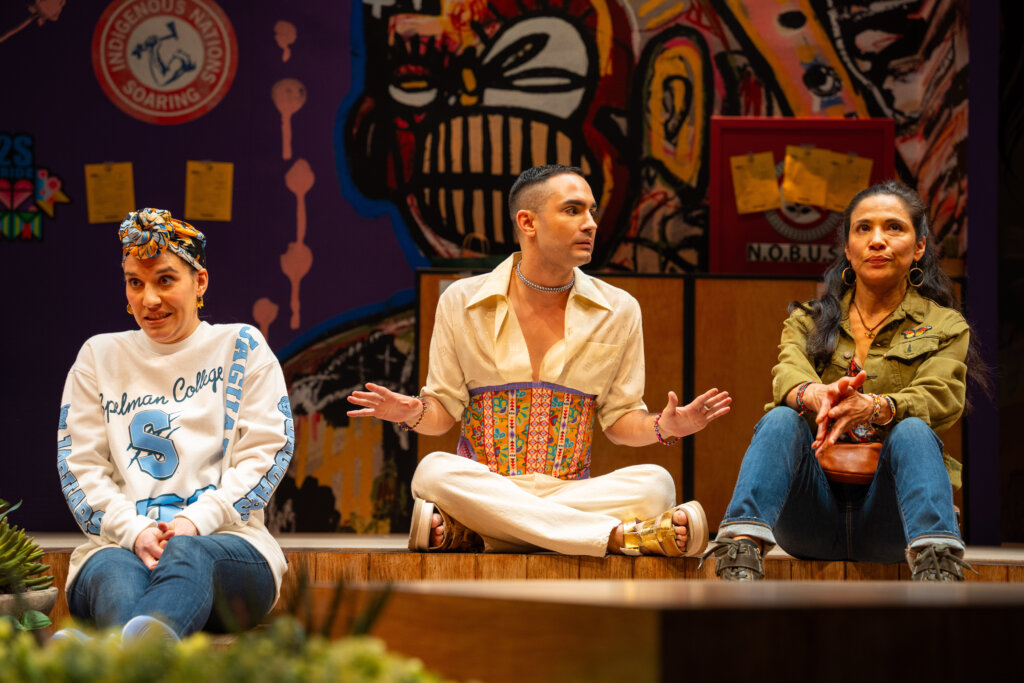
The strained conversations in “Fake It Until You Make It” felt similar to reading the ludicrous, wannabe hip comments on an Instagram reel, rather than enhancing the characterization of each individual. This is evident when River said she was going to “pick a tribe” to identify with, and that she was “coming out” as Native American. Additionally, Grace said that the “push against heterosexual norms” has helped to implement the race fluidity ideology that she strongly advocates for. The attempt at satire was apparent, but the play’s banter felt more forced than ingenious.
This aspiration for trendiness and sounding “current” is also attempted through the loud, upbeat music that jolts audiences out of their seat during scene transitions. The offices moved smoothly off-stage during these transitions alternating with a set of stairs, which historically depicts social hierarchy within theater productions. The walls were full of graffiti-style paintings, pride flags, and multicolor lights. Overall, the stage setup was full of vibrant hues and showcased an upbeat mood, which ultimately contributed to the messy nature. While quick action and dialogue are typical for a farce, the jumbled plotline and confusing timestamps made for a substandard framework for the story. Viewers were thrown right into each new conflict, consequently missing several layers of supporting information.
Humor feels necessary during a time of political uncertainty. The pure chaos and jumbled absurdity of this production are perhaps a good reflection of the current state of the nation. Or maybe it’s as confusing as writing a restraining order for your office neighbor’s cat.
