


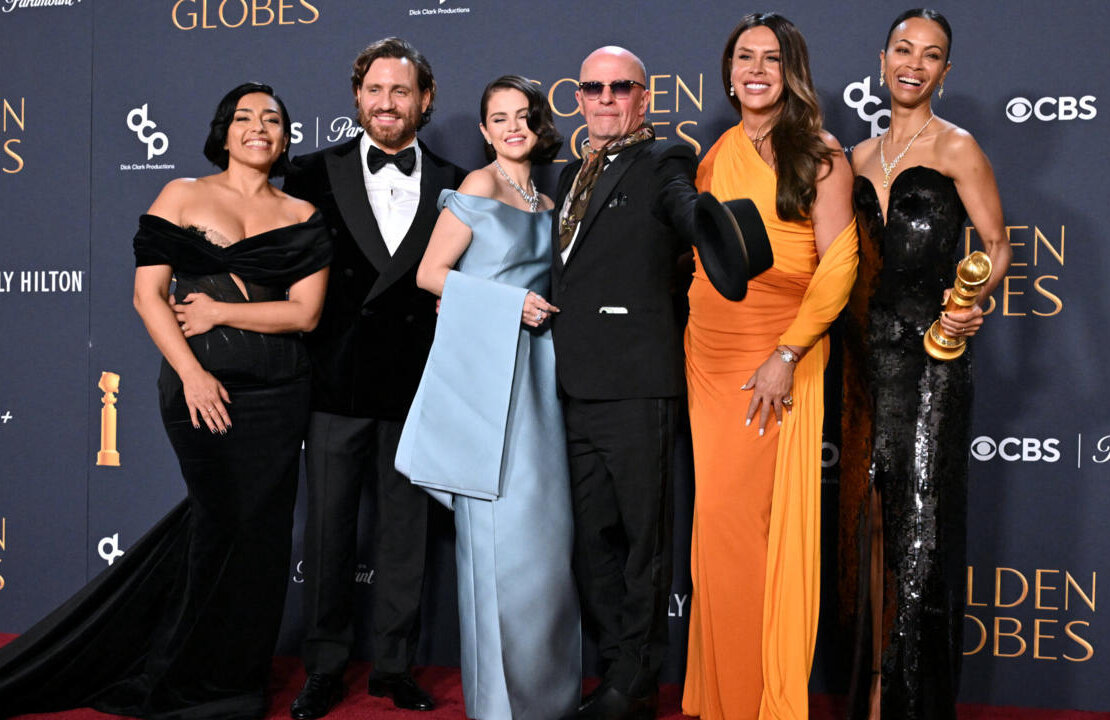
Jaques Audiard’s 2024 film “Emilia Pérez” received a high number of nominations and won two categories at this year’s Academy Awards. It was the film on everyone’s mind, but not necessarily in a positive light.
In a French interview with “Konbini,” Audiard cites the inspiration for the film, Boris Razon’s novel “Écoute.” He describes the novel as the story of “a Narco who wants to become a woman.” In Audiard’s adaptation, a Mexican cartel leader and transgender woman (Karla Sofia Gascón) enlists a lawyer (Zoe Saldana) to help her both medically transition, fully becoming Emilia, and escape her violent past. Rita, the lawyer, also must balance re-introducing Emilia to her family while keeping her former identity secret from her ex-wife (Selena Gomez).
The film is a musical, a comedy, a dark drama, and a crime show – all the while in Spanish, a language Audiard does not speak. Although it attempts to be an international, genre-defying, emotional piece, critics instead argue this film bit off more than it could chew.
Just weeks before the Oscars, lead actress Karla Sofia Gascón faced backlash for resurfaced tweets from 2020, which many viewed as ignorant and racist. Nevertheless, she attended the Oscars, but she did not receive any awards in her name.
However, the overall negative reception of the film began months before. Many critics have issues with the film completely outside of Gascón’s internet scandal – most with problems of the film itself, even more with director Jaques Audiard.
Critics of the film tend to fall into three categories:
- LGBTQ+ members, allies, and others who have issues with Emilia as a character and the film’s representation of trans identity
- Those who feel the representation of Mexico and Mexican people is shallow and un-researched, particularly Spanish-speaking viewers
- Filmmakers and movie fans alike who just think the film is bad. Their focus varies from poor writing and awkward pacing to its obvious pandering towards the Academy.
This is an exploration of these three groups and their key arguments.
Trans Exoticism
LGBTQ+ viewers are some of the most prominent critics of “Emilia Pérez.” The titular trans character, Emilia, was poorly represented in the minds of many trans viewers.
The main success is the casting of an actual trans woman as Emilia. At her request during filming, Gascón plays both the pre-transition and post-transition character with the help of special effects and makeup. However, it falls short of a net positive in the face of her controversies and the depiction of Emilia’s character in the film.
One major issue is the dichotomy between pre-op and post-op Emilia, both of which notably still get called by her male deadname and male pronouns by other characters. Before transitioning, Emilia is incredibly violent, reckless and borders on narcissistic. After, a gentler, kinder Emilia appears, but the audience quickly sees her revert to her old ways through her interactions with Jessie, the wife who presumed her to be dead. Emilia and Jessie fight over their children, culminating in a violent outburst from Emilia, who shoves Jessie and screams at her, using the words “my children” instead of “your” or “our” in a Freudian slip. This is an on-the-nose jab at the “old” and “true” Emilia bubbling to the surface, implying that no matter how much she changes herself, she will always, deep down, be an aggressive and violent man.
In case one missed this symbolism, the next scene nails it in. A split-panel triptych shows Emilia and Jessie both furiously ranting to Rita over the phone about their argument. Each character is shown under a different colored spotlight to create a colorful, vibrant scene. It’s probably not a coincidence that Jessie’s light is pink and Emilia’s light is blue.
Another problem is the writers’ handling of Emilia herself. Our supposed titular character is not the focus of the film and is not introduced until around 15 minutes in. The true main character is Rita, and that time is spent establishing her as a lawyer who struggles to get recognition as a Black woman working amongst white men. Then, we finally meet Emilia, and she is shown to the audience through the eyes of Rita. The rest of the film features little to no solo on-screen moments for Emilia; she is always on-screen with at least one other character. Emilia never gets a chance to tell the audience who she is – her story is only told to us through the eyes of her cisgender costars.
Whether knowingly or not, many little details reinforce anti-trans stereotypes. As defined by gender studies scholars, gender essentialism is the idea that every little aspect of a person that can be gendered, from wearing dresses to watching football, is inherent and biological. Oftentimes, it leads to the idea that defying this biological (or psychological) truth is wrong, deviant, or a lie to oneself. It manifests as both innocuous comments and blatant jabs, from Rita’s horror-filled gasp at seeing Emilia’s budding breasts to her son saying she still “smells like Papa.” This is a harmful ideology, not just for trans people but all people. It is the means through which women are denied careers and forced into caretaker roles. It is responsible for the idea that “boys don’t cry”: the stifling of emotions in men that leads to high male suicide rates. Everyone is hurt by the pathologization of gender roles.
The worst of all is probably the song “Vaginoplasty.” Out of the context of the film, it could appear as a cheeky, campy satire of the culture of trans healthcare and the reduction of trans individuals into boxes before or after The Surgery™. However, in context, it fails to be supportive of trans people and actually turns the corner towards harmful. It becomes a trivialization of gender-affirming care as a buffet for Rita to pick and choose every surgery on the menu. The cherry on top is the fact that Emilia gets no say in her own medical treatment. Her transition is chosen for her at the whims of cis characters.
It’s also worth noting that this musical number is set in a facility in Thailand, a country known for its access to gender-affirming care and surgeries for trans patients. Before this, Rita visited a white doctor who was portrayed as reasonably skeptical of Emilia’s transition, but the Thai doctors seemed to throw surgeries away like candy. The contrast between these doctors is also perceived by audiences as a subconscious racist bias coming to the screen.
Paris, the Capital of Mexico
Although the film is centered around Mexico City, it was primarily filmed in and around Paris, France. In his “Konbini” interview, Audiard gave his reasoning for filming in Paris instead of Mexico City, translated from French:
“I realized the film called for a stylization that the natural setting would not give me,” Audiard said. “It would be very embarrassing. And only the studio can give me that.”
So few on set were Hispanic/Latino, and even fewer were Mexican. While many are of Latin descent, the entire main cast hails from the United States or Europe. The director and writers were all French, with little to no English and zero Spanish.
Still, they decided to use the Spanish language for the majority of the film. Fluent Spanish-speaking critics feel the dialogue and lyrics sound like a poor use of Google Translate.
Audiard clearly does not think higher of Spanish speakers than reflected in the film, perhaps even lower. In the same “Konbini” interview, Audiard calls Spanish “the language of migrants, the language of the poor.” While this could have been an innocuous comment on the dominance of the English language in Western society, viewers did not give him the benefit of the doubt.

This supposedly Mexican film is so un-Mexican that one Mexican filmmaker, Camila Aurora, decided to turn the tables with a parody film. It tells a French story full of stereotypes and poor representations of French culture. Its titular main character is aptly and satirically named “Johanne Sacreblu.” It has gone viral for its strong critiques of “Emilia Pérez” and other flailing attempts at representation in film.
If the groups featured in the film and the intended audience of the film were a Venn diagram, they would be two separate circles. The trans community, the Mexican community and diaspora, and victims of cartel violence are not meant to watch and enjoy this film. It is a zoo for cisgender, white Americans to view these groups and have their existing biases confirmed. Minorities are exhausted from having to feed this Anglo-Franco-caucasian fantasy.
Oscars Bait and Just Overall a Bad Movie
Critics have taken issue with several other aspects of the film, notably the poor writing, Selena Gomez’s inauthentic accent, and the awkwardness of musical numbers even beyond “Vaginoplasty.” One stands out above all: the blatant cash- and award-grabbing intention.
A Letterboxd review from @comrade_yui, who rated the film 0.5 out of 5 stars, perfectly encapsulated the public’s feelings on the strategic inclusion of so many social issues in the film:
“What [“Emilia Pérez”] offers is not meaning, but the sensation of supposedly meaningful things moving in rapid succession, and it hopes the resulting blur will pass by quick enough that we do not notice the superficiality of its style–in other words, a perfect film for awards season,” they wrote.
Despite opinions that Gascón’s controversial tweets threw best picture, as Bill Maher stated on his late-night show, Academy voters likely had more important reasons in mind. The tokenized identities and musical numbers – which felt like an afterthought – lift the thin veil of awards season bait. In a refreshing change from past awards, the Academy did not reward such shallow attempts at winning best picture.
Sean Baker’s “Anora” took the award instead, and critics, including at the New York Times, found it deserving. In reality, it sends the message that awards were created to honor films, and films should not be molded to fit awards. Indie films like “Anora” are made with no such ulterior motives; they are simply art for the sake of art, which should be rewarded over-serving an industry.
“Anora” also contrasts “Emilia Pérez” as a successful representation of different identities. It discusses sex work and class in a riveting but serious manner. Furthermore, Baker’s previous film, “Tangerine,” highlights the lives of trans women, some of whom are in sex work. It proves that a white cis man is fully capable of creating multi-faceted and genuine characters of a group he does not belong to.
If “Emilia Pérez” is supposed to be a cultural critique, it’s failing. It upholds the very systems of oppression it aims to challenge. All the while, it produces musical and textual mediocrity. It seems only the industry appreciates this self-congratulatory and shallow box-checking film.
