


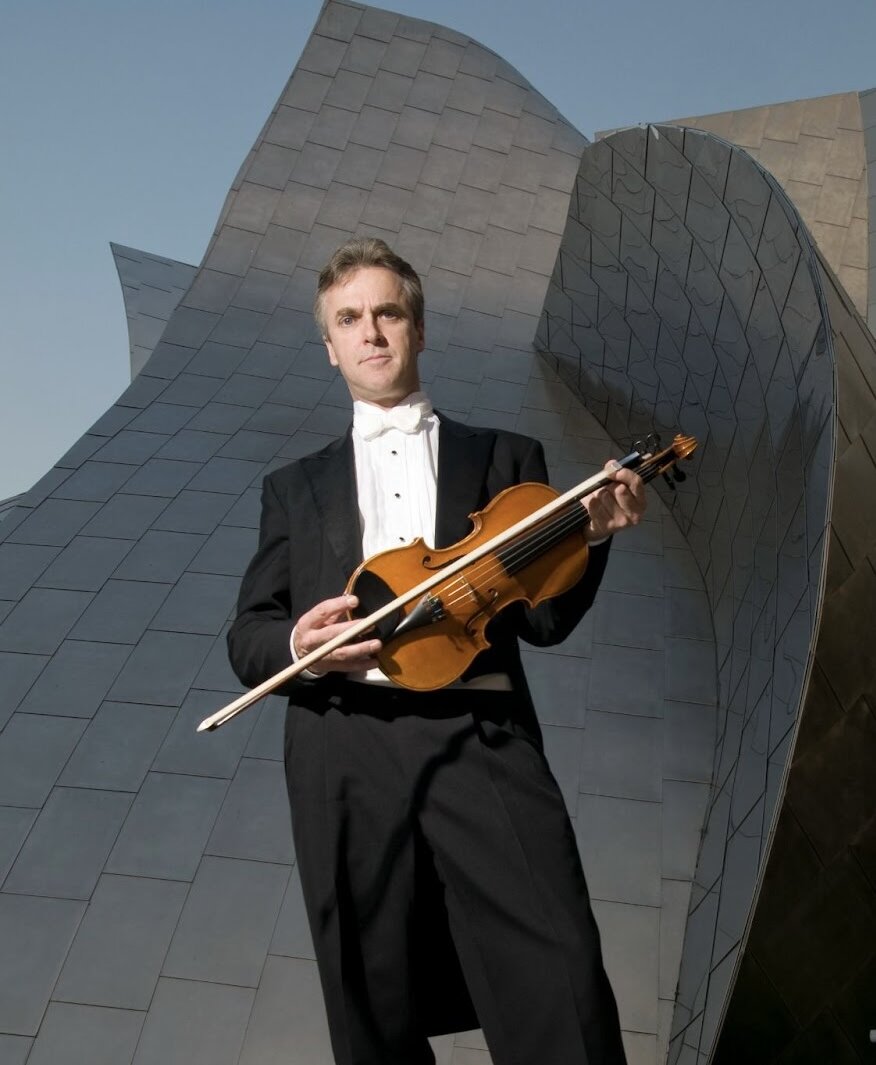
On April 12, Los Angeles Philharmonic’s Principal Concertmaster Martin Chalifour took the Walt Disney Concert Hall stage with his violin for one of the last times in his career. The renowned violinist is retiring after 30 years with the L.A. Phil as the Principal Concertmaster, leaving behind a legacy of passion for growth and continued development of the world of classical music.
Chalifour, a native Canadian who grew up in Montréal, Québec, did not have a traditional introduction to the world of music. “I came from a path that doesn’t usually lead to world success. My parents were not musicians, and they were just looking for a hobby for the kids,” Chalifour said. With that said, his parents decided to put Chalifour in music lessons. “We had a little upright piano, and they decided to look for a piano teacher.”
Chalifour took piano lessons casually, initially learning by imitation and playing by ear. When he got to age 15 and improved his playing, his teacher recommended that he finish schooling at home to focus on his studies. “My mom was more of the hands-on one of my parents, and she said ‘No, absolutely not,’” in response to the home-schooling suggestion. Little did she know, Chalifour would go on to be accepted into the Curtis Institute of Music in Philadelphia, Pennsylvania – one of the most prestigious and exclusive music schools in the world.
Following his time at the Curtis Institute of Music, Chalifour was offered a chance to audition for the role of Assistant Concertmaster at the Atlanta Symphony. After a few weeks of preparation, Chalifour made it through every round, ending up as one of two finalists. By the end of the week, he was chosen for the position and spent six years in the symphony.
“I had two offers to go to Europe to be the number one [concertmaster], two different offers in France and in Switzerland,” Chalifour said. “But I had kids, and my father-in-law was in poor health, so we chose to stay, and I went to Cleveland, which was regarded as the finest, most refined orchestra in the USA.” He spent five years at the Cleveland Orchestra.
At last, Chalifour ended up in sunny Southern California with the Los Angeles Philharmonic in 1995. “I’ve seen it grow from a very well-meaning orchestra and very talented, but some unevenly distributed talent and motivation.” With the building of the Walt Disney Hall in 2003, Chalifour said, “the orchestra became more proud of itself.” Chalifour was the first person to play a note of music in the Hall when he stood at the base of the 6,134-pipe organ and drew his bow across the strings of his violin, a christening of sorts of the now iconic Downtown L.A. architectural masterpiece.

“Sometimes, as musicians, we’re able to feel as moved by the music as perhaps the audience can be. But sometimes we’re too busy counting,” Chalifour explained. “I remember, we recorded a Mahler symphony, Symphony No. 3. And yes, the audience goes crazy, and they’re on their feet, and they’re moved, and they pay you all these compliments on the sidewalk. I said, ‘Yes, I guess we played well, I remember this, and I remember that.’”
It wasn’t until Chalifour was alone in a car that he decided to listen to the new recording. “By the end of it, it was such an emotional moment, I started crying,” he said as he recalled his soul-stirring interaction with his own musical performance.
There are still many moments and subtleties in the music, however, that only musicians can experience and of which laymen in the audience are unaware. “I have my favorite measures and moments in Vivaldi’s Seasons, where I want to bring out something, and it gives me little shivers each time. I hope the audience knows those moments, and someone enjoys them as much as I do,” Chalifour said.
Judging by the minutes-long standing ovation for Chalifour’s performance of “The Four Seasons”—the iconic violin concerto by Italian composer Antonio Vivaldi—it is clear that many audience members did, in fact, enjoy those moments just as much as he did.
The concert began with Spring, followed by Summer, then Autumn, and finished with Winter. Each season, Chalifour explained, is accompanied by a poem, with lines of each poem projected on the walls of the Walt Disney Concert Hall as the musicians play below. “Nothing is comparable,” he said, “to seeing the words at the moment and seeing what Vivaldi is trying to depict.”
With Spring, sweet songs of birds are captured in musical notes, as well as small winds, murmurs of plants, and festive bagpipes. Summer brings a bolder north wind, a weeping shepherd, swarms of bugs, and fierce thunder of hot mid-year storms. Autumn is ushered in with village peasants celebrating a bountiful harvest. However, “Autumn is actually very violent,” and is later interrupted by a passionate hunt, full of guns, dogs, and horns.

“I love the slow movement of Winter,” Chalifour said of the second-to-last movement of the performance. Winter consists of icy snow, battling winds, and teeth-chattering cold.
The intricacies of the music are abundant, Chalifour explained. “There’s different music for different kinds of winds: the winds from the north, the gentle wind, the crazy wind. And then thunder is being imitated by the strings. And then it’s written in such a way that I see it as ‘thunder,’ and Vivaldi writes ‘thunder.’ And normally it’s played just loud. But that’s not thunder, thunder normally starts soft and grows like a lion’s roar and finishes.” All of these layers within the music are key to understanding and completely appreciating the fullness of the listening experience, as revealed by Chalifour.
Looking back on his career, Chalifour is focused on leaving a legacy of growth. “I’ve always rooted for the orchestra to get better and better and to take things seriously, and my wish has come true,” he said. “I think each new hire that we do inspires the younger generation, so everybody keeps bringing a new and higher level of excellence. It was time. It was time for me to take a rest and let the curve continue.”
He hopes that this curve will not only continue within the orchestra, but also within its audience. “I hope that, economically and culturally, [music] will continue to have its importance in the city and elsewhere. Because it’s essential, and music and arts should be part of health care, and available to everybody.”
Chalifour will finish his season with a final concert on September 4, 2025, at the Hollywood Bowl, but his final solo performance will be of Vaughan Williams’ “The Lark Ascending” on July 24, 2025, also at the Hollywood Bowl. Tickets can be purchased on the LA Phil’s website.
