


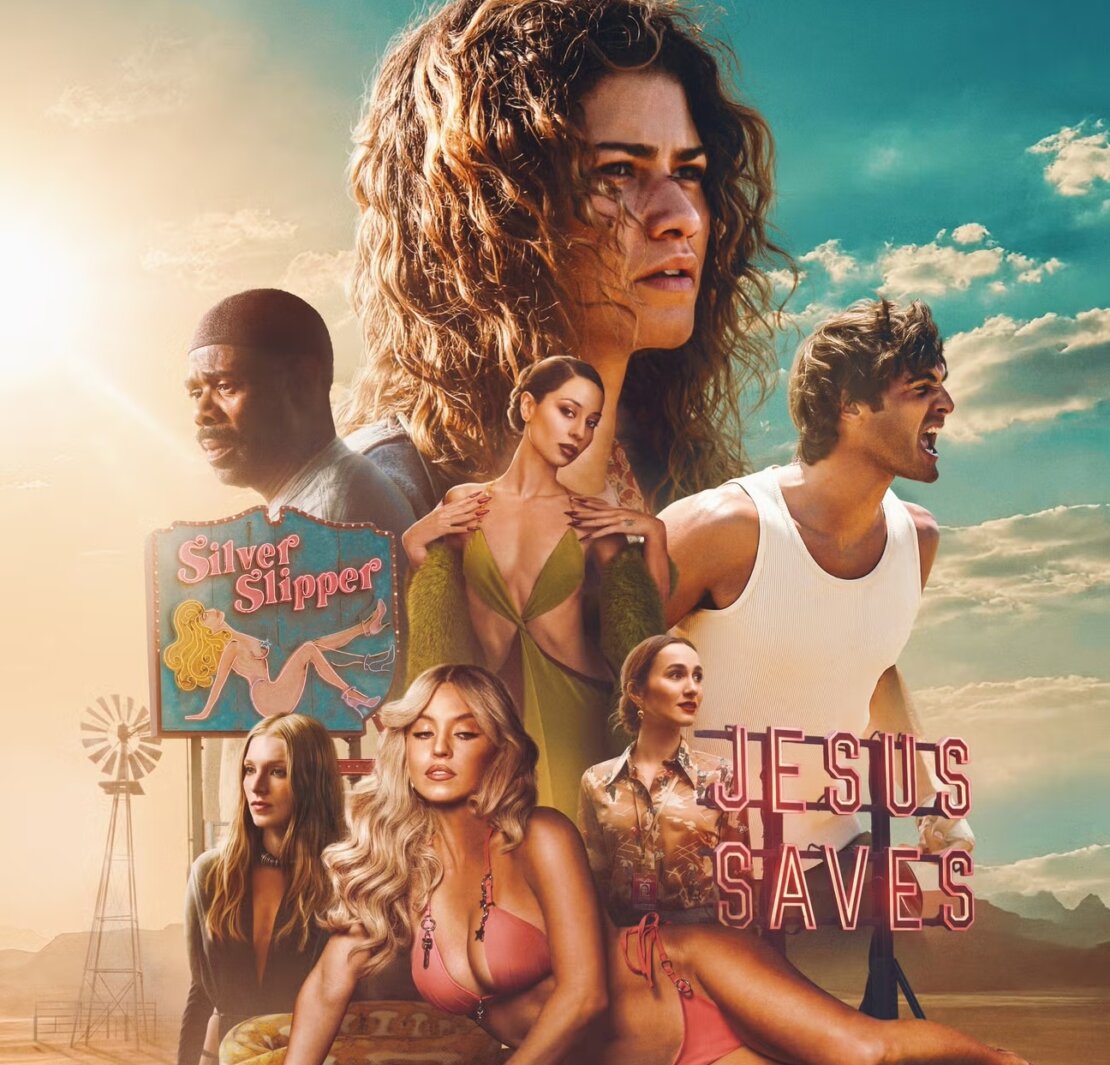
Euphoria has been surrounded by controversy since its release in 2019. It’s been accused of glorifying serious topics such as drug addictions and criticized for its emphasis on sexual content between underage characters. Seven years later, Euphoria’s long awaited third season has finally premiered and is under more scrutiny than ever before. Rue Bennett (Zendaya), the main character of the series, puts it best when she hits rock bottom, “this is the part where the character never recovers.”
The four years between season two and three forced the show’s creator, Sam Levinson, to make changes to his original script for season three. Some of the original cast did not return due to scheduling conflicts or creative differences, such as Storm Reid’s Gia and Barbie Ferreira’s Kat. Levinson’s solution was to simply write them off and pretend they were never there in the first place. Actors pushing 30 can no longer pass for high schooler characters. As a result, season three takes place after a nondescript time skip.
HBO’s Euphoria was based on an Israeli show of the same name created by Ron Leshem in 2012. While the exact plot was not stolen from its predecessor, its premise is virtually the same; a group of teenagers deal with the harsh realities of life, focusing on sex and drugs. Artist and photographer, Petra Collins, alleged that HBO and Sam Levinson used her ideas for the show. Collins told Punkt that Levinsion, “reached out my agency and told [me], ‘I wrote a show based on your photos. Will you direct it?” Collins agreed but was later fired for “being too young.” Season three is the show’s first season where Levinson has near complete creative control. Without outside influence, the show has gone from a story about troubled young people, to exploiting their experience for shock value.
Cassie Howard’s arc across all three seasons, portrayed by Sydney Sweeney, best illustrates this shift. She starts off as sweet yet misunderstood; as she is vehemently slut shamed by men—most aggressively by Nate Jacobs (Jacob Elordi). In season two, she starts sleeping with him. Cassie changes everything about herself to reflect Nate’s desires, going as far as to tell him, “I belong to you and I will never complain because I trust you know what’s best.” When Nate asks her if she’s worried others will look down on her, she responds, “at least I’m loved.”
Nate, however, is known for his cruelty. He physically and verbally abuses one of the other central female characters, Maddy Perez (Alexa Demie), in season one and threatens her with a gun in season two. He only values women in relation to his extreme standards of femininity, which is described at length within the show’s first season. If he truly does love Cassie, it’s only because she’s willing to change herself to fit into his carefully curated fantasy.
By season three, Cassie and Nate are engaged and are living a, “right wing suburban bubble,” according to Rue. Cassie makes content for social media because Nate controls her finances. In episode one, her housekeeper films her dressed as a dog. The shot opens in a close up and zooms out to reveal Cassie sitting on top of the doghouse, her back facing the camera as she barks and “wags her tail.” She claims her videos aren’t pornographic when Nate calls her a “prostitute.” In reality, Cassie is making fetishized content that borders on the line between what traditional forms of social media allow.

Instead of condemning Nate for essentially trapping Cassie in their relationship, the show glorifies OnlyFans, a subscription-based social media platform primarily known for adult content, as a place for women to be their own bosses and make their own money. The show frames this as empowering for Cassie to take control of finances. The rest of the female cast follows a similar pattern: Jules a sugar baby, and Maddy rumored to become a madame later in the series. Instead of telling a meaningful story about how and why women turn to sex work, Levinson is more interested in simply showing sex on screen.
Season three feels more in line with Levison’s other HBO show, the critical failure that is The Idol, than it does Euphoria. While the show’s success begged for another season, Levinson’s inability to recapture what made it compelling—and his thinly veiled exploitation of its female characters—makes it hard not to wish we’d left Euphoria in the past.
