


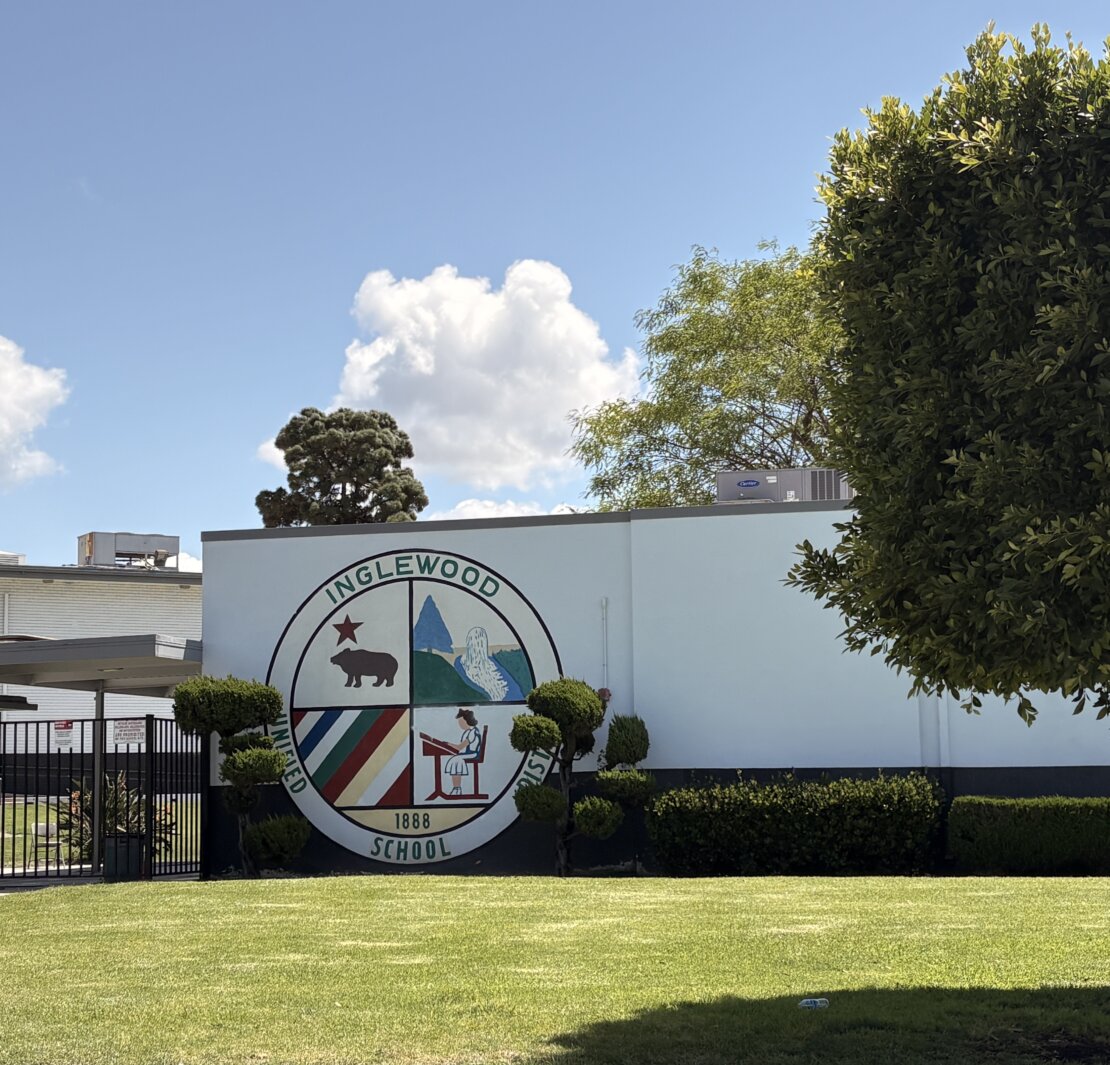
Every other Saturday since 2022, Inglewood High School’s Upward Bound program has held tutoring and enrichment activities for a group of eligible students who were accepted into the program. That abruptly ended in December when Loyola Marymount University, the program’s affiliate school, discontinued its Upward Bound program. Upward Bound provides academic tutoring and college counseling to first-generation low-income high school students to prepare them to pursue higher education, run by affiliate colleges and universities.
“It put me on the right track,” said Amaya Hazard, a senior at Inglewood who had been in LMU’s program since 10th grade. “It definitely kept me more focused and kept me grounded throughout high school.”
Harmony Kemp, an Inglewood senior, was in the first cohort of students at the high school who participated in LMU’s program.
“I learned a lot from the program. I really connected with the administration,” said Kemp, who has been in the program since she was a freshman.
Like most Upward Bound students, Hazard and Kemp were in the program for most of high school.
Upward Bound programs nationwide were thrown into disarray after the Trump Administration proposed massive funding cuts in 2025 and followed through on them in 2026. The funding loss affected more than 43,000 of the more than 73,000 low-income and first-generation students who relied on the program to access college. The U.S. Office of Management and Budget defended the cuts, calling the programs in a statement “relics of the past,” while Secretary of Education Linda McMahon argued that low-income students no longer face hurdles to reach higher education.
Supporters of the cuts point to figures that show the number of first-generation college student applications has steadily increased since 2013. The mission of these programs, they say, is over, and the $350 million in federal funds these programs used should go elsewhere. Supporters also say these programs participate in discriminatory racial and ethnic quotas that promote DEI. But this isn’t the full picture.
Upward Bound, part of the federally funded TRIO programs, was created in 1965, one of President Lyndon B. Johnson’s “War on Poverty” initiatives to increase college access and retention for first-generation low-income students. The programs are not explicitly minority-serving. Rather, they serve students in their communities.
The challenges first-generation students face have not changed, say critics of the cuts.
“As a first-generation college student, you do not have any parents or usually any guidance on how college works because nobody in your family has gone to college,” said Kacey Daniels, a researcher and executive director of student services at Redlands Community College in El Reno, Oklahoma. Daniels has studied the effectiveness of Upward Bound programs on students in central Oklahoma.
Daniels’ research found the program had clear benefits for participating students.
“A lot of them felt like they were prepared for college academically,” she said. “They felt like navigating college was a bit easier.”
A study by the Pell Institute for Opportunity in Education found that students in an Upward Bound program are 50% more likely to obtain a bachelor’s degree.
Besides the academic preparedness, students in Upward Bound also build relationships.
“They let me build a very close-knit community…We’re all different people in some ways, so we got to learn more about each other. There were a lot of bonding activities,” said Hazard. She lived on LMU’s campus with students from other schools for six weeks in the summer of 2025 as part of the program.
“Students do feel like they have a community and a sense of belonging, and I think that’s a huge thing of what you do need when you’re in college,” said Daniels.
Since the Trump Administration pulled funding for programs nationwide, more than 120 TRIO programs have been shut down.
Institutions could avoid denials of their grant applications by removing language flagged by the Administration as DEI, such as “minority” and “underrepresented.”
Even for the programs that survived, the actions have caused stress. The Upward Bound program at Redlands Community College, which Daniels ran for 10 years, was not cut, for example.
Still, said Daniels, “It’s created a lot of fear.” Staff worry they may lose their jobs, while families are uneasy that their children’s best access to college may suddenly go away.

“I feel very upset and saddened at the fact that my little sophomore friends, my sister, can’t participate in that program,” said Hazard. “They don’t get to experience the same community that I did, the same network, especially the same growth.”
“I wanted to cry,” said Kemp. “It’s like losing a parent.”
LMU deleted its Upward Bound and Upward Bound Math & Science websites.
“LMU carefully considered all available options regarding the Upward Bound grants,” said an LMU spokesperson via email. “Ultimately, logistical and financial constraints made a successful restart impossible.”
“The academic advisors on campus that we used to see all the time are gone now,” Hazard said. “There are other college prep programs there, but it definitely still isn’t the same.”
“All the kids that really need this program are going to miss out on it,” said Kemp.
Hazard plans to attend Spelman College in the fall to study political science. Kemp will attend Pitzer College to study neuroscience and theater.
The Department of Education did not respond to a request for comment for this story.
