


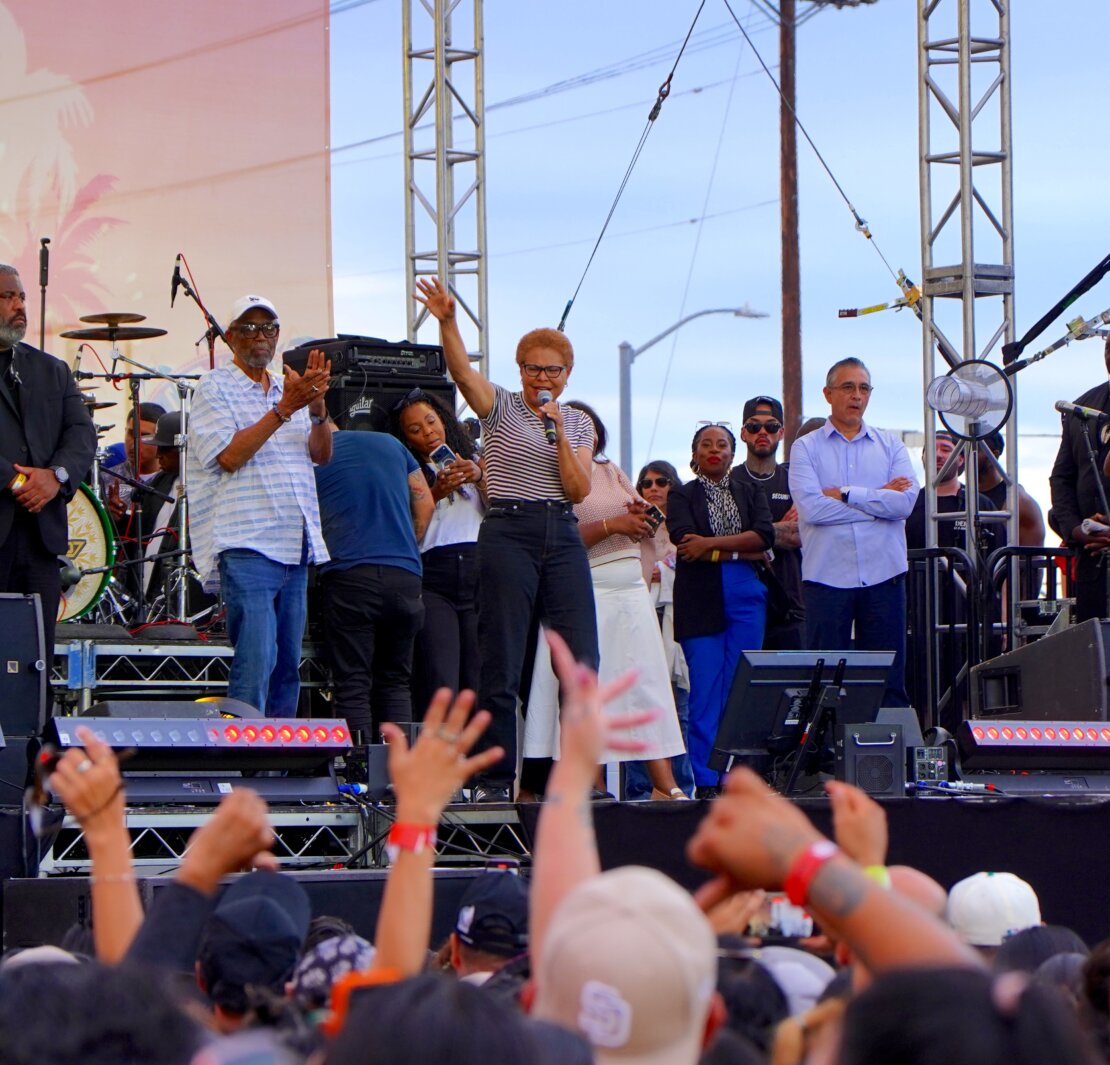
As Mayor Karen Bass stepped onto the stage at a Council District 9 candidate forum in early October, residents cheered and sang “Happy Birthday.” As a native of South LA and the place where she began her career, Bass was met with a warm welcome.
District 9 has had a Black council member since 1963, but both November candidates are Latino, and the incumbent, Curren Price, leaves in December.
A week earlier, Bass was shouted off stage at the second annual Latino Carnival in South LA, hosted by Councilman Price’s office. As she began speaking, boos rose from the crowd, and she left the stage about 10 seconds after taking the microphone.
With just a day until the election, an Oct. 28 Berkeley/L.A. Times poll reveals Bass and Councilmember Nithya Raman neck and neck, with 40% of likely voters supporting each and 19% of likely voters still undecided.
But the numbers show some slippage at the edges of her base. Bass leads among Black voters 71% to 13%, with 15% undecided, and 73% of those who voted for her in June still support her, though 16% now say they’ll vote for Raman. Among Latino voters, Raman holds a narrow lead, 43% to 40%, with 18% undecided. While Bass’s base may not leave, it’s unclear how motivated Black and Latino voters are to show up.
John Abedi, 31, is a property manager and leader with Youth4Bass, an organization that has supported the Bass campaign since she first ran for mayor in 2022. Abedi canvassed for a day in South LA—a neighborhood Bass won comfortably in June—and found the majority of residents either backed Bass or said they weren’t voting.
“She’s working on homelessness big time,” Abedi said to one resident hidden behind his steel screen front door.
“No she’s not,” the man interrupted forcefully. “Look around.”
“There’s been an 11% reduction-” Abedi said before being interrupted again.
“I don’t see 11%… I want to see 50%,” the man said.
“Stats can always be manipulated,” said Abedi, “And people’s experience, you can’t negate that… a feeling is more important than a stat.”
According to the Los Angeles Homeless Services Authority (LAHSA), the number of homeless people living in LA rose 3.4% from 2025 to about 45,000, with unsheltered homelessness rising 7.9%.
The overall homeless count is the total number of people experiencing homelessness on a given night, including people in shelters and unsheltered people living outside. The 17.5% Bass touts is the two-year drop in unsheltered homelessness through 2025, and blames federal budget cuts for the increase in 2026.
Al Bailey, 29, of Inglewood, works in advertising. He didn’t vote in 2022, and remains undecided.
“I want to understand the metrics that [Bass] has for her progress in homelessness,” said Bailey. “How are we measuring this?”
The Berkeley poll shows Bass at 15% among voters 18-29 compared to Raman’s 69%, and 55% among those 65 and older. Among Latinos 18-49, Bass holds just 25% versus Raman’s 63%, but 47% of those 50 and older, compared to Raman’s 32%.
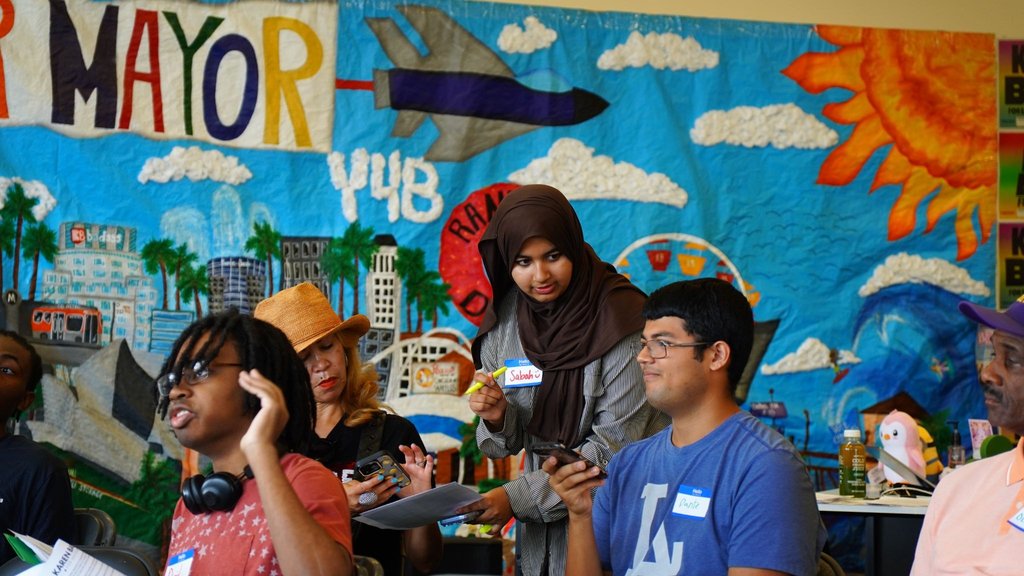
Sabahat “Sabah” Nabiha, 22, is a Bangladeshi immigrant raised in LA and co-founder of Youth4Bass. She’s not convinced by September’s poll numbers, which had Bass at 4% in that age group.
“It doesn’t seem like 4% of our age group are going to vote [for Bass]… It’s higher than four,” she said, pointing to volunteers at the youth headquarters, estimating there were more than 60 participants that day. “If there’s anything that I want to do, it’s to make sure that it’s higher than 4%.”
“This time it feels like I’m fighting for the soul of my city. I’m fighting for what LA was for me when I was younger,” she said.
Nabiha explained that some of her “volunteers are hardcore Trump supporters, but at the same time some of my other volunteers are hardcore anti-Trump.”
The latest poll shows 41% of voters who backed Pratt in the June primary plan to support Bass, while only 14% favor Raman. However, 45% of those voters are still undecided, down from 63% in September.
“She has a broad appeal because she cares about every community from San Pedro to San Fernando Valley,” said Nailah Malik, a long-time elder of Second Baptist Church of Los Angeles in South Central LA.
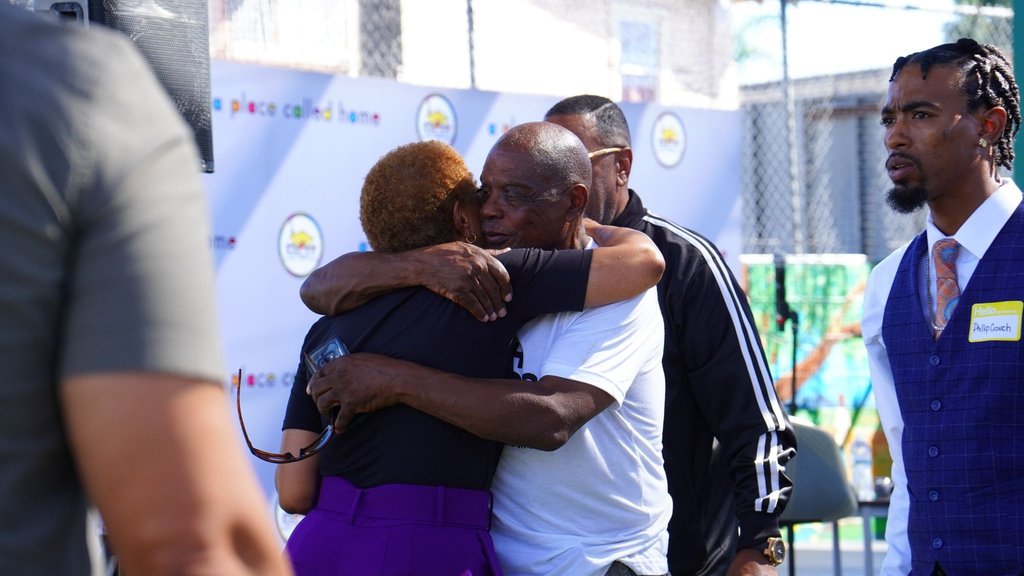
Other voters in her base are less sure, like Rodney Barnes, over 60 years old, and a vendor in Leimert Park. He didn’t vote for Bass in 2022, but will vote this November to choose “the lesser of the two evils.” Barnes, an avid Pratt supporter, criticized the city’s approach to homelessness, saying, “They spent billions of dollars, and it’s getting worse.”
Diana Dean, 38, a member of Alliance of Californians for Community Empowerment (ACCE) Action, a social justice nonprofit, lives in Council District 10 and said she once knocked on doors for the mayor.
“We just loved the ideas that she had and the vision that she had for LA,” Dean said. “But at the end, nothing of that ever happened.”
She said she and fellow members pressured Bass on rent and eviction protections and left a June meeting with the mayor unsatisfied. Dean now hopes Raman wins. “At least she gives a damn,” she said.
Raman calls these feelings a “broken status quo” and has been trying to leverage widespread discontent to fuel her campaign. After the Lineage warehouse fire burned for eight days in Boyle Heights, residents booed Bass at a July town hall.
Bass had Boyle Heights’ support in the primary just two weeks earlier, and Raman said in an interview that she believes, “many residents saw this mayor’s response to the Lineage fire as a real abandonment of a Latino community that needed her.”
When asked about Black voters, she was candid. “I don’t expect that residents of this city, including Black residents, will trust me immediately,” she said.
Undecided voters will decide the election. Turnout in June rose 31% from the 2022 primary, but residents in South LA still vote at lower rates than the Westside and Valley. The final Berkeley poll conducted in 2022 before Bass’s first election as mayor understated her margin of victory. She led 45-41 in the poll and went on to win by nearly 10 points over Rick Caruso at 54.8% to 45.2%.
