


After visitors walk through a set of double doors, they’re greeted with sanitization stations and rows of shoe covers, quiet signals that everything inside is meant to stay clean and calm. Beyond the doors, cats peer through small openings and perches, watching each new arrival.
A kitten named Kanon, wearing a red collar and nursing a weeping eye, lingers near the entrance before cautiously approaching visitors.
Warm sunlight filters through a large window, spilling over colorful decor that makes the space feel like home. Tea and coffee are available in a small corner kitchen area, while cats move freely between spaces, jumping from couch to perch and eventually landing in a visitor’s lap.
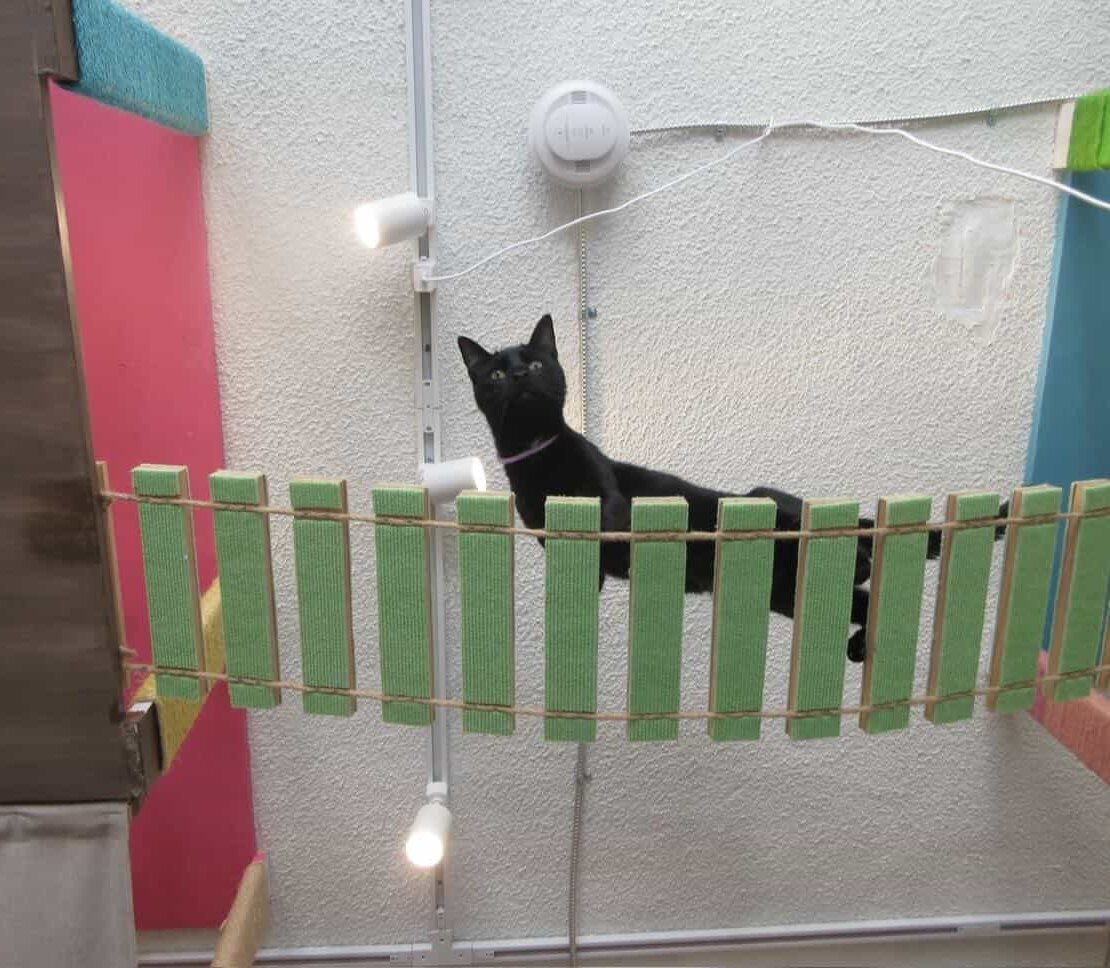
Above the seating area, a black cat named Micha, wearing a purple collar, watches from a cat bridge before leaping down to weave between guests. Each cat wears a colored collar for identification, but it’s their personalities, not their labels, that shape where they go next.
Cat cafes are surging across the United States, with dozens of new locations opening in nearly every state. Originally popularized in Asia as spaces for stress relief, most of these cafes are now run as nonprofit partnerships with local shelters in response to rising cat overpopulation. Supporters say the cafes give people a unique way to connect with animals before bringing them home, while also providing space for cats that may have been strays or without shelter.
“You actually get a chance to interact with these cats… and develop a relationship with that animal before deciding to adopt,” said Alistair Whatley, founder of CafeWithCat, a directory of cat cafes across the United States, United Kingdom, and Canada.
Unlike traditional shelters, where cats are often kept in cages, cafes allow visitors to interact with them freely before making a decision to adopt.
The world’s first cat cafe opened in Taipei, Taiwan, in 1998. The concept grew in Japan, where cat cafes became spaces for visitors to relax and interact with the animals.
“In Japan, it’s all one experience. You go in, you get your drink, you hang out with the cats,” said Whatley.
Pet cafes spread globally and reached the U.S. in 2014. A four-day pop-up hosted by Purina ONE in New York City opened on April 24, 2014. Later that year, the first permanent U.S. cat cafe, Cat Town Cafe, opened in Oakland, California.
While cat cafes have existed in the U.S. since 2014, growth was relatively slow until recent years. More than 50 new cafes opened in 2023, 56 opened in 2024 and more than 40 in 2025. As of early 2026, there are an estimated 270 to 300 cat cafes across the U.S., with counts varying as locations open and close.
Reservations are often required, and policies vary by location, including whether food is allowed in cat areas.
“They’ll frequently partner with these rescues and take a lot of overflow cats,” said Whatley.
The growth of cat cafes is tied to a larger issue: cat overpopulation and crowded shelters. According to the Humane Society, 3 to 4 million cats enter animal shelters every year, and at least half are euthanized. Many cafes and rescue partners aim to raise awareness and encourage community involvement in addressing the issue.
“Their main focus is trap-neuter-return (TNR), but they also take in cats for foster care, including abandoned friendly cats, highly social cats from colonies, kittens, and animals with medical needs,” said Jena Carr, co-owner of Cool Cat Collective, a cat-themed boutique in Long Beach, California, with adoptable cats. “These cats are first placed in foster homes for quarantine and medical care, including spay or neuter surgery, vaccinations, microchipping, and deworming, before being made available for adoption and, if space allows, placement in the cafe.”
Animal surrender rates remain high due to factors like veterinary costs and housing restrictions that prevent renters from keeping pets. “Seventy-five percent of veterinary practices have been bought by private equity, and that is really increasing the cost of that care across the board,” said Carr. In some cases, immigration enforcement situations also contribute, as individuals may be forced to leave pets behind if they are unable to take them during relocation or deportation.

These challenges contribute to cat overpopulation, as unmonitored breeding can begin as early as four months of age, further increasing stray populations. A single unspayed cat can have more than 100 kittens in its lifetime. As a result, more kittens are born than there are homes to support them, especially during “kitten season,” when shelters see a surge of newborns, many born outdoors.
So while adoption rates aren’t rising significantly, cat cafes are expanding how cats find homes within a much larger system dealing with overpopulation.
Even within this system, some cats that enter the cafe are adopted faster than expected, especially those with the distinctive story or needs.
“Interestingly enough, sometimes our higher medical cats get adopted really fast, like cats who have a story that people find really compelling,” Carr said. She remembers a three-legged cat who had a front leg amputated and was adopted quickly, along with another cat named Bucky, who had one eye and was adopted within five days.
While some cafes accelerate adoptions, others focus more on long-term adjustment and socialization. At The Kitty Crib, owner Kim Dalluge said the environment is designed to help cats gradually become more comfortable around people, while also making the space more accessible for visitors.
One cat named Lime, who was initially reserved and avoided interaction, slowly became more social over time.
“He would come and maybe mingle for a few minutes. And then he’d go back up to his perch,” Dalluge said. “But now he will jump on your lap. And he is actually in a foster-to-adopt home.”
