


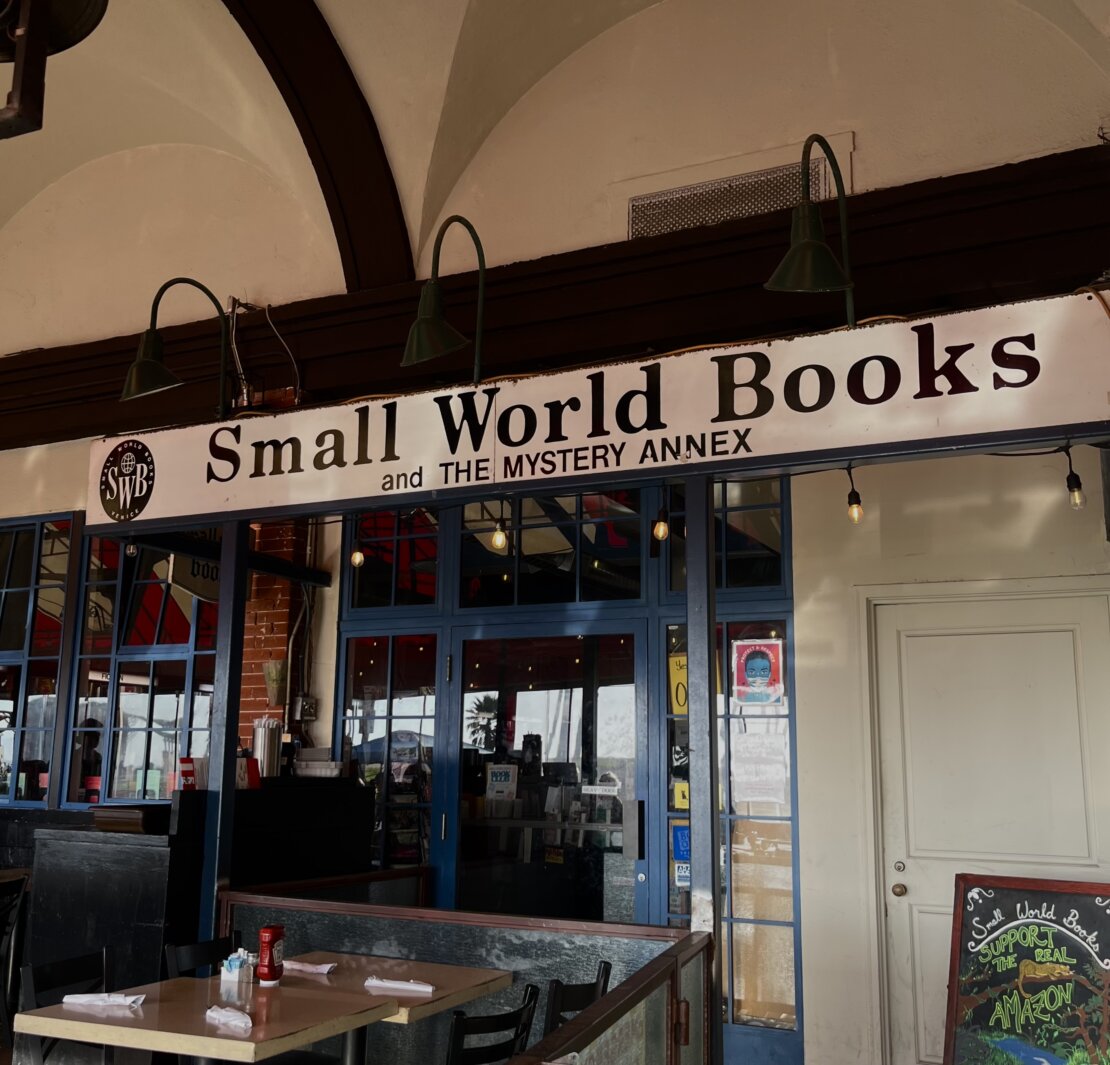
Nestled between an overpriced coffee shop and a shop selling rows of tops with pretentiously placed ‘Los Angeles’ prints, Small World Books offers passersby an unexpected collection of books, food and shelter cats awaiting cuddles. Its location makes it prone to odd encounters—so many that manager Adam Lipman stated that the “uniqueness has become normal.” Having worked there for 11 years, Lipman has shaped the bookstore into what it is today.
Founded in 1969 by Mildred Gates and Mary Goodfader, Small World Books calls itself a “purveyor of odd literature”—and for good reason. According to Lipman, a heavy percentage of the books in the store are personally curated by the people working there.
“I mean, we hire people who like to read, and they have specific tastes, and because we’ve been reading for so long, I guess it’s easier to go, ‘Okay, this is cool, and this is not.’ Yeah, it’s all according to us, I guess.”
This philosophy is what sets this store apart from corporate retailers. Unlike big-box stores that only care about their profits, this shop boasts about its huge variety.
But the reality is that owning an independent bookstore in 2025 is no small task. Across the country, bookstores have been closing at an alarming rate with U.S. Census reports stating that between 1998 and 2019, the number of independent bookstores in the United States have decreased by nearly half, from 12,151 to 6,045. What was once a vibrant community is now a shadow of its previous self, unable to compete with Amazon’s discounts and same-day shipping.
“Amazon hurt us a little bit,” Lipman said. “We struggle with Amazon because it’s just easier, and they don’t have—they can afford to cut prices.”
This isn’t just a Small World Books problem. Bookstore owners across the U.S. have spoken out about how Amazon’s stranglehold on publishing has made survival nearly impossible. By controlling both distribution and pricing, Amazon has put independent bookstores at a severe disadvantage.
Publishers, too, feel the effects. Large and small publishers alike have become reliant on Amazon—often forced to sell their books through the platform even if it means shrinking profits. But while Amazon is good at mass book sales, Small World Books and other indie bookstores have chosen a different path: curation, expertise and community.
“Amazon can buy everything in a warehouse, but we can be more specific in terms of what we curate,” Lipman said.
With rows of translated books, small-press publications, books by people of colour and LGBTQIA stories, the store refuses for books to become a disposable product.
This philosophy extends beyond curation—it is about ensuring that books that deserve recognition get it. As book bans sweep libraries and bookstores across the United States, targeting literature that challenges mainstream narratives on race, gender and politics, Small World Books has made it a point to rebel against it. This commitment is more significant in today’s political climate, where misinformation and censorship shape public opinion.
“I definitely think that Trump is going to affect how people buy,” Lipman said. “I mean, I would hope so at least. It makes a difference in terms of how people want to be informed and how people want to think about the world. I hope we provide books that they’re interested in that way, in terms of opening up their world and providing an alternative to that kind of ‘person.’”
Small World Books focuses on making diverse perspectives readily available.

“We always try to advocate for books that have been taken off shelves elsewhere,” Lipman said. “We keep track of what’s being banned in other parts of the country and make those books available here.”
Yet, unlike some businesses that frame representation as a selling point, Small World Books doesn’t view inclusivity as a statement—it’s just common sense.
Getting more passionate, Lipman exclaimed, “When you run a bookstore and you’re interested in everything, when you’re interested in human rights and the dignity of all people, then you get those books in the store because you want to hear different perspectives.”
Small World Books has always been iconic, with events attracting stars like Anne Rice, Michael Connelly and Matt Groening—among others. While it no longer chases big-name appearances, the store remains deeply connected to its community through local author signings, book clubs and intimate discussions—keeping it a safe space for a large demographic of Los Angeles.
As independent bookstores fight to survive in a world increasingly dominated by digital convenience, Small World Books stands as a reminder of what is lost when bookstores disappear—not just a place to buy books, but a space where literature, conversation and community come together. A place that gives you a chance to discover a book not because a machine suggested it, but because someone who loves reading placed it on a shelf, knowing it deserved to be found.
For now, Small World Books keeps turning its pages—one unexpected boardwalk encounter at a time.
