


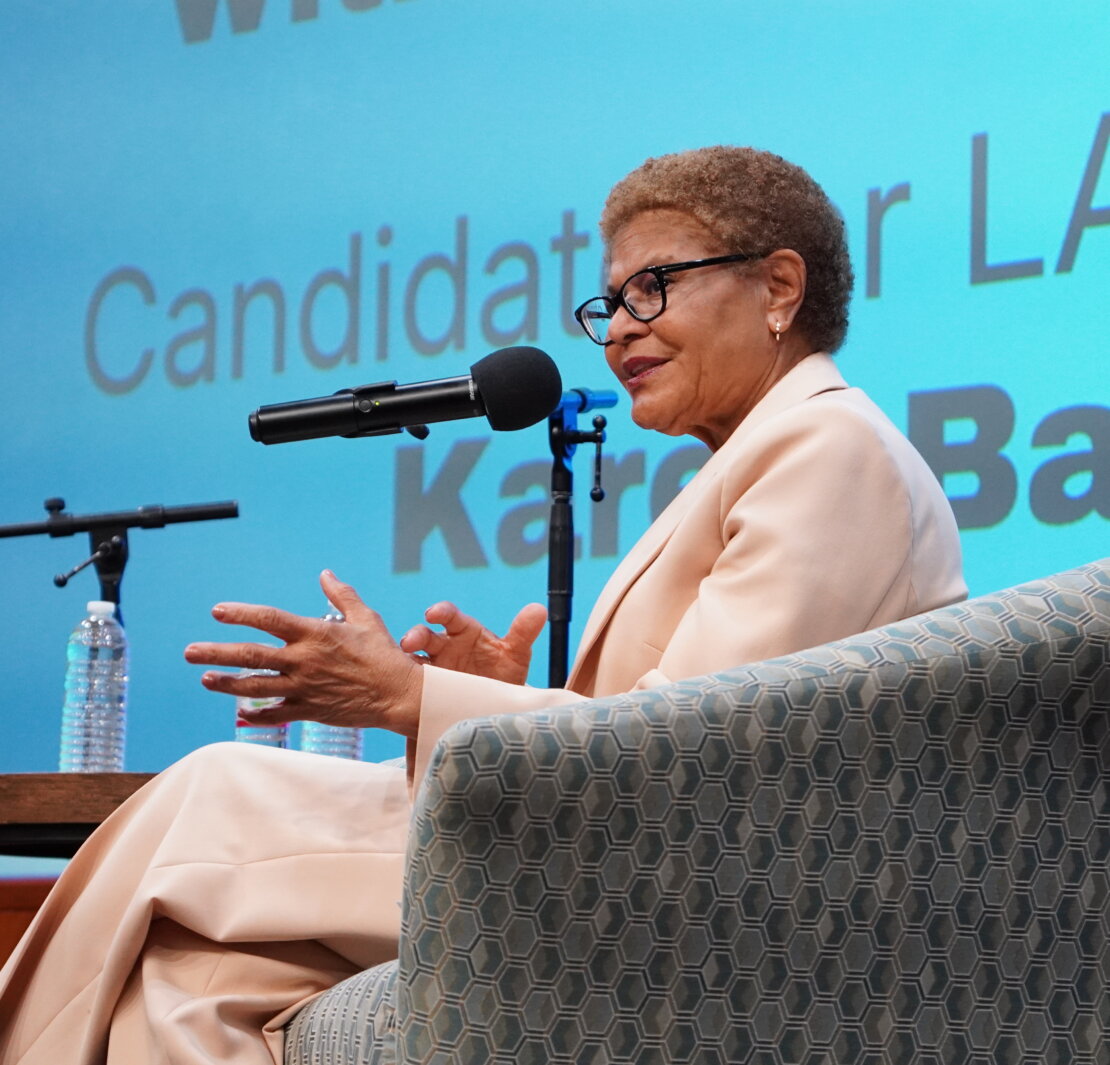
Monday, Apr. 27, LMU hosted the last of its three-part series of Candidate Conversations led by LAist AirTalk’s Larry Mantle, this time, joined by Mayor Karen Bass. Throughout the session, Bass defended her record on wildfire recovery, homelessness, and city infrastructure, while pointing to longstanding systemic barriers she said have slowed progress.
Bass, the incumbent in this year’s election, has been the Mayor since 2022, and has more recently faced backlash for her perceived lack of initiative during the recovery of the Palisades and Eaton fires in early 2025. Mantle addressed this criticism by acknowledging her approval rating, noting that more than half of the people hold an unfavorable view of her leadership.
When Mantel asked what she would have done differently in her post-fire response, Bass responded that there was limited room for preparation due to the unprecedented nature of the disaster.
“I would have to say what I would have done the same,” said Bass.
Bass proceeded to cite the inefficiencies and uncertainties across departments that arose during the crisis, and attributed miscommunication in weather forecasting and confusion about city and state jurisdictions as areas to improve on moving forward. Still, she’s proud of what’s been accomplished thus far.
“If you compare the Palisades to fires in other areas in California, we are way ahead… we’ve issued over 2,000 permits for over a thousand properties,” Bass said.
In a CalMatters report, Devang Shah with Genesis Builders said that using permits as a metric of progress may be premature, contradicting Bass’ statement.
“People can pull permits, but you know, if they don’t have their costs sorted out — we’ve had folks abandon their plans,” said Shah.
The same question of whether Bass’ metrics fully reflect conditions on the ground also came up in her defense of Inside Safe, her signature homelessness program.
This program is another strong point of contention during this election. While her opponents, Councilmember Nithya Raman and Rae Huang, acknowledged its flaws with potential solutions, Bass defended its successes.
When justifying the program’s funding in her new budget proposal, she believes the costs are worth it. “To me, this is the first time two years in a row we have had a reduction in street homelessness. We have cleared over 120 encampments,” said Bass.
Mantle emphasized that approximately 40% of those served by the program still end up back on the streets, challenging the effectiveness and value of a program with such a substantial budget.
“It’s the type of analysis that needs to be done,” said Bass, referring to a way to track individuals served by Inside Safe. “Looking at the 40% that left Inside Safe, we don’t know where they are. That’s one of the problems with the system.”
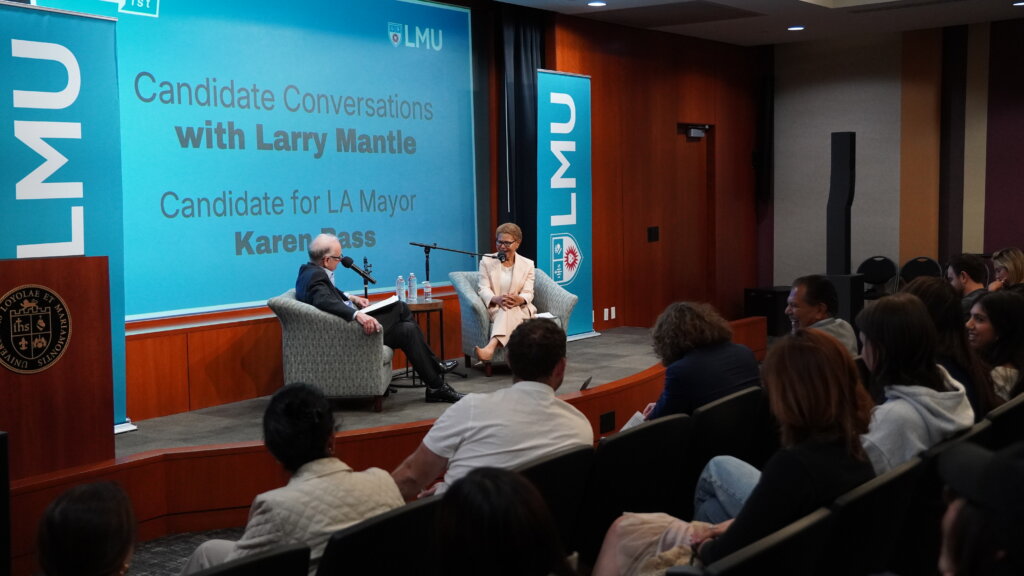
Bass repeatedly framed these challenges as symptoms of deeper dysfunction inside the city government, an argument that became clearer when the discussion turned to infrastructure.
“The city of Los Angeles in many ways functions like a small town,” Bass said. “I come into these areas in the city that have been dysfunctional for decades, and I am addressing them.”
Los Angeles has been lacking a Capital Infrastructure Plan, which would provide an established long-term strategy for prioritizing and funding major physical improvements, including transportation, utilities, public facilities, and other large-scale infrastructure projects.
When an LMU student asked Bass about some of these time-consuming developments of large-scale projects, such as the recent LAX and Metro construction.
Bass responded that “There is so much of our city that is really out of date… and so we did not have a comprehensive infrastructure plan.”

This gap has been used as leverage by Bass’ opponents, Raman and Huang, who both previously emphasized its importance. Raman, in her visit to LMU last week, claimed, “That’s a key intervention that I don’t just want to talk about, I want to implement.”
Bass announced that for the last couple of years, she has been working on this infrastructure plan. “It should be releasing in the next few days, that lays out a method, a timeline, a strategy for how to deal with our city’s infrastructure,” said Bass.
After discussing the infrastructure plan, Bass was questioned about another major planning challenge facing Los Angeles: how the city intends to protect taxpayers as the city prepares to host the 2028 Olympics.
There are concerns that if the city is unable to reach its revenue goals from the LA Games, it leaves the city and, therefore, taxpayers responsible for covering potentially hundreds of millions of dollars.
The city has yet to agree to the terms of its contract with LA28, the local Olympic organizing committee, which would lay out where financial responsibilities lie. In the 1984 LA Olympic Games, for example, there was an explicit ballot initiative to ensure the city couldn’t incur any of the remaining expenses.
Although Bass said the contract has been “basically approved,” it still awaits City Council approval after being reviewed by the City Attorney. Regardless of concerns about meeting revenues for the games, Bass assured, “there’s no evidence that there’s a struggle financially right now,” noting successful ticket sales and fundraising thus far.
Bass’ answers repeatedly returned to the same argument that Los Angeles’ biggest problems, from homelessness to infrastructure, are rooted in decades of governmental dysfunction. As she seeks another term, the question is no longer only what she inherited, but whether her administration has done enough to reform those systems.
