


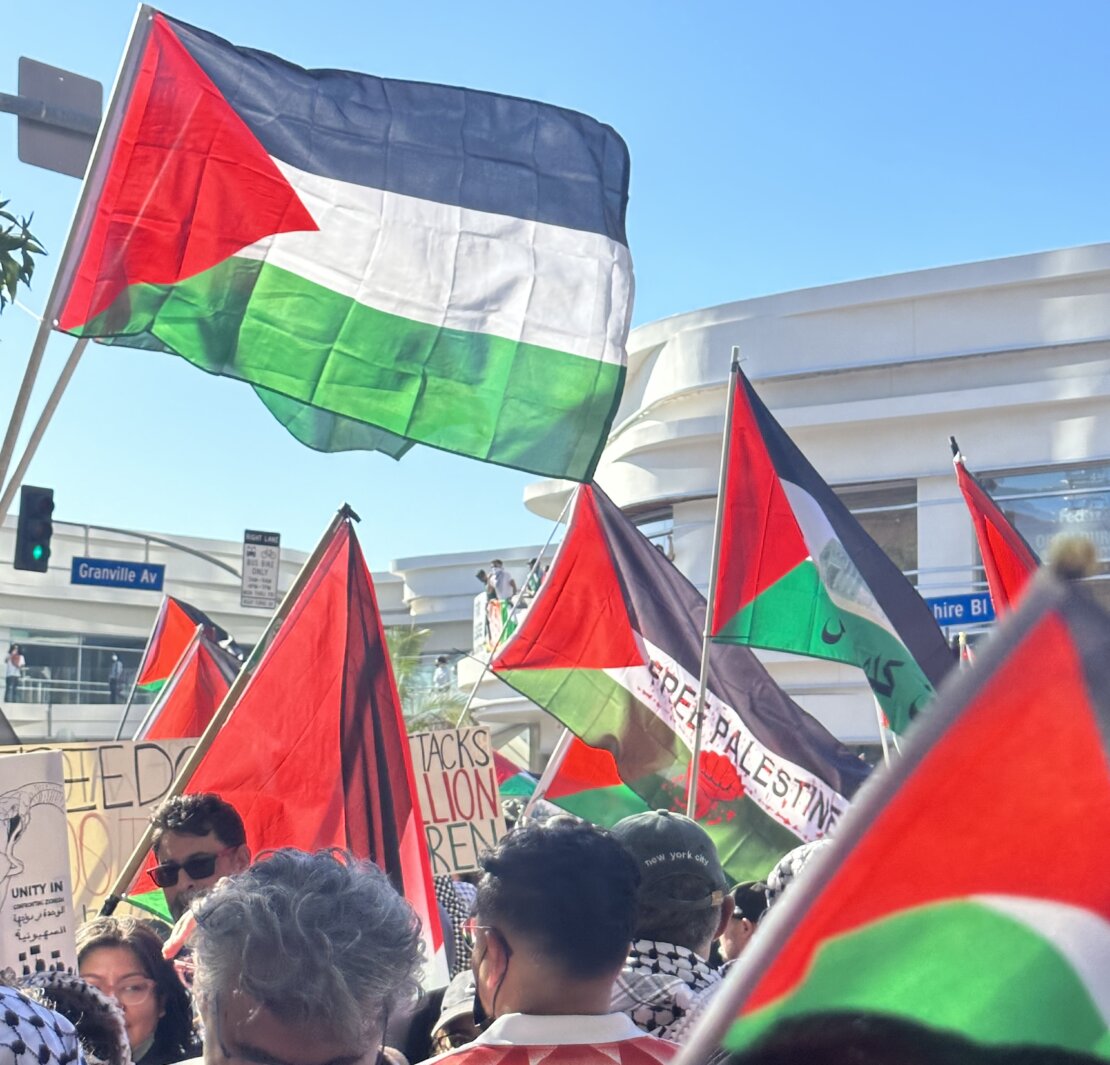
LMU pursues a mission of promoting justice and welcoming students of diverse cultural backgrounds. It has also made a commitment to promoting diversity, equity, and inclusion. Despite these efforts, Arab and Palestinian students say they feel unsupported amid the ongoing Gaza war.
In multiple conversations The Lion had with a range of Arab and Palestinian students from different schools and class years, isolation and fear were continually brought up. Their feeling that LMU wasn’t being supportive of them, they said, was making the stress of the war worse.
“What is happening in Gaza has affected me personally,” said Lana Kayali, a senior Health and Human Science major. “It has affected my social and academic life.”
“It is something I think about consistently,” said David Kandah, a junior Mechanical Engineering major. “It’s been difficult even to complete my day-to-day things…. I was in one of my classes and my mind kept wandering off to what was happening in Gaza.”
Similar feelings were echoed by non-Palestinian Arab students from countries where large populations of displaced Palestinians settled in the wake of the 1948 Arab-Israeli War.
“I grew up in the Middle East, specifically in a large Palestinian community,” said an Arab senior, one of several students interviewed who requested anonymity due to concerns about their safety and well-being. “The amount of people dying is not just a number to me, it is personal…. I have lost family and friends.”
On Oct. 7, Hamas launched a surprise attack on Israel, killing about 1,200 Israelis. In response, Israel began an ongoing campaign of air strikes on Gaza. According to the Gaza Health Ministry, more than 11,000 Gazans had been killed in the strikes as of Nov. 23, though that day was the last the ministry released the number due, it said, to the collapse of the Gaza health system. According to the Gaza Media Office, the death toll exceeds 14,500.
“LMU has responded poorly,” said Seema Kayali, a junior Political Science major. “The school could have been more supportive, [Arab students] were not even given a comfortable platform to discuss our side.”
On Oct. 10, there was a prayer held at LMU’s Sacred Heart Chapel in which LMU “[joined] the global community in denouncing the horrific terrorist attacks against Israel, and by expressing sorrow for the senseless loss of Israeli and Palestinian lives,” according to an email sent to the campus community by LMU Communications. The group prayer has thus far been the only one sponsored by the university.
Muslim Student Life (MSL) held its own prayer service on Oct. 23 for civilians killed in Gaza.
The Lion contacted LMU Communications requesting an interview about the students’ concerns but was told that an in-person interview would not be possible. Instead, the university asked that we email questions so that they could be “[sent] out for a response.” The Lion emailed several questions asking what services and support are available for Arab students, what kind of ongoing dialog the university plans on fostering, and how LMU would respond to Arab students who say they feel the school is promoting biased narratives about the war.
The university responded with a link to the statement by President Timothy Law Snyder that had been emailed to the LMU community 11 days earlier.
In the statement, titled “Affirming our Inclusive Care,” Snyder emphasized stricter federal rules about discrimination on college campuses, condemned discrimination on college campuses, and included a link to LMU resources including the Campus Ministry and the Office of International Students and Scholars.
“I note particularly, and with admiration, the patience and collegiality demonstrated by students, one to another, continually, in support of each other, no matter their backgrounds, origins, beliefs, or politics,” Snyder said. “I continue to have faith that our collective strength, compassion, and resilience will guide us through these challenges.”
The statement did not address the specific concerns raised by Arab students, nor did it provide details on how LMU plans to guide students through these challenges.

Arab and Palestinian students have found support from sympathetic faculty.
“When I broke down to my professor, she had no idea how impacted I was,” said an Arab senior. “After realizing how affected I was, she responded amazingly and told me even if the school does not offer enough support for [Arab students], the faculty would.”
Kayali said that professors with whom she has spoken have been “hesitant” to offer full-throated support. None attributed that to the university, but fears about speaking out are not unfounded.
Students and faculty nationwide are being targeted for speaking out by Canary Missions, a group that, according to their website, “documents individuals and organizations that promote hatred of the USA, Israel, and Jews on North American college campuses and beyond.”
Photos of students’ and professors’ faces are posted on the website along with their names and the area in which they attend or teach school. The Jewish Voice for Peace claimed that Canary Missions is “an effort to intimidate and blacklist students and faculty who stand for justice for Palestinians.”
Arab and Palestinian students here at LMU have called for a platform to openly discuss both sides in an educational setting.
An event held by the Jewish Studies faculty on Oct. 19, called “Understanding the Israeli Perspective on the West Bank and Gaza,” was co-sponsored by Academic for Jewish Religion/CA (AJRCA), the BCLA’s Dean Office, Catholic Studies, the English Department, Hillel, and the Philosophy Department. It featured Political Science and International Relations Prof. Evan Gerstmann leading the conversation.
“The talk was biased and only showed the Israeli perspective, and as an academic school, that is disappointing,” said an Arab junior. “We expect that LMU offers an actual informational conversation discussing the history and both sides.”
Kayali added that the talk “alienated” many Arab students she knew.
“We want acknowledgment from the school on what is going on,” she said. “We Arabs have found ourselves educating others; we are the ones who are expected to start these conversations, and as an academic university, our school should be the ones taking on the responsibility of properly educating the student body.”
Yet at the same time, many Arab students said they feel unsafe discussing the war and expressing their feelings about it. This is particularly true for international students, many of whom are in the U.S. on an F1 visa, which allows them to temporarily live in the country while at university.
“As an international student, it is hard to be as politically active because of our visa status,” said an Arab senior. “I remember coming to this school trying to join a Palestine club, but there was not any…. I was also reminded to be careful with what organization I join on campus because of my visa.”
Several international Arab students told The Lion that they’re reluctant to publicly condemn the U.S. government’s ongoing support of Israel’s bombing campaign because they believe there could be serious repercussions.
“We fear that we can be sent back to our country because of our visa,” said an Arab sophomore.
Arab students who are U.S. citizens shared a different sentiment.
“Because I have my citizenship, I am not as scared to speak out,” Kayali said. “I have faced challenges on my views, but that has not hindered me.”
Kienan A. Taweii is the current Muslim Chaplain Interfaith Coordinator and advisor for the Arab Student Association, and he says he’s supporting Arab and Palestinian students in recent weeks.
“MSL just co-sponsored a panel talk on Understanding the Modern History of Palestine featuring several faculty members offering their scholarly perspectives on the conflict,” Taweii said of an event held on Nov. 14. “I am working with our Arab and Palestinian students to plan programs to provide them community and support.”
That panel discussion, called Understanding the Modern History of Palestine, was led by Profs. Najwa al-Qattan, Gil Klien, and Amir Hussain. It was co-sponsored by MSL; the Arab Student Association; the African American Studies, Chicana/o and Latina/o Studies, Economics, History, Modern Languages and Literature, Women’s and Gender Studies, and the Asian Pacific American Studies departments; and Catholic Studies.
In addition to MSL, students say they’ve found refuge in official university student groups, most notably the Arab Student Association (ASA).
“ASA has been a supportive and safe space,” said an Arab freshman. “Being in this club allows us to take on a shared burden so we do not feel alone in what is happening.”
The Arab Student Association was founded in October 2021. The club’s stated mission is to provide a safe and welcoming space for students to practice their culture.
“I want people reading this to understand that their Arab community members at LMU — especially Palestinians — are going through a challenging time,” Kayali said. “We need the voices of many to support us.”
