


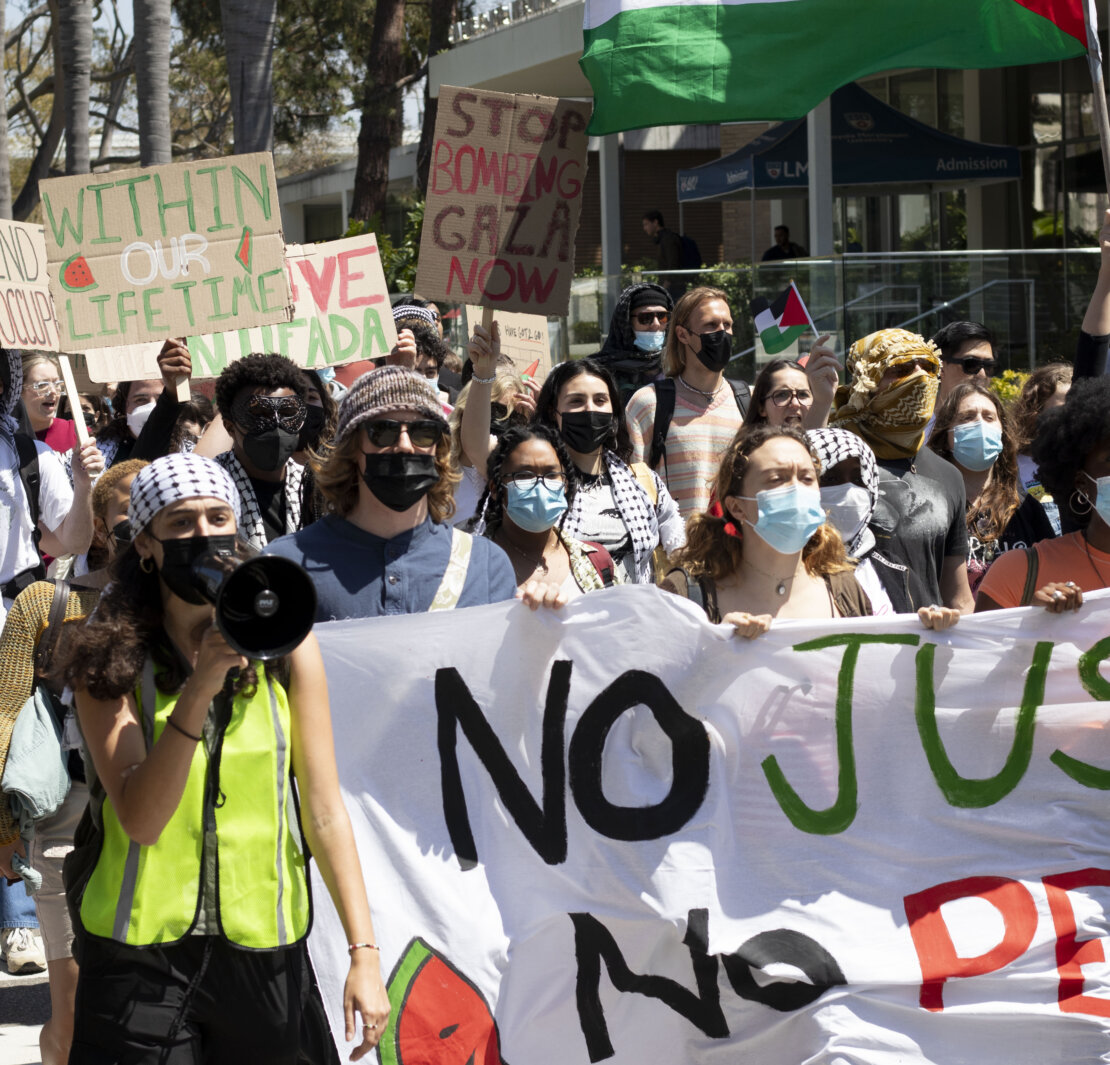
About 100 students joined a protest that snaked across campus Monday, led by LMU’s chapter of Students for Justice in Palestine (SJP).
The protest came after the Palestinian Youth Movement called for a Tax Day action “demanding an end to the genocide in Gaza.” LMU’s chapter of SJP cited their own additional reason for protesting: The recent veto of a pending ASLMU resolution and bylaw to financially boycott companies believed to support Israel’s war in Gaza. ASLMU has an annual budget of $750,000.
“We were going to have the protest regardless of the veto — I want to make that clear,” said senior Film major Meera Macki, the SJP Co-President. “[But it] mobilized a lot of students, [and] students are even more angry.”
On April 4, the ASLMU Senate unanimously voted in favor of the resolution and bylaw; a week later, that legislation was vetoed by new ASLMU President Drew Hartz.
In an interview with the Loyolan last week, Hartz said his veto decision was rooted in a desire to ensure any legislation — bylaws are binding for ASLMU, resolutions are non-binding — reflects the desires of students.
“The decision is just an effort to maintain ongoing dialogue,” Hartz told the Loyolan, “but with all perspectives included in the process so that hopefully ASLMU can serve as a mechanism for uplifting students and a force for unity rather than division.”
SJP Co-President David Kandah, a junior Mechanical Engineering major, said more than 30 student organizations signed a petition endorsing the legislation.
“To say this is not representative of the student body makes me think what kinds of bills would be,” Kandah said.
At about noon on Monday, people gathered at Alumni Mall and began the protest with chants and speeches calling for a ceasefire. They then marched across campus to University Hall.
“We will not rest until you divest,” protestors shouted as they went.
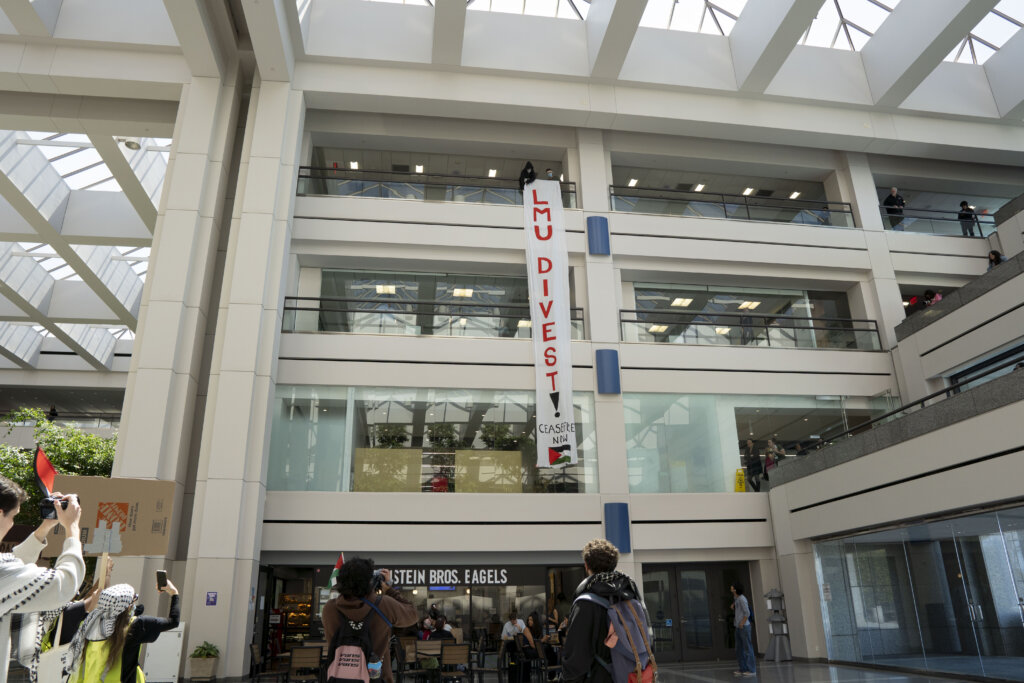
Once at University Hall, members of SJP hung a two-story-long banner from a 4th-floor railing near LMU President Timothy Snyders’s office. The banner read, “LMU Divest! Ceasefire Now.”
“I am a Palestinian-American born and raised in America,” senior Journalism major Sammer Tarazi, the SJP Fundraising Head, told the Lion. (Tarazi was on staff at the Lion in Fall 2023.) “I’m here today to show support and show our campus that Palestinians’ lives matter.”
Following the Oct. 7 surprise attack by Hamas in which 1,200 Israelis were killed, Israel began an ongoing military campaign in Gaza. According to The Gaza Health Ministry, over 33,000 Palestinians have been killed and another 75,600 have been wounded. Additionally, U.S. government officials recently echoed aid agencies and NGOs in declaring that Palestinians living in the besieged Strip are suffering from famine.
“It’s really been heartbreaking every single morning waking up every day, opening your phone, and just reading what’s going on without being able to do anything but raise our voices,” Tarazi said.
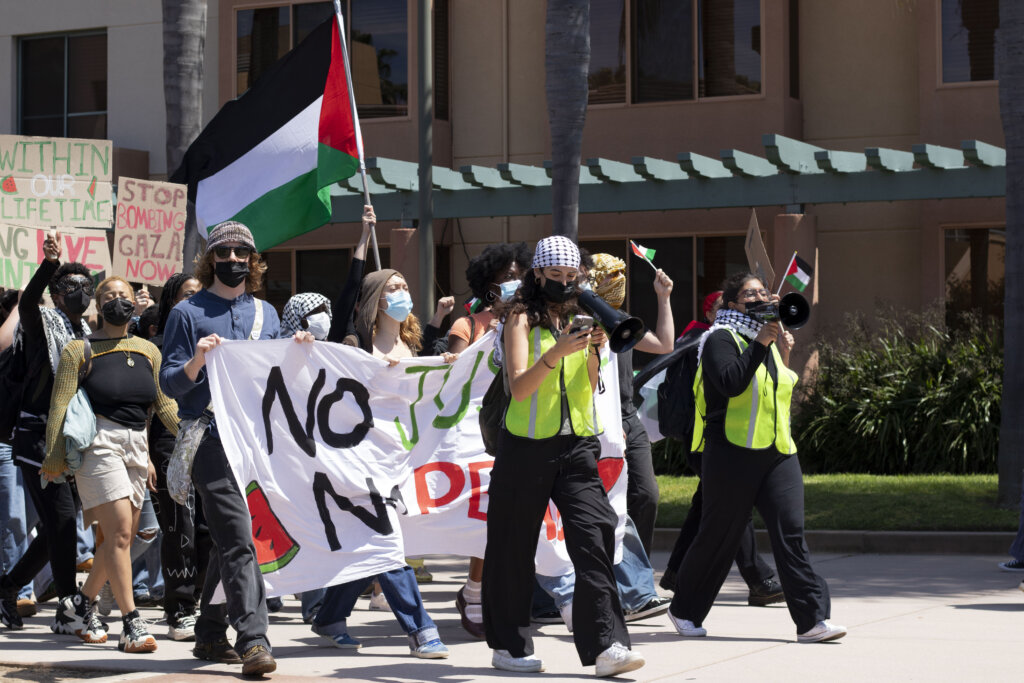
As protesters made their way through campus, many students looked on.
“I’m very impressed with SJP and the work they’ve done to build awareness of the ongoing genocide in Gaza,” SFTV grad student Seamus Oryan said while at Alumni Mall. “I wanted to show out and support them.”
Others joined the protesters.
“I was just walking from a class and I saw this gathering and wanted to see what this was about,” said Mateo Gonzales, a sophomore Theatre Arts major. “I’ve been hearing a lot about the Gaza genocide…. I wanted to come out and hear about it more, and be more educated.”
Several administrators and professors also looked on.
“I’m here to support all of our students in whatever way that they want to express themselves and to make sure that people are safe,” said Emelyn A. dela Peña, LMU’s vice president for Diversity, Equity & Inclusion.
The campus was hardly united in its views, however. Many individual students and some student groups expressed support for the veto.

“I’m really happy about [the veto] because I think many students here don’t really understand what the [Boycott Divest and Sanctions] movement is and how hurtful it can also be, not only to Israelis but also Palestinians who work in Israel and who make [a] profit off Israeli companies,” said sophomore Psychology major Michelle Shulmann, acting president of Students Supporting Israel. “I don’t think [protestors] really understand how that can affect both sides.”
According to SJP’s Leo page, “Students for Justice in Palestine (SJP) is a grassroots, student-led organization united by a shared goal: to raise awareness about the Palestinian struggle, work towards ending the illegal Israeli occupation, and promote Palestinian self-determination through non-violent resistance.”
“Hopefully, there will be a permanent ceasefire,” Kandah said. “SJP needs to advocate for that on campus and push our university to advocate for that and uphold their acclaimed Jesuit values.”
Several members of the ASLMU Senate, including new Vice President Yinka Akinlade — she is also a member of SJP — shared their dismay following the veto.
“It’s very disappointing that the voices of students were made loud and clear and were vetoed,” Aklinade said. “I didn’t expect a veto to come out of nowhere. It truly was a surprise to us.”
Hartz declined the Lion’s request for additional comment.
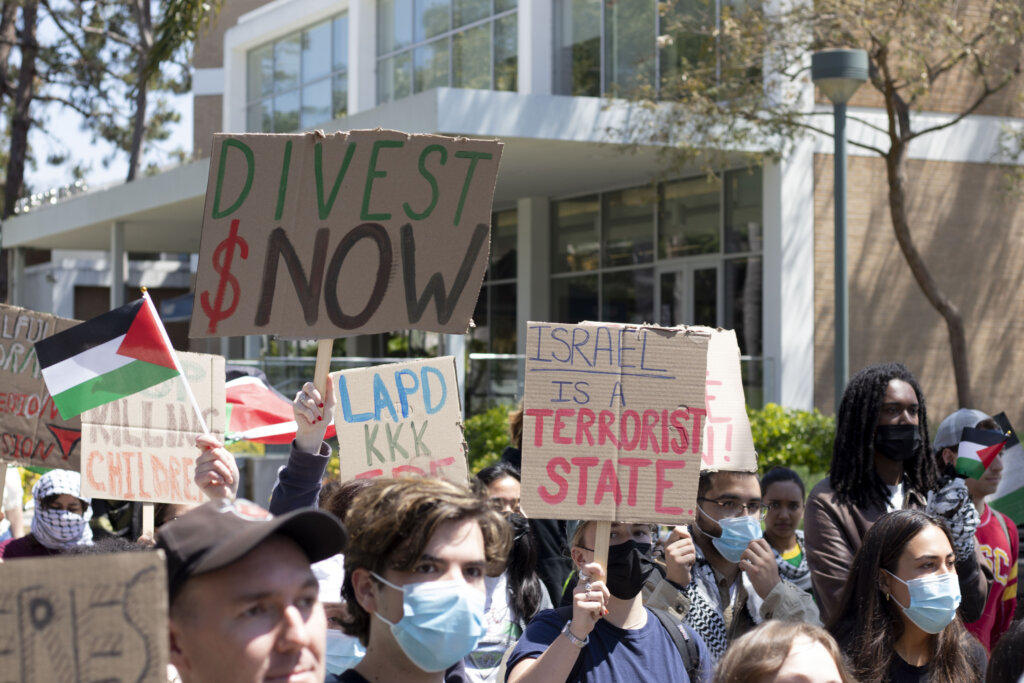
“I was just very disappointed in the way it was handled,” stated ASLMU Senator Sophia Ferguson. “I know that [Hartz and Akinlade’s] platform was running on the idea of transparency, and he was not transparent with us at all.”
SJP organizations have been calling for divestment for two decades, but those calls have spread in the past six months. Recently, the University of California-Davis student government passed a bill that prevents the school’s Associated Students budget from being spent with companies listed on the BDS website, joining many other university student governments that have enacted similar divestment plans.
On Thursday, the ASLMU Senate will hold a revote on the bylaw and resolution; if three-fourths of the ASLMU Senate votes in favor, the veto will be overturned.
Additional reporting by Caroline Baker
