


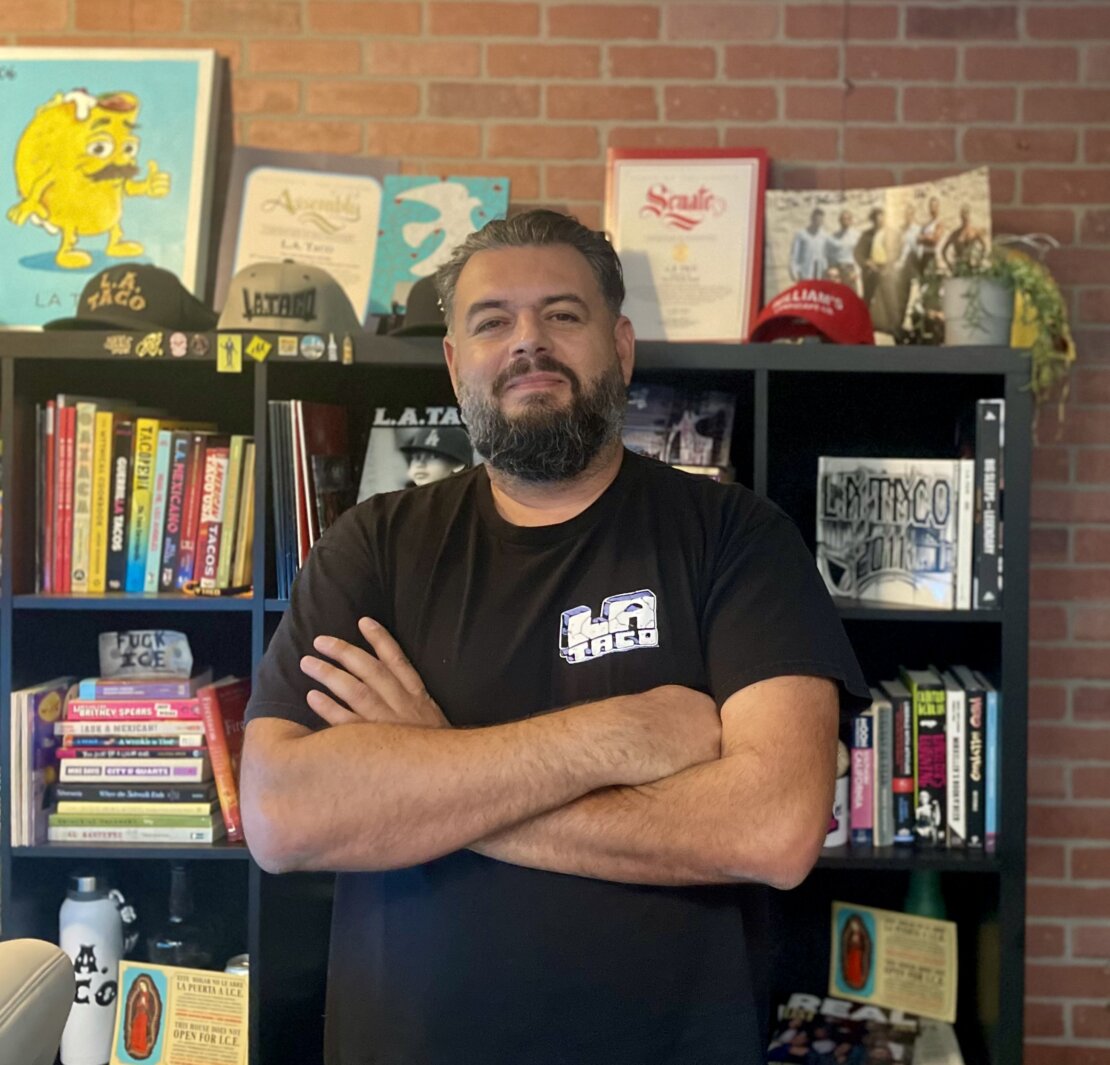
LOS ANGELES – Since federal agents started flooding the streets of Los Angeles last summer, terrorizing and targeting immigrant communities across the county in ICE deportation raids, those same communities have searched far and wide for a voice in the media they can trust. Memo Torres came along just in time.
Torres joined L.A. Taco in 2018 when the blog was re-launched as a publication during a media crisis that saw news organizations like the LA Times gutted across Los Angeles. Previously working in the landscaping business, Torres had a network of connections to find stories in his community.
Initially involved in L.A. Taco’s marketing analytics, helping spread the word and get membership off the ground, Torres would eventually start writing his own stories, following the street-food and culture scene in Los Angeles. As L.A. Taco began to rise in the world of news, so did Torres.
“I wrote about the food, and then from there just led to writing about some news things, and just getting more involved and covering more of LA,” said Torres. “And then when the ICE thing happened, it just was an automatic switch.”
As an Inglewood native, Torres is no stranger to anti-immigrant policies in California. When he was in his early teens, Torres watched as Governor Pete Wilson pushed to pass Proposition 187, a referendum targeting Hispanic communities in California. “That was the first moment that kind of radicalized me,” he said.
Proposition 187 was a 1994 ballot initiative that proposed to prohibit undocumented immigrants from using public education and social services. Although the measure passed, it was quickly struck down in the courts and abandoned five years later. “That’s when I started seeing people protest,” said Torres. “I was like, ‘Why the f— are they trying to remove this stuff from my family members?”
Attending UC Berkeley in 1998, the politics around Torres only became more visible. “At UC Berkeley I became a little bit more politically active, especially because of Prop 209,” he said. “I started doing protests and helping organize demonstrations.”
Since the proposition effectively repealed Affirmative Action in state and local agencies, Torres felt the effects ripple across his college campus. “I went to school when there would have been an average of like 800 Latinos in my class; it went down to like 200 immediately.”
While at UC Berkeley, Torres returned to L.A. just in time for the 2000 Democratic National Convention, where protests were planned outside the Staples Center. “I mostly went because Rage Against the Machine was playing their last concert there,” Torres said. “I kind of wanted to be a part of the protest.”
There, Torres saw police shooting pepper spray, rubber bullets, and tear gas into crowds of protestors. While filming protestors in an approach to remember the event, Torres witnessed police brutality on a scale that he would never forget.
“I have not seen police behave like that since, from that point to recently, when they came out to defend ICE and DHS at the June 8 protests.”
Now, as the L.A. Taco Director of Engagement, Torres sits at his desk in front of a ‘F— ICE’ dollar bill and posters that read ‘FREE L.A.’ on the wall, to ritualistically cover similar police activity in his series: Daily Memo. But for a smaller local publication like L.A. Taco, reporting on law enforcement has its drawbacks.
“We always had trouble getting sponsors from the beginning, just because we’re very anti-establishment,” he said. When L.A. Taco ran stories following the food scene, brands had no problem advertising on their platform. But when they shifted their coverage to law enforcement, companies pulled out of brand deals. “We had people like Goya [Food Company] who didn’t want us to put anything we did with them alongside articles about police brutality.”
Amidst losing advertisement deals that were followed by a shut down announcement two years ago, the publication’s numbers have unprecedentedly doubled since then. Once the ICE raids arrived in Los Angeles, L.A. Taco’s raw coverage of detainments and protests saw membership rise to 7,000 people.

Even in a moment where public trust in the media is at a record low of 28%, community trust is what keeps L.A. Taco going, further separating them from corporate media.
“I think corporate legacy media has fallen into the trap of being run like corporations, where the main people that they want to keep happy are their shareholders,” said Torres. “I think that was really highlighted when the chaos started happening, people were like, ‘Who do we turn to? That’s when people realize [L.A.Taco’s] part because we are the community. We’re in the community. We’re part of it.”
After rising to become a prominent figure within the community, Torres emphasizes the difference between federal agents and household warriors, who put themselves on the frontlines in protecting Los Angeles communities, is what make his reporting all the more honest — entitling him to share his opinion. Where national outlets obsess over showing both sides, Torres doesn’t feel it’s fair to those affected by Trump’s immigration policy.
“They want you to treat 100 ICE agents in full militarized gear with assault rifles, and full masks the same as moms and dads coming out of their houses with whistles and cameras… they’re not equal,” said Torres.
Torres has little faith in any top down reformation for the agency, but still believes in the people.
“I’ve always viewed everything as a pendulum,” said Torres. “Are you gonna let the pendulum take its full swing, or are you gonna step up and push it back?”
