


LAS VEGAS– The Enhanced Games, a company that aims to reinvent sports through the implementation of performance-enhancing drugs, is set to have its inaugural Olympic-style competition May 21-24 at Resorts World Las Vegas. With its marketing and funding seemingly encouraging–or at least not discouraging–athletes to use steroids, the Enhanced Games has sparked controversy in the athletic world.
Source: Enhanced Games
Founded by Aron D’Souza, an Australian tech entrepreneur, the event will provide any athlete who breaks a world record with a $1 million bonus. Additionally, participating athletes will receive appearance fees. Each event will have a prize pool of $500,000, with individual winners receiving $250,000. To contrast, American gold medalists typically receive $37,500 from the U.S. Olympic and Paralympic Committee for their excellence.
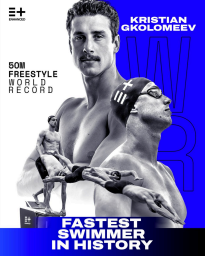
The Enhanced Games has already put on a similar spectacle earlier this year, where the men’s 50-meter freestyle “world record” was broken by Greek swimmer Kristian Gkolomeev. Using PEDs, Gkolomeev clocked in at 20.89 seconds, just under the actual world record of 20.91 seconds set by Cesar Cielo of Brazil in 2009. Gkolomeev, a silver medalist who recently finished fifth in the Paris Olympics, was subsequently rewarded with a $1 million bonus. American swimmer and four-time world champion in long and short relays Megan Romano also signed up to compete in the 2026 Enhanced Games, marking the event’s first American and female signee.
Source: Enhanced Games
Swimmers, sprinters, and weightlifters will be the focus of the PED-fueled event. In the pool, events that will be offered include the 50-meter freestyle, 100-meter freestyle, 50-meter butterfly and 100-meter butterfly. On the track, only the 100-meter dash and the 100- and 110-meter hurdles will be offered. For weightlifting, the snatch and the clean and jerk will be available. These specific sports are some of the most quantifiable in terms of metrics. The company appears to want to quantify peak athletic performance through its athlete’s usage of steroids.
The Enhanced Games is backed by multimillion-dollar investments, including some from notable businessmen like Peter Theil, the co-founder of Paypal and Palantir Technologies, as well as Omeed Malik, Chris Buskirk and Donald Trump Jr. of 1789 Capital. With these funds, the company has ensured a safe and controlled scientific approach to the implementation and usage of PEDs among its athletes.
“Protecting athletes is our top priority. Every competitor will undergo rigorous, state-of-the-art medical profiling before participating in the competition,” the Enhanced Games’ official website states. This profiling will include monitoring the heart rates of participating athletes and demanding transparency from them regarding what steroids they are taking.
There appears to be no structure in how exactly the company will approach such drug testing. Company officials say a select group of participating athletes will have all their medical care provided by Enhanced Games and receive their PEDs as part of a clinical trial that is pending ethical approval. ESPN reported that others may apply to compete as independently enhanced athletes, and natural athletes who are not taking any PEDs are also welcome. Ultimately, the company’s sensationalization of PED use has led many governing athletic bodies to condemn it.
With the recent addition of American sprinter Fred Kerley, a world champion and Olympic silver and bronze medalist in the 100 the company has signed its first track athlete. The signing sets a precedent for not only more track athletes to be enticed by the lucrative event but also for banned athletes to find new opportunities in their respective sports.
Kerley was provisionally suspended by the Athletics Integrity Unity on Aug. 12 for three missed anti-doping tests within a 12-month period. The penalty, although likely no longer relevant, can come with a one- or two-year ban from the sport. Kerley, the 2022 world champion, has already had a tumultuous year, including two run–ins with the law. These incidents, paired with a 2024 incident that saw Kerley, who at the time was sponsored by Asics, wear Nike spikes at the New York Grand Prix, made it difficult for him to pick up a shoe sponsor before his suspension.


Image of Fred Kerley. Source: Enhanced Games
The addition of Kerley opens the door for banned athletes in any sport to receive financial compensation. Why wouldn’t Erriyon Knighton or Issam Asinga, both former world under-20 record holders, consider joining after their recent suspensions? If Knighton, who finished fourth in the 200-meter final as a 19-year old in the 2020 Tokyo Olympics, ever wants to try to win a gold medal again, avoiding the Enhanced Games is a must.
World Athletics President Sebastian Coe, who is also a member of the International Olympic Committee, has expressed his disdain for the Enhanced Games, punishing any athlete that competes for them. “There’s only one message and that is if anybody is moronic enough to feel that they want to take part in that, and they are from the traditional, philosophical end of our sport, they’ll get banned and they’ll get banned for a long time,” Coe said.
Athletes dream about competing and representing their country in the Olympics, but the majority of the athletes who make it struggle to make ends meet. Professionals in low-revenue sports barely see any financial gain from their greatness. According to a survey conducted by the U.S. Olympic & Paralympic Committee, more than half of the U.S. Olympic hopefuls, or 59%, reported making less than $25,000 during the year of their respective Olympics.
The harsh reality is sports like swimming or track don’t entice fans to continue to invest back into the sports in the same ways that basketball or soccer do. Thus, most of the Olympic hopefuls in these sports are left to ultimately find other outlets to keep supporting themselves, and the Enhanced Games could be that.
