


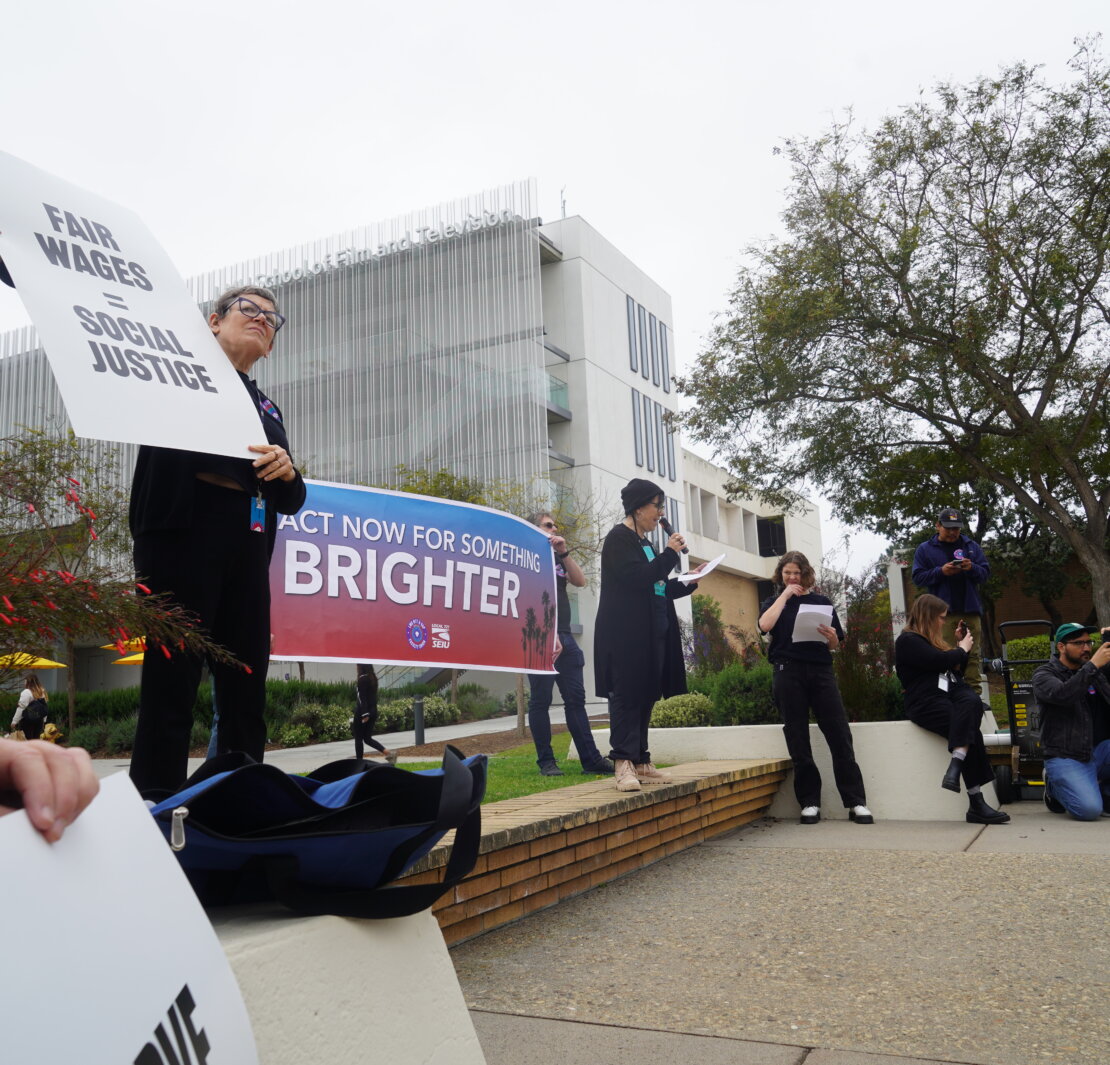
Since their first meeting in December 2024, the non-tenure track (NTT) faculty union bargaining team has presented 36 articles to the school, outlining demands they wish to see implemented in a new contract. Thus far, the school has presented three articles of their own, and only discussed counter proposals for two of the union’s articles– they are expected to discuss four or five more counter proposals at their next meeting on Friday April 11.
Outside of the bargaining room, new tensions have emerged as the school has issued a legal threat to the NTT faculty union. On February 27, union attorney Hannah Weinstein received a letter accusing the union of violating LMU’s intellectual property (IP) rights over their use of school logos in social media posts and promotional materials. The letter was sent by Christina Loza of Loza & Loza LLP, a firm hired by LMU, but not the same one that has represented the school in contract negotiations. Loza demands that the union “immediately cease and desist all unauthorized uses of LMU’s intellectual property,” noting that “failure to comply will result in litigation.”
Attached to the letter are reference images of the union’s instagram page and promotional materials such as flyers and stickers featuring LMU’s logo, which Loza argues violates IP law. In the letter, Loza also accuses the union of vandalism and destruction of property, citing instances where union stickers were placed around campus and claiming they were “costly to remove.”

In response, Weinstein wrote a letter asserting that the union’s use of the logo does not infringe upon the school’s IP rights, as it is not “in connection with the sale of goods or services”, and therefore does not violate the Lanham Act. Weinstein also referenced legal precedent from previous cases where labor unions’ use of company icons were deemed fair use, citing WHS Entertainment Ventures v. United Paperworkers Int’l Union (1998) and Trader Joe’s Company v. Trader Joe’s United (2024).
“There have been multiple instances of employers going after unions for this kind of thing, and the employers generally lose,” explains rhetorical arts instructor and NTT union bargaining team spokesperson Brian Wisch. “We think it is completely legally baseless, and in terms of why they’re doing this, I think that they are trying to intimidate us.”
Upon receiving the legal threat, the union immediately filed an unfair labor practice charge to the National Labor Relations Board (NLRB). NLRB deliberations over such matters generally take several months, but Wisch explains that the union is not waiting for the NLRB, and intends to keep pushing in its negotiations.
“For us, this changes absolutely nothing. We are going to keep showing up to these bargaining sessions and we’re going to keep pushing the school to do right by the non tenure track faculty to pay them a living wage” says Wisch. “What I will say is that this really this really creates a juxtaposition between the words that the administrators use at the bargaining table versus the actions outside”
Wisch explains that during bargaining sessions, the administration has emphasized their desire to collaborate and be partners with NTT faculty. Meanwhile, on the outside, the school is threatening the union with a lawsuit, and still has yet to respond to 34 of their 36 demands. Wish adds that the school has prepared four or five additional counter proposals, which will be discussed during the next bargaining session on April 11. A slow response time was expected for some of the union’s articles proposing meaningful administrative changes. Other articles, however, propose changes related to social justice and academic freedom, leaving the bargaining team puzzled by the delayed response.
“One article, for example, calls for nondiscrimination. We’re saying we don’t want the university to discriminate against university members based on race, gender, sexual orientation, religion, etc.” explains Wisch. “Others demand that the university respect our academic freedom. So, like, what’s the hold up on those?”
As negotiations slow to a grind and the school threatens escalatory legal action, NTT faculty have turned to the LMU community to rally support. On Thursday March 20, the NTT bargaining team held a silent demonstration in University Hall outside of the Provost’s convocation. Students and faculty engaged in silent prayer, meditation, and marched carrying signs that read “FAIR WAGES = SOCIAL JUSTICE” and “SERVE FAITH & PROMOTE JUSTICE”.
The following week, on Wednesday, March 26, the union held a rally on Alumni Mall addressing both faculty rights and the bargaining process, alongside growing concerns over the nationwide crackdown on campus protest, immigration, and diversity, equity, and inclusion initiatives. The union promoted the rally with a flyer featuring the following list of demands:
- Stand in solidarity with immigrants and refugees.
- Protect trans students, staff, and faculty.
- Invest in diversity, equity, and inclusion programs.
- End union busting and delays at the bargaining table.
- Defend free speech and protest rights on campus.
- Empower the faculty senate
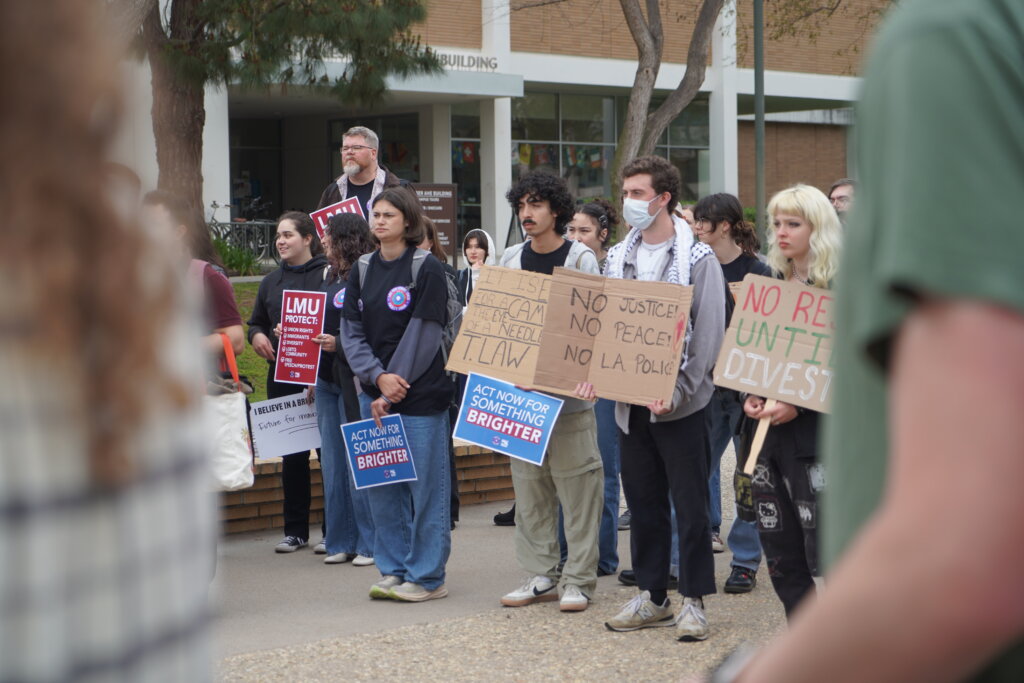
Dozens of LMU students and community members attended the Wednesday rally, carrying signs and chanting slogans. Faculty and student leaders delivered speeches calling on the university to respect NTT faculty and to uphold free speech, diversity, and support for the school’s immigrant community.
The NTT faculty union has stressed the importance of continued student and community support in the negotiating process, and maintains that fair wages are essential not only to faculty, but for ensuring a stable learning environment for LMU students. Despite the delays in negotiations and the threat of litigation, the bargaining team remains hopeful that it will reach a contract agreement with the school by the end of the semester.
