


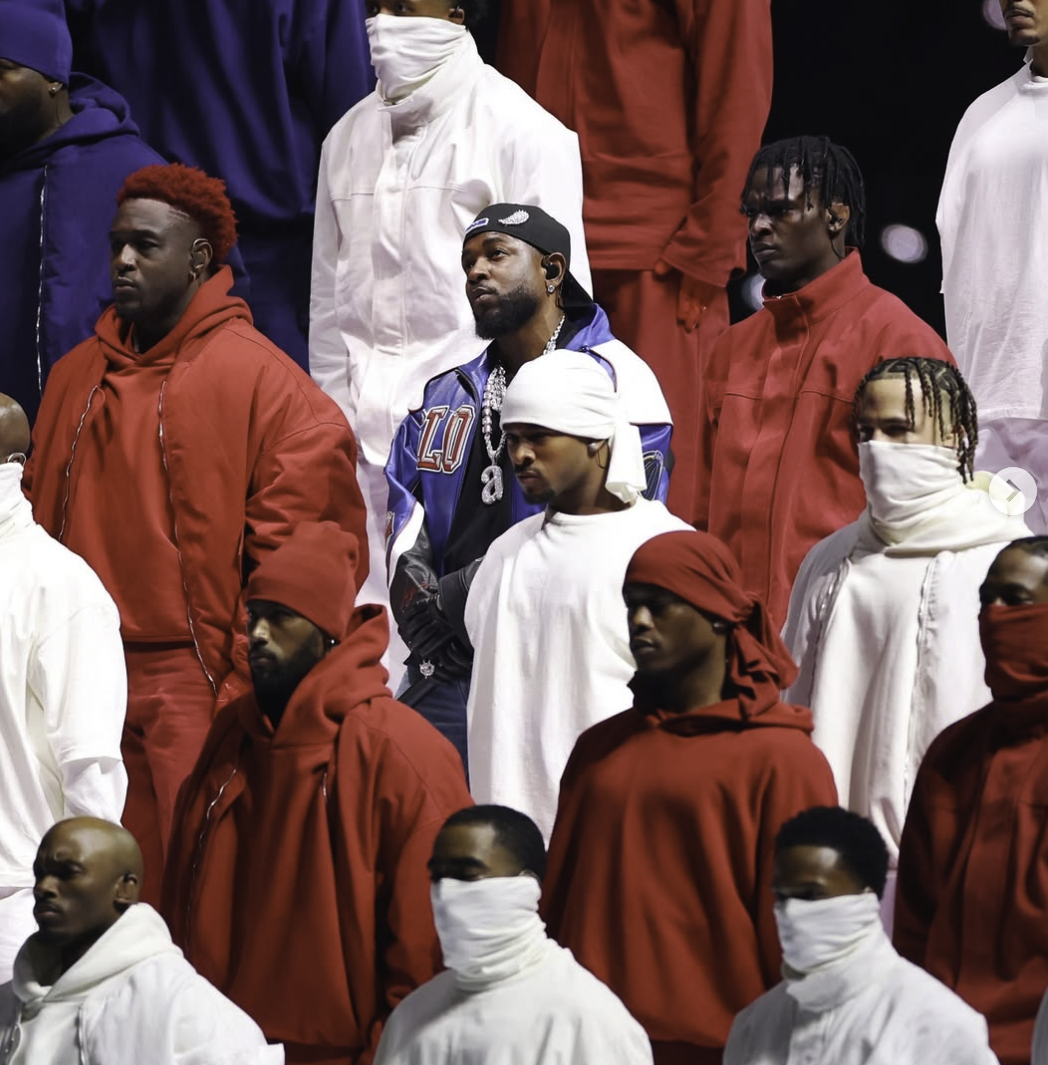
“This revolution’s about to be televised, you picked the right time but the wrong guy,” sang Lamar early in his halftime performance at Super Bowl LIX. With these words, as well as an introduction and nagging commentary by legendary actor Samuel L. Jackson, costumed as patriot father Uncle Sam, and flags for Palestine and Sudan present on stage at one point to boot, one thing was immediately clear: this was not your grandfather’s halftime show. While many conservative NFL fans had predictably terrible things to say about the performance, for those willing and able to read into its genius, this only affirmed that the subversive set had done its job perfectly, and strengthened, rather than diluted (as some fans feared it might) the rapper’s artistic integrity.
Lamar’s set did not meander, nor did it rely on any gauche effects as is standard for Super Bowl halftime performances; instead, he delivered a harsh, authentic barrage of his newer material while surrounded by talented Black performers in a truly subversive performance that took precise aim at the powers that be, that is to say, Trump’s America and its inextricable erasure of the Black struggle was rightly felt to be on blast; from the Black bodies making up an American flag, at the center of which Lamar sang, to the subtle but weighty commentary by the role-playing Jackson, which seemed to say to the 126 million Super Bowl viewers (including one Donald Trump firsthand, who was purportedly booed as he arrived at the game, and left angrily after Lamar’s performance): “I already know some of you won’t like this and I already know what you’re going to say. This is not for you, it’s about you.” In light of the direction our country is heading, spearheaded by the President gazing down at him, Lamar was defiant and self-assured, and the performance was exactly what Americans needed to see at the halftime of one of the most heavily propagandized events on our calendars: clarity.
From one song to the next, the semiotic Lamar exemplified what made him a Pulitzer and 22-time Grammy winner among a legion of other awards: confrontational, cacophonous poetry, rooted in the reality of the Black struggle and his lived experience with it hailing from Compton, California. His decision to perform a stripped-down set with nearly all live vocals was well taken; it gave the performance a grounded atmosphere that paired rather flawlessly with his raw, emotional style as he sang textured lines like, “40 acres and a mule, this is bigger than the music/yeah they tried to rig the game, but you can’t fake influence.” A crimson-clad SZA, who accompanied him on stage for two songs, made for a phenomenal balance between the more angsty and the more ethereal sides of Black artistry.

Lamar sang some of his best songs well, particularly the anthemic “Not Like Us,” a diss track aimed at more establishment-friendly rapper Drake, whom Lamar appears to feel represents the decadent & depraved side of industry success. His downright cutting song, which quickly became a number-one hit and was sung along to by thousands at the show, contains accusations of pedophilia on Drake’s behalf. While officially unconfirmed, it remains difficult to dismiss in the wake of what is clearly a larger-than-we-know child-rape scandal that has quietly sept into the annals of American celebrity. As the crowd sang along with utter abandon, the climactic “a-minorrrrr” lyric, cleverly drawing a line between the music that both men produce to great applause and the alleged predatory behavior by his contemporary was a jaw-dropping moment in a jaw-dropping performance. Lamar’s music often feels like fight songs for the war on systemic racism and corruption, and like any great revolutionary, he is not afraid to cast aspersions at what he considers the impure members of his own community. If there were any flaws to this performance, which gave the impression of a needle lancing the boil of white nationalism, the pus-filled head of which may very well be observed during events like the Super Bowl – where a group of mostly Black men put their bodies on the line for the entertainment of millions of white men – I certainly could not point them out.
