


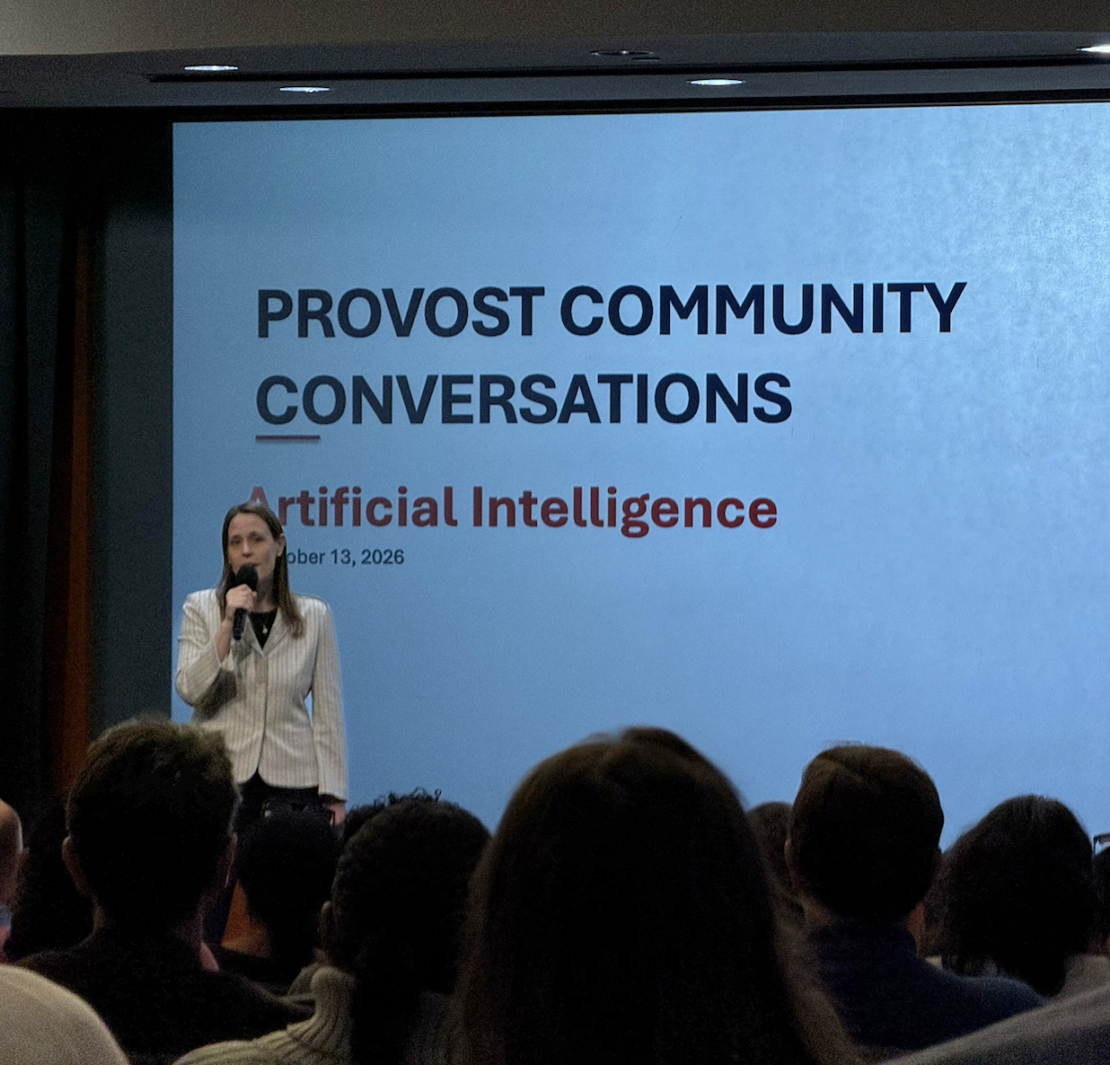
“I think AI is not an enduring question. It’s a new question,” said Associate Provost Mairead Sullivan at the Provost’s Community Conversation on artificial intelligence Oct. 13. “It shadows and shades all of our enduring questions.”
Community Conversations are hosted by Provost Kat Weaver in an effort to bring faculty and staff together to hear updates from university leadership in a discussion on a single topic. The conversation in Ahmanson Auditorium opened with status updates from Weaver and the Faculty and Staff Senates, before turning to Sullivan’s presentation on AI and an audience Q&A. Weaver said it was among the largest turnouts for a Provost Community Conversation.
Sullivan, who is also a professor of Women’s and Gender Studies, was named special assistant to the provost for artificial intelligence earlier this year, a position recommended by the university’s Task Force on the Scholarly and Academic Use of Generative AI. Weaver assembled the Task Force in spring 2025 to examine how AI is affecting teaching, research and university operations. Sullivan was also a member.
In March 2026, the Task Force submitted its list of recommendations and guiding principles. “As soon as we set the recommendations, the whole thing changed. Every day there’s new updates,” Sullivan said.
A recurring theme throughout the discussion was collective uncertainty. “[AI] is moving faster than anything that I’ve seen and anything that you’ve seen,” Weaver told the audience.
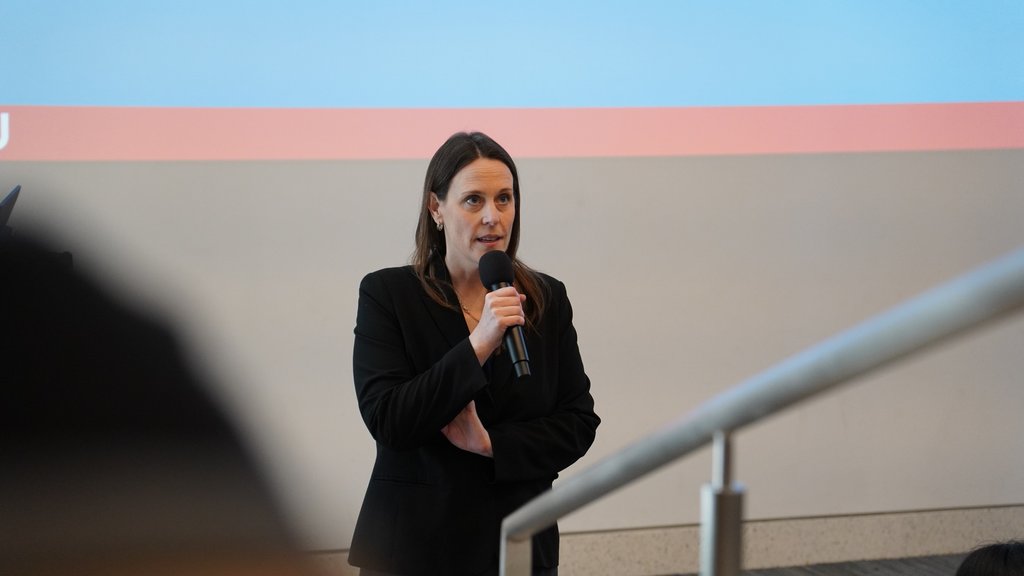
Despite the rapidly changing AI ecosystem, Sullivan said a number of the Task Force’s recommendations have been completed. LMU has launched an AI-centered website, appointed two AI faculty fellows in the Center for Faculty Development, and sent 10 faculty to a summer training on teaching with AI.
Other recommendations are still in progress, including a student advisory group Sullivan is forming with Student Affairs, ASLMU, and GSLMU, and “multiple artificial intelligence coordinating groups.”
Computer Science has launched a postgraduate certificate in AI, Sullivan said, and a Bachelor of Science in Artificial Intelligence was recently approved and will launch next year. Other programs are moving through the approval process.
Throughout the presentation, Sullivan referred to two guiding documents: MIT’s Report on AI and Education, and Magnifica Humanitas, the recent encyclical letter from Pope Leo XIV. “These have become my North Star for the work that we’re doing here,” Sullivan said.
Among the Task Force’s recommendations was a review of LMU’s curriculum and learning outcomes. “We don’t want to write AI into any university learning outcomes because we don’t know if this language is durable,” Sullivan said.
LMU has “something like 27” university learning outcomes, she said, and reviewing them is “a bigger thing we need to do together.” Instead of naming AI, Sullivan said the goal is to write the university’s educational commitments into its learning outcomes.
The Task Force also recommended LMU define and articulate a shared understanding of AI literacy for students.

A faculty member asked how the university should approach AI literacy as it changes. Sullivan said the term “means different things in different contexts” and that there isn’t a shared sense of what it is, calling it “kind of a placeholder.” She said she doesn’t know whether LMU will end up using it.
Another faculty member asked to what extent environmental analysis is shaping the university’s discussions on AI, citing the environmental cost of data centers, growing community pushback against the infrastructure, and the climate crisis as a source of student anxiety.
“I don’t have an answer. I don’t know that anyone does. I wish I did,” Sullivan said, adding that there are no current metrics for measuring the impact. She said LMU has an opportunity to lead on the topic as a Jesuit and Marymount institution. Weaver said part of students’ education should be “teaching students the cost of the tools,” including the environmental and ethical questions around them.
Regardless of this uncertainty, LMU plans to position itself as a thought leader in the AI space. Sullivan said LMU is not going to build a supercomputer or move everything online. “We can offer thought leadership. We can help shape this moment,” she said. “This is our moment to lead.”
Weaver explained that the next Community Conversation will offer a status update on the university, with statistical data. Attendees were invited to stay afterward and continue the discussion.
Sullivan closed her presentation by calling for a university-wide effort to navigate AI. “It’s all hands on deck. It’s all of us. We’re doing it together,” she said.
