


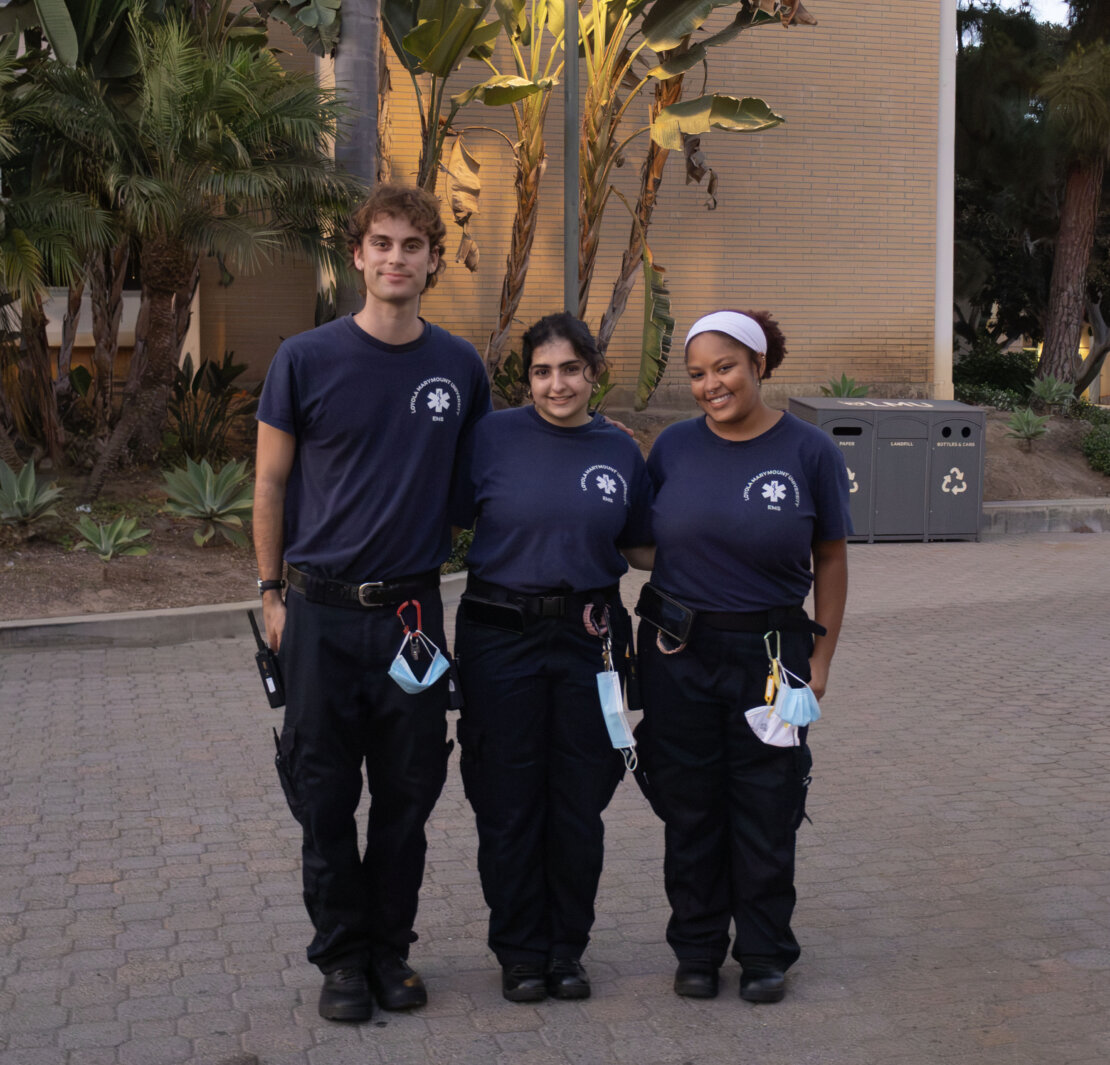
LOS ANGELES – At exactly 5 PM on the dot, right as the interview was about to start, EMS received a call. Before the team could explain what a night on shift looked like, they were already responding to a student. There was no time to sit down and talk – somewhere on campus, someone needed help.
It was a fitting introduction to the secret lives they lead. One second they’re just college students. The next? They’re first responders.
That distinction is right at the center of what the team represents. Behind the uniforms and medical equipment are students balancing college life and being a regular twenty-something at LMU with the responsibility of responding to other students who need their help.
Led by a group of EMT-certified students, EMS helps out when Public Safety is off the clock from responding to emergencies around campus. Starting from 5 PM until 8 AM the following day, they are on duty, ready for calls, ready to help.
For students in LMU’s Emergency Medical Services program, the interruption is part of a routine. Between calls, they study, watch TV, get coffee, and spend time together– all while staying alert and prepared for whatever that shift might bring.
The night begins before the official shift time at 5. Around 4:45 PM, the responders are meeting at the EMS apartment, collecting equipment, and heading to Public Safety in their golf carts. At check-in, they examine their equipment bags to ensure that they have everything they might need, and whatever is missing, the shift leader takes note of it to ensure that it is restocked. The equipment bag contains anything that an EMT might need, like oxygen tanks, different respirators, an AED, and gauze.
During the quieter periods, the group might study in The Den or watch a show at the apartment in Hannon. They can try and get some rest, although they know a call could interrupt that at any moment.
“We can literally be anywhere on campus,” Monique Thomas, a Veteran in Training, said. “We’re just chilling, maybe sometimes we’re even sleeping and then it’s a very, like, blaring, jarring sound that goes off and, like, that’s definitely the main adrenaline part.”
When Public Safety alerts them, the responders receive a location and a brief description of the situation. They then travel to the scene, exchange information with Public Safety and begin assessing the patient.
Each person has a role while on shift. The rookies take vitals and provide basic care like cleaning wounds or wrapping a sprained ankle, Veterans in Training ask questions about the patient’s symptoms and history, then Veterans oversee the response and determine whether to request additional care under the program’s protocols. Afterwards, the team calls the local fire department if they decide that the patient needs to be taken to a hospital and provides a handoff report to the arriving responders.
Their experience helps with the initial rush of adrenaline, and that remembering that they have training and teammates to rely on does too. Remaining calm is part of reassuring the person they are treating.
Their responsibilities continue further after leaving the scene. They document the entire interaction, from the first questions they ask of the patient’s account to leaving the scene. The reports help Student Health Services understand what happened as if they were on site, too, and it helps them when they contact the student for a follow-up if they need any more assistance.
“There are calls that kind of stick with you,” Sophie Haddad, a veteran and a training officer, said. “And in those cases, it is harder to switch back.”
The EMTs described talking with their teammates and their medical director when a call weighs on them. Seeing a peer in such a vulnerable position can be quite difficult, especially when they can only do so much to help.
“Sometimes we see, you know, chronic conditions or like past institutions that have failed some of our patients, or stuff that is just not working in a favor and it’s frustrating to see,” Max Barnett-Abrams, another veteran-in-training, said.
The organization only has 14 members and they were hoping that a few more would be willing to join during the upcoming recruitment to expand the team. They also wanted more students to know that their classmates were available to provide medical help while on campus. Applicants for EMS must already have their EMT certification and the selection process has a written application, an interview, skills assessment and a written exam. Growing the organization also means more help for students and the campus community understanding what it does. The responders said that some students are surprised to learn that LMU has student EMTs available on campus.
“I tell them like, ‘Oh, I’m an EMT,’ and they’re like, ‘Oh, where?’” Haddad said. “And I’m like, ‘On campus,” And they’re like, ‘What? We have that?’”
The group wanted students to know that they are peers behind the uniforms who are eager to help. For the responders, being part of EMS provides both a way to serve the campus and a community of teammates who understand the responsibilities that come with the work.
“I think it’s a really big privilege and an honor to be able to help out the community,” Haddad continued. “It’s every day I’m thankful that I get to do this and I get to be a part of something that’s as great as this org and just being able to help LMU and like my fellow peers, that’s just amazing.”
It’s nerve-wracking to treat others on campus, but Thomas believes that it is something worth the adrenaline.
“It’s really something special. You don’t really see that anywhere else,” Thomas said.
With time comes experience, and with experience, responding to calls becomes more familiar and maybe even lighter. The responders said that confidence develops with experience, but they still have to manage their own uncertainty while reassuring the patient. The team emphasized relying on their training and other EMTs around them.
Once the patient is cleared, the adrenaline eases and the team reflects on the case and writes their report to send to the Student Health Center. With the paperwork finished, they can return to what they were doing, either studying, relaxing, or settling into a possibly restless night. Their shift continues until 8 AM, when some members might head straight to class.
“Those 8 am classes are really rough,” Haddad said. “Because you have to show up in your uniform. Sometimes you’re in class and you haven’t had enough sleep that night because you’ve been up for a call… it can be taxing, but at the same time, I would take that over not helping someone and not going to that call.”
Afterward, there are still classes to attend, homework to finish, and, if time allows, a well-earned nap.
