


On Sep. 24, 2026, the Laband Art Gallery at Loyola Marymount University opened its doors to acclaimed artist Phyllis Green, showcasing her retrospective exhibition, “Phyllis Green: ‘Of My Own Making’”.
Much of her work draws on feminist thought and challenges the popular stereotype of what women should be, how they should act, and what activities and hobbies they’re confined to.
Green had always been an art kid at heart, but hadn’t truly embraced her identity as an artist until she finished her education. Growing up in Vancouver, Canada, Green’s experience in the art world was less integrated than when she moved to the United States and landed in Los Angeles.
“When I had started exhibiting, I didn’t consider myself a professional until I finished graduate school. Which was 1981,” said Green.
Upon entering the gallery, one of the first things viewers will see is the giant lion/lamb piece suspended in the air, being showcased for the very first time due to the COVID pandemic.
“When I made it, I was thinking, ‘well people could gather under it,’ then COVID came along… and I couldn’t have anybody gathering under it,” Green said “So this is the first time I’m showing it.”
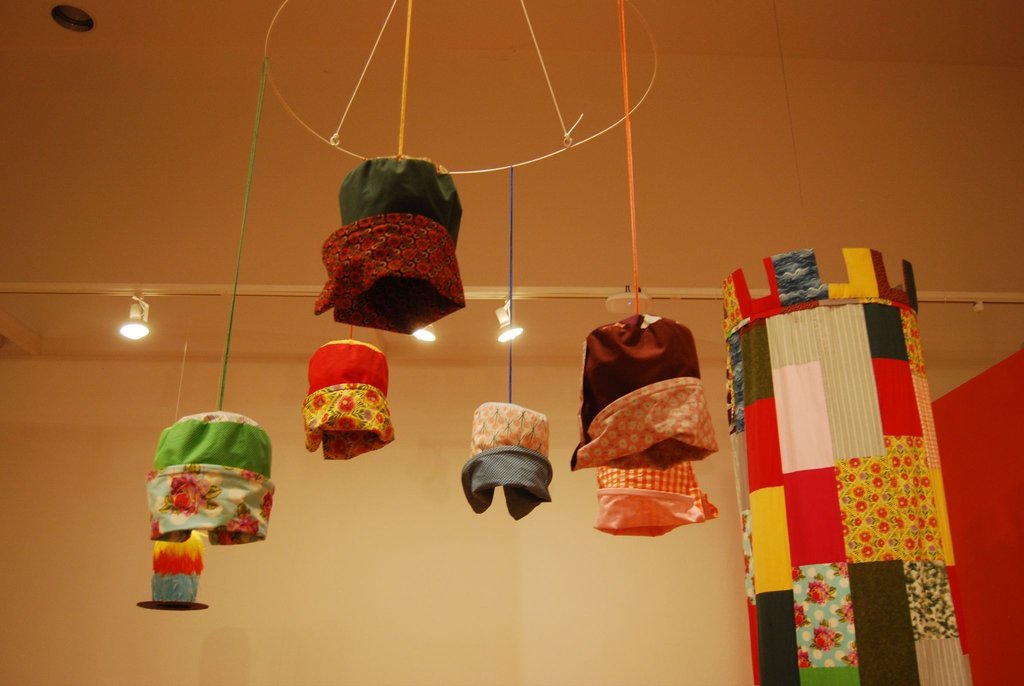
Some of the newer works include her quilt tower, colorful floating hats suspended on a metal ring, a makeshift meditation chamber, and more.
“When I started working as an artist, my intent was to challenge the notion that working with fabric and working with decoration were feminine pursuits and not worthy of mainstream art consideration,” said Green.
Green was inspired to challenge ideas of what art is worthy of being consumed, based on the thoughts of past critics like Adolf Loos. As a critic of decoration and the ornate, Loos deemed it unnecessary and condemned it. Deciding to go against Loos’ minimalistic thought with her work in the 90s, Green was inspired to put a focus on decoration and ornate in her artwork.
“I decided to load on all the decoration and ornament that I could. I did that to subvert that modernist notion that you should not decorate, because “decoration was a crime”. It was something that was considered old-fashioned and inappropriate,” explained Green.
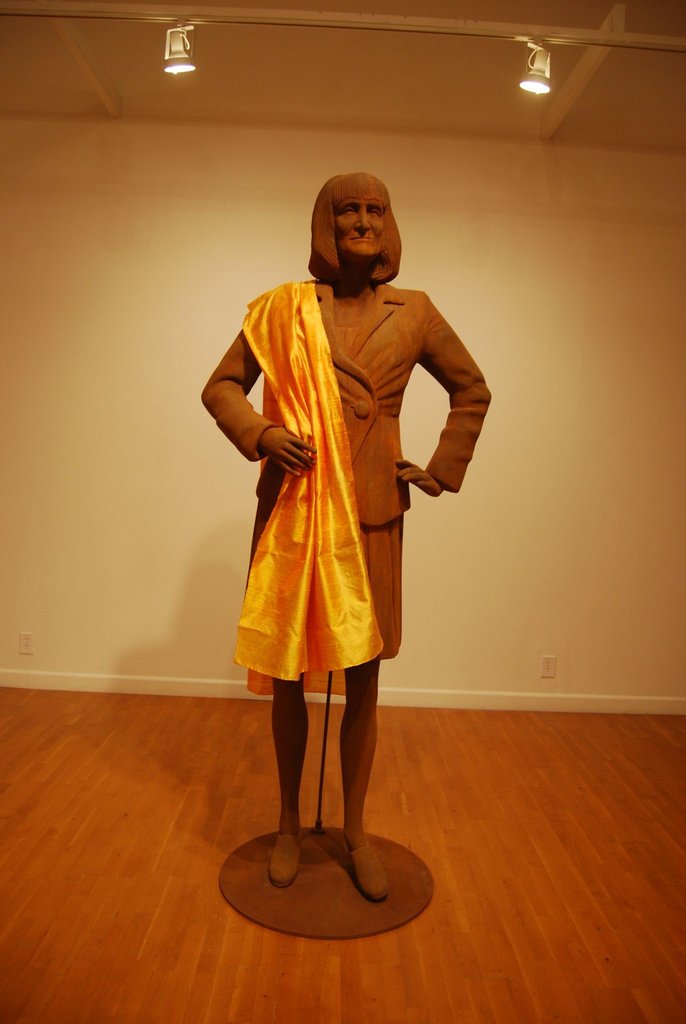
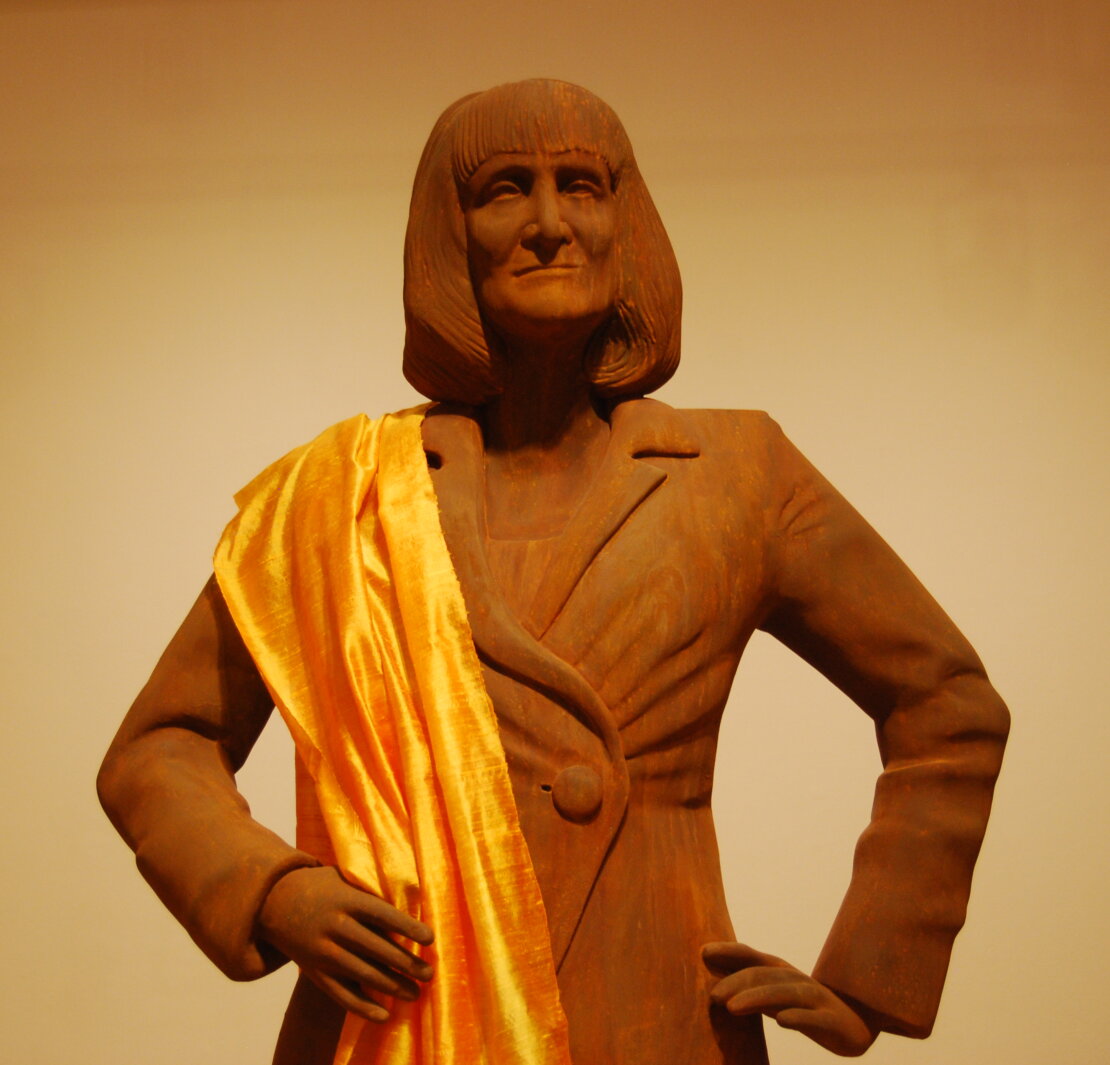
When discussing her giant sculpture piece titled “Fall 12: An Autobiography Considering Charles Ray’s ‘Fall ‘91,’” made in 2013, Green emphasizes how important her travel has been in influencing her artwork, especially in relation to her trips to India.
“Traveling can really rock your world, and change your perception of a lot of things, and that was particularly the case for me in my travels to India.”
Green has been to India three times and emphasizes how her travels have influenced her life and work. She expands on the Fall 12 piece, saying she was inspired by Vedic thought, indicated by the orange Sari draped around the giant sculpture.
She further expands on why she has highlighted Indian culture and thought in her artwork, explaining that she is on the path to enlightenment and doesn’t consider herself an enlightened person, noting how there is a process and journey to achieving higher thought and embracing one’s own role in life. Much of the work that Green exhibits showcases her reflective and curious nature relating to the different ways of life and thought she has studied.

Making reference to her Fall 12 piece, Green states, “I got interested in that way of looking at the world, and I embraced that in maybe 2012, which was around the time I did that,” said Green.
With Green’s newer works, a big theme she focused on was monuments. Her quilted tower piece, imagined meditation chamber, floating hat rings, and other works have been inspired by this theme of monuments in American culture.
Green explained that the new works in the exhibit shifted her focus on monuments and make commentary on her inspiration for some of the pieces being culturally inspired,
“A lot of monuments that existed were unflattering and uninspiring to a lot of big populations, particularly the minorities in this country,” said Green. “There was a movement to get rid of all those things, to purge museums and public places of the monuments. So I decided to make a show with some monuments.”
When talking about the newer shifts in her artwork she has embraced with some of her newer pieces, Green said, “Well, definitely when I did that tower, I said, ‘I’m going to use up all of the fabric I’ve used in making a lot of these pieces for the last number of years, because this show is really work from 2012 to the present.” stated Green.
The exhibit will be open to the public from Sep. 24 to Dec. 5, 2026. Stop by the Laband Art Gallery on Loyola Marymount University’s campus to see Phyllis Green’s “Of My Own Making” for yourself and further explore her artworks.
